

August 5, 2026 | Protocast Inc
Aluminum Sand Casting Colorado
Table of Contents
Aluminum Sand Casting in Colorado: A Complete Guide for Engineers and Manufacturers
Aluminum sand casting is a versatile manufacturing process that produces complex aluminum components by pouring molten metal into sand molds. For engineers and manufacturers seeking aluminum sand casting Colorado solutions, this method offers exceptional design flexibility, cost-effective tooling, and the ability to create large parts in low to medium volumes. We at Protocast Inc. bring these advantages directly to the Rocky Mountain region.
The process supports a wide range of aluminum alloys, giving product teams the material variety needed to meet specific performance requirements. Our comprehensive protocast foundry overview details the full scope of our sand casting services, From Prototype to Production. With in-house CNC machining and engineering support, we partner with our customers to refine designs and streamline manufacturing timelines.
Our Commerce City, Colorado facility provides local support that translates to faster turnaround and reduced shipping costs for Colorado-based manufacturers. Being Made in the USA also offers a reshoring advantage for companies looking to bring casting projects back to domestic soil. We maintain ISO 9001:2015 and ITAR certification, ensuring your components meet rigorous quality and security standards.
Beyond traditional sand casting, we offer multiple casting processes under one roof, including 3D printed sand casting for rapid prototyping and CNC machined aluminum castings for precision finishing. This multi-process approach enables seamless transitions between manufacturing methods as your project evolves from development to full production, a topic we will explore further in the following sections.
Understanding the Aluminum Sand Casting Process
When manufacturers need a versatile, cost-effective way to produce near-net-shape parts, aluminum sand casting in Colorado delivers a proven solution. Aluminum sand casting is a process where a sand-and-binder mold is formed around a pattern, then filled with molten aluminum to create the desired component.
The aluminum sand casting process starts with a pattern that matches the part’s shape. For intricate designs, 3D printed sand casting creates mold sections directly from CAD files, eliminating conventional pattern tooling. After placing the pattern in a flask, sand mixed with binder is packed around it to form the mold cavity. Cores made of bonded sand are inserted to create internal passages, and the mold halves are closed. Molten aluminum is poured into the cavity and solidifies. The casting is then shaken out from the sand, and finishing operations — trim removal, cleaning, and machining — bring the part to specification. We also supply CNC machined aluminum castings to achieve precise tolerances.
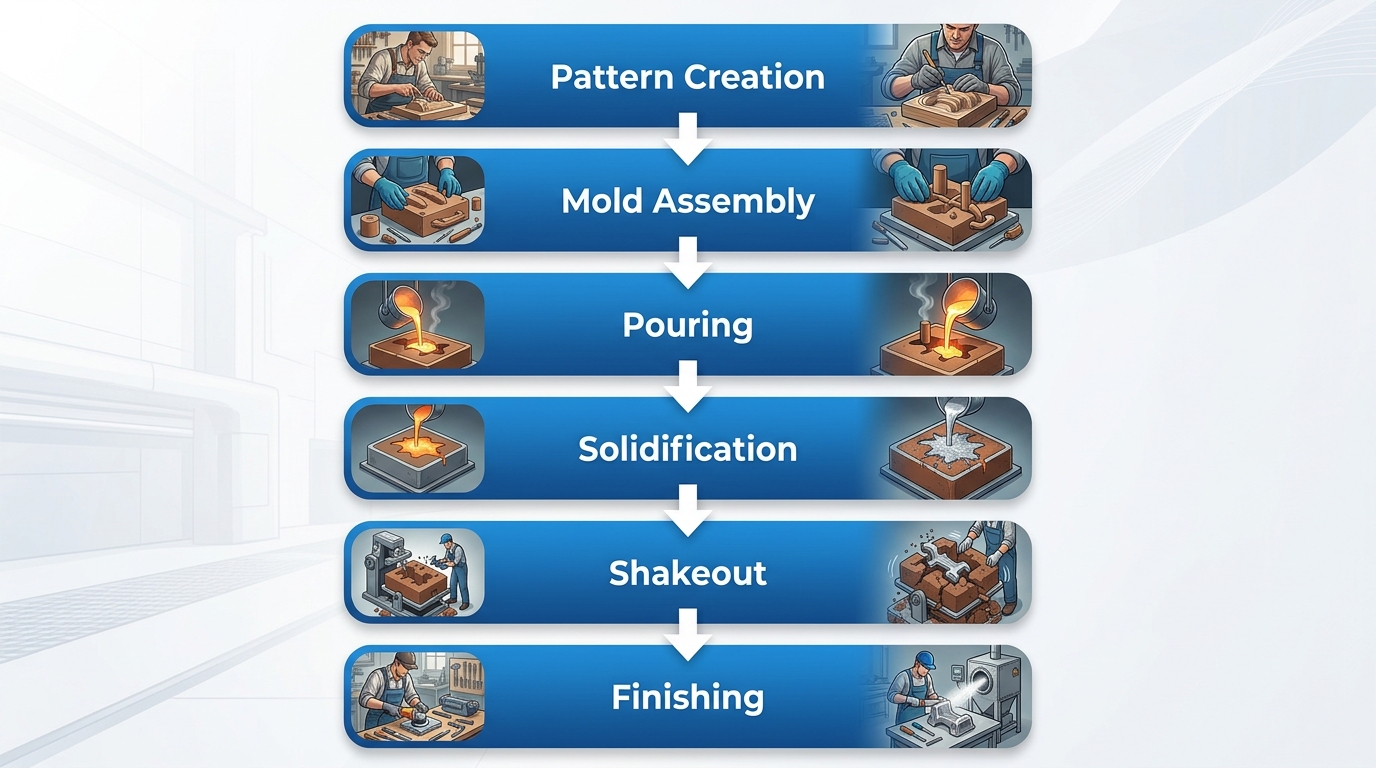
Aluminum sand casting process stages from pattern creation through finishing.
Compared to die casting and investment casting, sand casting offers distinct advantages in tooling cost, lead time, design complexity, and production volume. The table below summarizes these trade-offs to help you choose the right process for your project.
Data based on Protocast’s process capabilities and industry standards.
| Factor | Aluminum Sand Casting | Die Casting | Investment Casting |
|---|---|---|---|
| Tooling Cost | Low to moderate | High | Moderate to high |
| Lead Time | Short (days to weeks) | Long (weeks to months) | Medium |
| Design Complexity | Good flexibility | Limited by tooling | Excellent |
| Production Volume | Low to high (prototype to 10,000+) | High (50,000+) | Low to medium |
Because sand molds are consumed each pour while patterns can be reused, tooling costs remain low to moderate — a significant cost advantage over die casting and investment casting. Sand casting also accommodates a broad production range, from single prototypes to annual runs exceeding 10,000 units, bridging low-volume flexibility with moderate serial production. Design flexibility is another strength: we can produce large parts with thin walls, incorporate complex internal cores, and handle geometries that would be difficult with other methods. According to the American Foundry Society, sand casting remains one of the most versatile metalcasting processes available. These capabilities make aluminum sand casting the first choice for many OEMs in the aerospace, automotive, and medical industries.
At Protocast, our precision sand casting capability extends the traditional process with tighter dimensional control and finer surface finishes, making it ideal for critical applications. Our ISO 9001:2015 and ITAR-certified facility in Commerce City serves the greater Denver area, and we offer multiple casting processes under one roof to match the best method to each project. From prototype to production, we partner with our customers, enabling OEMs to reshore their casting projects with Protocast while maintaining quality and shortening supply chains. As a Made in the USA manufacturer, we provide domestic supply chain reliability. For a full step-by-step walkthrough, see our sand casting guide.
How Aluminum Sand Casting Delivers for Aerospace and Industrial Components
For manufacturers seeking reliable, high-performance components, aluminum sand casting in Colorado provides a proven solution that balances design flexibility with exceptional mechanical properties. The sand casting process excels at producing complex geometries in production volumes ranging from single prototypes to 150,000 units annually. At Protocast Inc. in Commerce City, Colorado, we leverage multiple casting processes under one roof to match each project with the optimal manufacturing method, ensuring aerospace and industrial customers receive components that consistently meet demanding specifications.
Pattern Design and Molding
Pattern design represents the critical first step in the aluminum sand casting process, directly influencing part quality and dimensional accuracy. Patterns can be fabricated from wood, metal, or polymer materials depending on production volume requirements, with the pattern geometry accounting for the metal’s shrinkage rate during solidification. The gating system–including sprues, runners, and risers–must be carefully engineered to control metal flow and minimize turbulence, which can introduce oxide inclusions that compromise aerospace component integrity.
Mold preparation transforms the pattern into a precision cavity by compacting sand mixed with a binding agent around the pattern, then carefully removing it to leave the negative impression. For complex internal geometries, sand cores are positioned within the mold cavity before closure. The 3D printed sand casting capability available at our Commerce City foundry eliminates the need for hard tooling on complex core geometries, accelerating development timelines and enabling design iterations that would be impractical with traditional pattern-making alone. After mold assembly, the prepared cavity awaits the precisely controlled pour of molten aluminum.
Alloy Selection for Aerospace Requirements
Selecting the appropriate aluminum alloy constitutes a fundamental engineering decision that determines how a cast component performs under operational loads. The table below compares mechanical properties for three alloys frequently specified for aerospace and industrial sand casting applications, with data drawn from ASTM B26 standards and Protocast Inc. material certification records.
| Alloy | Tensile Strength (ksi) | Yield Strength (ksi) | Elongation (%) | Hardness (BHN) |
|---|---|---|---|---|
| A356.0-T6 | 39 | 26 | 5 | 75 |
| 319.0-T6 | 36 | 24 | 2 | 80 |
| 6061-T6 | 45 | 40 | 12 | 95 |
A356.0-T6 offers an excellent balance of strength and ductility, making it one of the most widely specified alloys for structural aerospace components where pressure tightness is essential. 319.0-T6 provides higher hardness at the expense of elongation, suiting applications that prioritize wear resistance and dimensional stability under load. 6061-T6 delivers superior tensile and yield strength with 12 percent elongation, making it the preferred choice when components must withstand high cyclical stresses common in aircraft structural applications. The American Foundry Society maintains comprehensive alloy specifications that guide foundry engineers in matching material properties to application requirements.
The ability to pour all three alloys at our Commerce City facility means customers receive objective material selection guidance rather than being steered toward whichever alloy a foundry happens to stock. This alloy flexibility represents a significant advantage for the Colorado aerospace supply chain, where projects often transition through multiple material iterations during development and production scaling.
Secondary Processes: Heat Treating and CNC Machining
As-cast aluminum components rarely achieve their full mechanical potential without secondary processing. aluminum heat treating T6 transforms the microstructure of precipitation-hardening alloys like A356 and 6061 through a carefully controlled sequence of solution treatment, quenching, and artificial aging. This process drives the formation of strengthening precipitates within the aluminum matrix, substantially increasing tensile strength, yield strength, and hardness while preserving adequate ductility for service conditions. For aerospace applications governed by stringent quality standards, T6 heat treatment executed under ISO 9001:2015 and ITAR-certified oversight provides documented traceability from raw material to finished component.
Following heat treatment, precision CNC machined aluminum castings achieve the tight tolerances and surface finishes required for mission-critical assemblies. Performing CNC machining in-house eliminates the logistical delays and quality disconnects that arise when castings shuttle between separate foundry and machine shop suppliers. Our three dedicated CNC machines handle everything from simple drilling and tapping to complex 5-axis contouring, producing finished components ready for CMM dimensional inspection, pressure testing, or non-destructive evaluation. This integrated approach–from pattern design through casting, heat treating, and machining–creates a seamless prototype-to-production pathway that reduces supply chain risk while maintaining consistent quality standards across every production stage.
For aerospace and industrial manufacturers evaluating domestic supply options, the combination of technical capability and geographic proximity that our Colorado foundry offers supports the growing momentum toward reshoring critical casting projects with confidence in both quality outcomes and program timelines.
Lead Times, Design Support, and Single-Source Casting Services in Colorado
When evaluating aluminum sand casting in Colorado, lead times, engineering resources, and supply chain structure play decisive roles. At Protocast Inc., we combine responsive scheduling, in-house design support, and a fully integrated single-source model to keep your project moving from concept to delivery.
Typical Lead Times for Sand Casting Projects
Sand casting lead times hinge on several variables, with pattern complexity being one of the most influential. Simple patterns can move through our Commerce City facility in a matter of weeks, while intricate geometries or large multi-cavity tooling may extend the timeline. Order quantity also matters — a handful of prototypes will typically run faster than a full production order that requires dedicated machine time and post-casting operations.
Secondary processes such as heat treating to T6 condition, CNC machining, or nondestructive testing further shape overall turnaround. Because we perform these operations in-house, we avoid the delays that arise when parts travel between separate vendors. Most sand casting projects can be completed within four to eight weeks, though highly complex builds with multiple secondary operations may span several months. This transparency lets procurement teams plan precisely.
Engineering Support from 3D CAD to Toolmaking
Our engineering team works alongside customers from the earliest design stage, providing feedback on manufacturability and material selection. With 3D CAD modeling, computational fluid analysis, and reverse-engineering capabilities, we identify potential casting defects before a pattern is made, reducing costly trial-and-error iterations. This collaborative approach accelerates the path to a production-ready design.
In-house toolmaking further compresses lead times. Using three dedicated CNC machines and additive manufacturing, we produce patterns that are both precise and durable. 3D printed sand casting patterns, for instance, can be turned around in days rather than weeks, which is especially valuable when a design is still evolving. Our toolmaking directly supports rapid prototyping aluminum casting, letting us deliver first-article parts quickly while maintaining the accuracy required for full-scale production. By keeping design, tooling, and casting under one roof, we eliminate the handoffs that often slow down traditional foundries.
Why Single-Source Casting Reduces Complexity
A single-source casting model concentrates every manufacturing step — casting, machining, heat treating, and inspection — within one Colorado facility. For aluminum sand casting in Colorado, this means that a part never leaves our control until it is fully finished and certified. The coordination burden on procurement teams falls dramatically: instead of managing a chain of suppliers, you work with a single accountable partner.
The following comparison highlights the practical differences between a single-source approach and a multi-vendor supply chain.
| Factor | Single-Source (Protocast) | Multi-Vendor |
|---|---|---|
| Total Lead Time | Shorter (no inter-supplier delays) | Longer (transit and coordination gaps) |
| Quality Control | Single accountability, continuous inspection | Shared responsibility, handoff errors |
| Communication | Single point of contact | Multiple points of contact |
| Cost | Potentially lower overall due to reduced logistics | May be higher due to markup chains |
Industry standards from the American Foundry Society affirm that consolidated supply chains improve quality outcomes and reduce lead times. By housing multiple casting processes under one roof — and adding CNC machining, heat treating, and NDT services — we give Colorado buyers a streamlined path from prototype to production.
Many companies are reshoring their casting projects with Protocast specifically to capture these advantages. Our Commerce City facility keeps all CNC machined aluminum castings within a single quality system, so tolerances are verified in-line without shipping parts to a third party. The result is a more predictable schedule, fewer administrative touchpoints, and a partner that stands behind every dimension of the finished component — a true single-source solution for the Denver area and beyond.
Advanced Techniques: 3D Printed Sand Casting and Complex Geometries
Building on the foundational casting methods, additive manufacturing has introduced a transformative approach to sand casting that redefines what’s possible for complex metal parts. For aluminum sand casting Colorado foundries, the adoption of 3D printed sand casting represents a leap forward in design freedom and production agility. This technique enables geometries that were once prohibitively expensive or technically impossible with conventional pattern-based tooling.
These differences make 3D printed sand casting ideal for low-volume complex parts where rapid iteration and reduced up-front investment are critical. By eliminating the need for physical patterns, printed sand casting empowers engineers to refine designs faster and respond to market demands without lengthy retooling cycles.
We see this technology as a strategic enabler for reshoring their casting projects with Protocast. Components that once required offshore tooling can now be prototyped in days and transitioned seamlessly into production right here in the greater Denver area. The rapid-iteration capability dovetails with our From Prototype to Production philosophy, allowing us to partner with our customers from the earliest design stages through full-scale manufacturing.
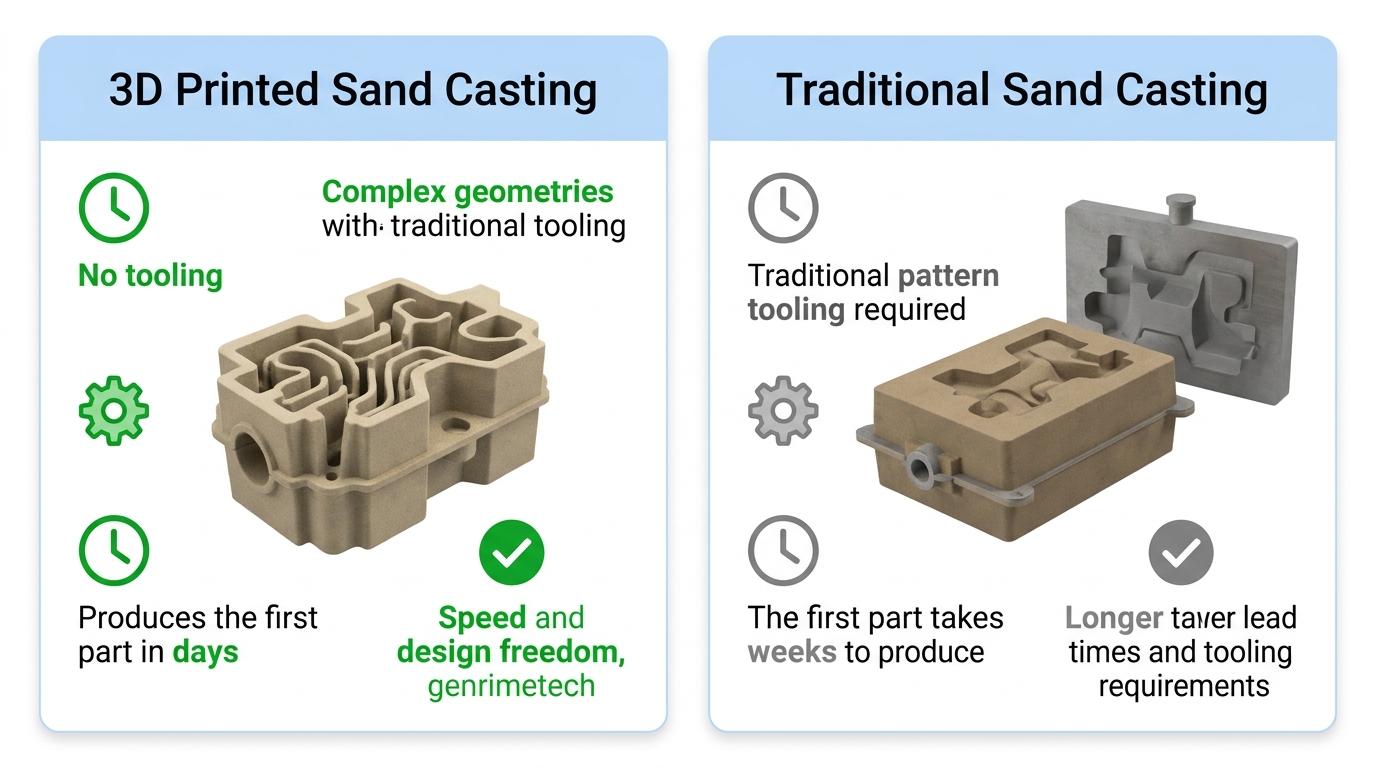
Comparison of 3D printed sand casting vs. traditional sand casting at Protocast.
What is 3D Printed Sand Casting?
3D printed sand casting — also called additive sand casting — prints the mold and core package directly from a digital CAD model, bypassing the need for hard patterns or core boxes. A print head deposits a binder onto thin layers of sand, building up the negative cavity layer by layer. The result is a finished mold ready for pouring, in a fraction of the time required by conventional tooling.
Key Advantages for Complex Geometries
This approach unlocks geometries that challenge traditional core assembly. We can produce intricate undercuts, internal channels, and contoured passageways that would otherwise require multiple loose cores and extensive hand assembly. According to American Foundry Society guidelines, conventional sand casting is limited by core placement tolerances and parting line constraints; printed sand molds remove those barriers, enabling single-piece mold designs that improve dimensional accuracy and reduce potential casting defects.
Integration with Other Processes
At Protocast, our multiple casting processes under one roof allow us to combine 3D printed sand molds with complementary services that deliver finished CNC machined aluminum castings. Once the casting is poured, our in-house CNC machining centers create precision machined features, while our complementary aluminum heat treatment services — including T6 solution heat treating — tailor mechanical properties for demanding applications. This integrated workflow streamlines supply chains, shortens lead times, and reinforces our role as a Made in the USA provider for complex aluminum components.
Frequently Asked Questions About Aluminum Sand Casting in Colorado
We’ve covered the advantages of aluminum sand casting earlier; here are answers to common questions Colorado manufacturers ask.
What is aluminum sand casting and how does it work?
Aluminum sand casting in Colorado uses a sand mold to shape molten aluminum into precise components. Following American Foundry Society standards, it serves aerospace, automotive, and other demanding industries.
Why choose aluminum sand casting for manufacturing in Colorado?
Local sand casting reduces supply chain delays and allows rapid iteration with 3D printed sand casting. Our Commerce City facility offers fast turnaround for Denver-area manufacturers.
What makes Protocast’s sand casting services unique?
We offer multiple casting processes under one roof so we can select the best method. Our From Prototype to Production commitment, Made in the USA quality, and support for companies reshoring their casting projects with Protocast make us a one-stop shop for aluminum sand casting in Colorado.
Can I get CNC machined aluminum castings from the same provider?
Yes. We provide CNC machined aluminum castings in-house, ensuring tight tolerances and eliminating the need for secondary vendors. This integrated service streamlines quality assurance for Colorado manufacturers.
Contact us to discuss how our team can support your next aluminum casting project.
From Concept to Casting: Partner with a Colorado Foundry That Does It All
For OEMs seeking aluminum sand casting Colorado expertise, our full-service foundry delivers end-to-end capability right here in Commerce City. Explore our protocast company profile to see how we bring designs to life with sand casting in Colorado, 3D printed sand casting, and CNC machined aluminum castings–all under one roof. From Prototype to Production, we combine multiple casting processes with in-house engineering, heat treating, and inspection. As an ISO 9001:2015 and ITAR-registered facility, we offer a Made in the USA reshoring alternative that lets you partner with our customers at every stage. Serving the greater Denver area and beyond, we help teams move confidently from concept to finished casting–without ever leaving Colorado.
