

August 5, 2026 | Protocast Inc
Permanent Mold Casting Kentucky
Table of Contents
Permanent Mold Casting in Kentucky: A Comprehensive Guide for OEMs
For OEMs considering permanent mold casting in Kentucky, this guide outlines why the process is a smart choice for medium-to-high volume aluminum and zinc components. Also called aluminum gravity die casting, the process uses a reusable metal mold to produce parts with repeatable tolerances and a superior surface finish. Permanent mold casting advantages such as faster cycle times than sand casting and excellent dimensional consistency make it an efficient alternative when production runs justify dedicated tooling.
Protocast offers fast, high-quality permanent mold casting services alongside sand, investment, and die casting–all from one Commerce City, Colorado foundry. By housing multiple casting processes under one roof, we help you select the optimal method for your project without coordinating between multiple suppliers. For OEMs in Kentucky, our From Prototype to Production approach delivers fast-turnaround samples that transition seamlessly into volume runs. The Made in the USA reshoring alternative shortens supply chains and simplifies logistics compared to overseas sourcing. This reshoring option not only cuts lead times but also reduces the risk of overseas disruptions.
Our team provides comprehensive engineering support, including design feedback and FEA, to optimize your parts for manufacturability. We maintain ISO 9001:2015 and ITAR certifications, ensuring quality and compliance for aerospace and defense programs nationwide. In-house CNC machining, heat treating, and NDT inspection let us deliver fully finished components ready for assembly–all under one roof. Explore the other casting and finishing services we offer to see how Protocast can strengthen your supply chain.
Understanding Permanent Mold Casting Fundamentals
Building on the overview of casting processes, we now focus on permanent mold casting, a manufacturing method that uses a reusable metal mold to produce high-quality components. In this process, molten metal–typically aluminum or zinc alloys–is poured into a steel or iron mold using gravity or low pressure. The resulting parts exhibit excellent surface finish and tight dimensional tolerances, characteristics that distinguish it from traditional sand casting. According to the American Foundry Society, permanent mold casting, often called aluminum gravity die casting, is a metalcasting technique that balances precision with production efficiency.
The following table compares permanent mold casting to sand and investment casting across several key attributes, helping manufacturers evaluate the best fit for their projects.
| Attribute | Permanent Mold Casting | Sand Casting | Investment Casting |
|---|---|---|---|
| Surface Finish | Excellent, smooth | Rough, requires machining | Very smooth, near-net shape |
| Dimensional Tolerance | Tight (.005 in/in) | Loose (.030 in/in) | Very tight (.003 in/in) |
| Typical Materials | Aluminum and zinc alloys | Wide range (ferrous and non-ferrous) | Expensive alloys, high-strength |
| Production Volume | Medium to high (1,000-50,000/year) | Low to medium (1-1,000/year) | Low to medium (10-10,000/year) |
| Tooling Cost | Moderate | Low | High |
| Lead Time | Medium (6-10 weeks) | Short (2-6 weeks) | Long (10-20 weeks) |
Permanent mold casting’s combination of superior surface finish and tight tolerances makes it ideal for applications where near-net shape is critical, though the tooling investment is higher than sand casting. The process excels at medium-to-high production volumes–from 1,000 to 50,000 units annually–where the per-part cost becomes competitive. In contrast, sand casting is more economical for low-volume prototypes due to its low tooling cost, while investment casting achieves the tightest tolerances for high-value aerospace and medical components.
The permanent mold casting advantages extend beyond dimensional accuracy. The rapid solidification caused by the metal mold yields a fine-grained microstructure, enhancing mechanical properties. Additionally, the process supports a wide range of part sizes and complexity, especially for aluminum and zinc alloys. Manufacturers across the country leverage this method; for example, businesses seeking permanent mold casting in Kentucky can apply the same fundamental principles we use in our Colorado facility.
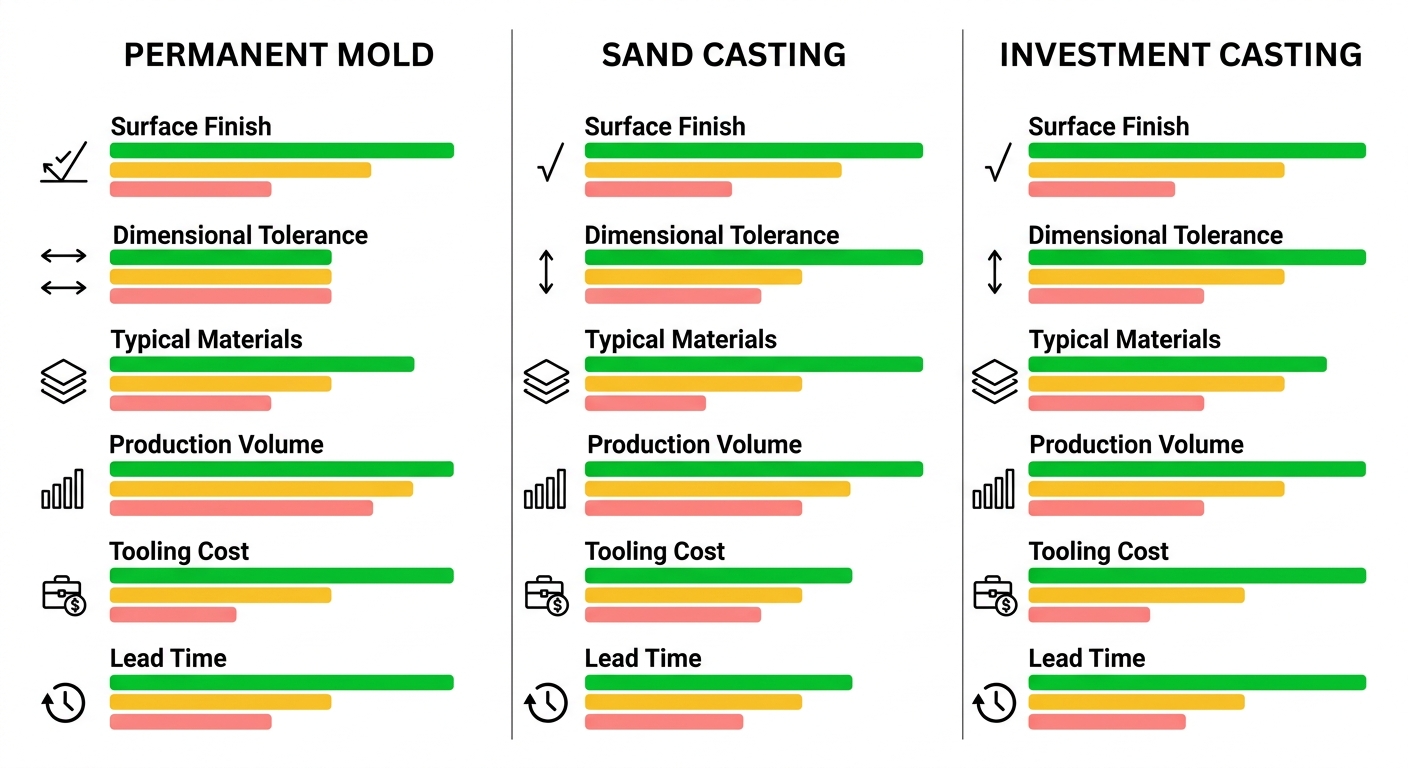
Comparison of permanent mold, sand, and investment casting processes across key attributes.
Reflecting on the key attributes, the permanent mold casting advantages become clear:
- Superior surface finish and dimensional tolerances compared to sand casting
- Efficient medium-to-high production volumes
- Moderate tooling costs and lead times
- Enhanced mechanical properties due to rapid solidification
Our team at Protocast recommends permanent mold casting for projects demanding repeatability across thousands of parts, particularly for aluminum housings and structural components. We often see this process excel in automotive and aerospace applications where consistent quality and moderate volumes are essential. The method balances the flexibility of sand casting with the precision of investment casting.
As we explore the specific advantages and applications in the next section, it becomes evident that permanent mold casting serves as a versatile bridge in metalcasting. For manufacturers seeking a reliable partner, choosing a metal casting company Colorado like Protocast ensures access to experienced engineers and multiple casting processes under one roof–from prototype to production.
Deep Dive into Permanent Mold Casting Advantages and Capabilities
Permanent mold casting offers distinct advantages that make it a go-to process for manufacturing high-quality metal components. We examine the specific benefits–enhanced part strength, cost-effectiveness, and superior surface finishes–that position permanent mold as an ideal middle-ground between sand and die casting.
How Permanent Mold Casting Improves Part Strength and Quality
One of the most significant permanent mold casting benefits is the rapid solidification that occurs when molten metal contacts a reusable steel or iron mold. Unlike sand casting, where the insulating sand slows cooling, the metal mold extracts heat quickly, resulting in a finer, more uniform grain structure. This refined grain directly improves mechanical properties such as tensile strength, yield strength, and fatigue resistance. According to industry data from the American Foundry Society, gravity-fed permanent mold castings routinely achieve mechanical properties 10-20% higher than equivalent sand castings because of the denser, less porous microstructure. The gravity-pour method, combined with controlled cooling, also minimizes gas entrapment and oxide inclusions, yielding a part with greater overall integrity.
In addition to strength gains, the consistent thermal conditions of permanent mold casting produce parts with highly repeatable dimensions and minimal internal defects. Because the mold is rigid and dimensionally stable over many cycles, we can hold tighter tolerances and reduce the variability that often requires additional inspection in other processes. This repeatability is especially valuable for components that undergo heat treating or CNC machining later, as the stress-relieved, homogeneous grain structure responds predictably to secondary operations.
Cost-Effectiveness Across Production Volumes
The advantages of the permanent mold process extend to cost savings across medium production runs. For volumes of roughly 1,000 to 50,000 parts annually, permanent mold casting balances tooling investment with low per-part cost. The reusable metal molds amortize quickly across these volumes, delivering lower per-unit expense than investment casting or CNC machining from billet. At Protocast, we leverage in-house toolmaking and multiple casting processes under one roof to recommend the most economical route without sacrificing quality.
The process also slashes scrap rates and secondary operations. Rapid, controlled solidification produces fewer internal voids and surface defects, so scrap is typically below 3%. Material waste stays minimal, and because the as-cast surface is smooth and dimensions are consistent, many parts require little or no machining before assembly. This translates directly into shorter lead times and lower total program cost–a benefit we see daily when customers transition from sand cast or machined-from-solid designs. When you partner with our customers, we often guide them from prototype to production using permanent mold tooling built with our dedicated CNC machines, delivering cost-competitive, Made in the USA castings.
Achieving Superior Surface Finishes and Reduced Machining
Permanent mold castings leave the tool with a smooth surface finish–typically 125-250 microinches Ra. The metal mold’s fine surface and rapid solidification suppress the formation of coarse dendrites on the casting skin, producing a near-net-shape part right out of the mold. For many functional and aesthetic components, this as-cast surface is fully acceptable without further treatment, eliminating the time and expense of belt sanding, tumbling, or CNC finishing.
When tighter tolerances or specific sealing surfaces are required, the reduced stock removal needed for machining still adds significant efficiency. Because dimensions are highly repeatable, we can program shorter CNC cycles and use smaller cutters, lowering tool wear and cycle times. Protocast’s in-house CMM and NDT services ensure every permanent mold casting meets strict standards, and our ISO 9001:2015 and ITAR certifications support ready-to-install components straight from our Commerce City, Colorado facility, serving customers across the greater Denver area and nationwide.
Beyond these benefits, permanent mold compares favorably with die casting. The table below highlights the key distinctions.
| Factor | Permanent Mold Casting | Die Casting |
|---|---|---|
| Process Type | Gravity-fed, metal mold | Pressure-injected, metal die |
| Material Range | Aluminum, zinc, copper alloys | Zinc, aluminum, magnesium |
| Part Size | Small to large parts | Small to medium parts |
| Tooling Cost | Moderate | High |
| Cycle Time | Moderate (2-10 min) | Fast (seconds to minutes) |
| Porosity | Minimal | Can be higher without vacuum |
| Typical Volumes | 1,000-50,000 parts/year | 10,000+ parts/year |
Permanent mold casting offers lower tooling costs and virtually porosity-free parts, making it ideal for medium volumes and larger sizes. Die casting excels in speed, but the gravity-fed approach provides greater material flexibility and a higher-integrity microstructure where performance counts.
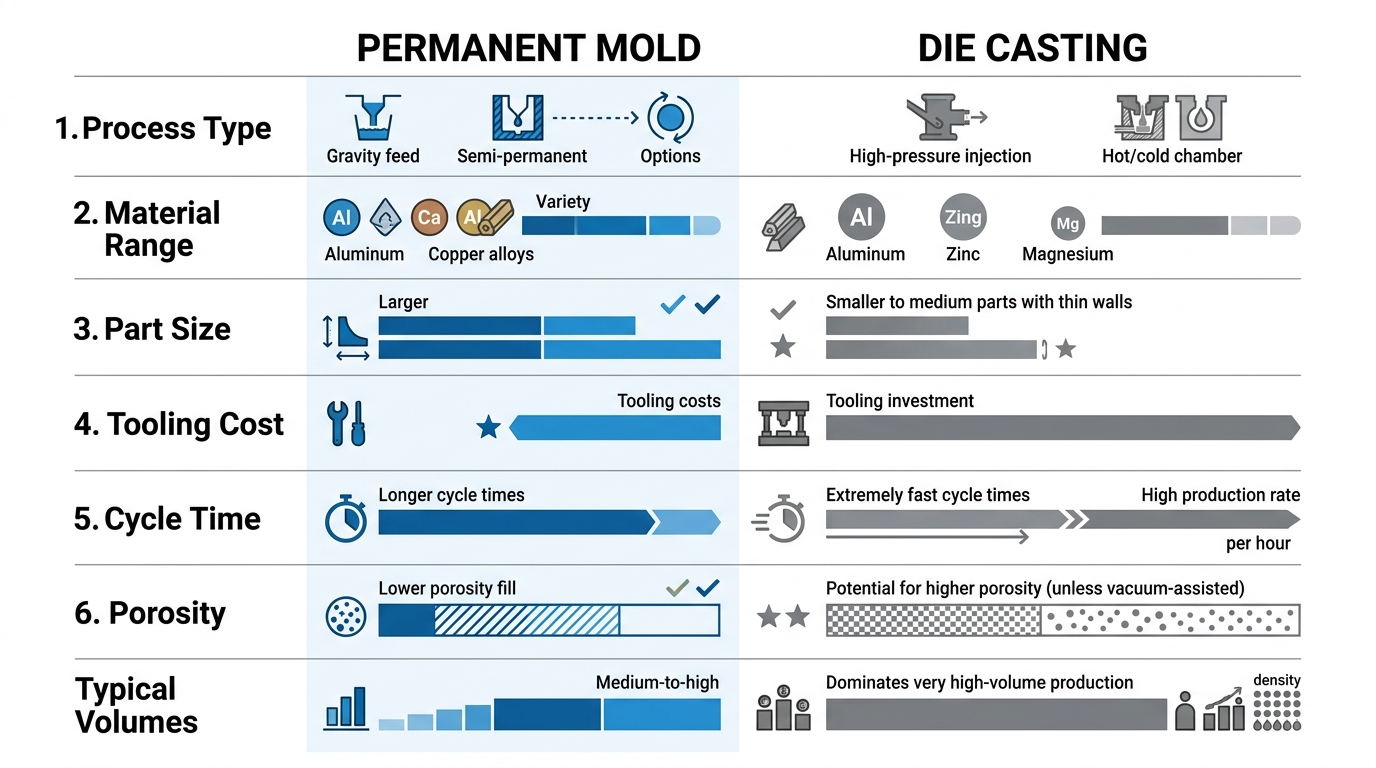
Permanent mold casting vs. die casting comparison across seven key factors using visual indicators.
With Protocast’s expertise and multiple casting processes under one roof, you can realize all these permanent mold casting advantages in your next project–better strength, lower scrap, and a superior surface finish from a Made in the USA supply chain.
Practical Applications and Engineering Support for Permanent Mold Casting
When evaluating permanent mold casting for your next project, practical considerations like alloy choice, lead times, and engineering support are just as critical as the process fundamentals. For many applications, the key decision is whether gravity die casting — the type of permanent mold used at Protocast — or pressure die casting is the better fit.
Selecting the Right Alloy for Your Permanent Mold Casting Project
The permanent mold casting advantages are especially evident when you match the alloy to the application. During early design reviews we help you evaluate the two most common options — aluminum and zinc — based on real-world performance:
- Aluminum offers an excellent strength-to-weight ratio, natural corrosion resistance, and can be heat-treated to T6 condition for demanding aerospace, automotive, or agricultural components. Its thermal conductivity also benefits parts that must dissipate heat.
- Zinc flows more easily, permitting thinner walls and finer surface detail at lower casting temperatures. It typically exhibits higher impact strength and can be directly plated or painted without extensive surface prep, making it popular for consumer products and intricate housings.
We generally recommend aluminum when weight savings, thermal management, or structural integrity are top priorities, while zinc shines where precision and surface appearance matter most. Our engineers walk you through the trade-offs so you can select the optimal alloy with confidence, always keeping the permanent mold casting process in focus.
Lead Times, Tooling Longevity, and Project Planning
Realistic expectations around tooling longevity and lead times are essential for project planning. According to the American Foundry Society, steel permanent molds can routinely achieve 100,000 or more cycles when properly maintained — translating to years of reliable production. Mold fabrication typically requires six to eight weeks, though at Protocast we accelerate the timeline through concurrent engineering, beginning mold design while final part models are still being refined.
For full project delivery, we often deliver first-article samples within eight to ten weeks of final design approval, with production ramping up immediately after approval. Our team maps out each phase — tooling, sampling, inspection, and production launch — so you can align internal milestones and supply-chain schedules without surprises. This disciplined planning, combined with ISO 9001:2015 and ITAR certification, gives your team the confidence to move from prototype to production on a predictable path.
Engineering Support and Design Optimization at Protocast
Our engineering support starts at the very first concept and continues through launch. We provide 3D CAD modeling, computational fluid dynamics analysis, and detailed design-for-manufacturability feedback to optimize your component for the permanent mold process. When a design calls for thin walls, challenging undercuts, or complex coring, our in-house toolmaking team — using three dedicated CNC machines — builds the mold right on site, eliminating the delays of outsourced tooling.
Because we house multiple casting processes under one roof, we never force a design into the wrong method. In addition to permanent mold casting, we also offer the investment casting process for complex geometries, as well as sand and die casting. This flexibility lets us partner with our customers from the earliest design stage, selecting the optimal method and recommending adjustments that save time and improve quality.
As a Made in the USA foundry, we’ve become a trusted reshoring alternative for manufacturers bringing casting projects back to North America. From Prototype to Production, our engineering team works alongside yours — from initial design review through production launch — ensuring every permanent mold component meets the highest standards. This commitment to engineering excellence carries through to our quality assurance processes, which we’ll explore next.
Advanced Processes: Heat Treating, Inspection, and Quality Control
In permanent mold casting, the journey from raw casting to finished component involves more than just pouring metal. Beyond the casting itself, advanced processes such as T6 heat treatment and thorough inspection elevate the final part quality. While many casting methods, including printed sand casting, can benefit from post-cast heat treatment, this section focuses on permanent mold casting.
We utilize T6 heat treatment to dramatically improve the mechanical properties of aluminum permanent mold castings, also known as gravity die casting. The T6 process involves three carefully controlled stages: solution treatment, where the casting is heated to dissolve alloying elements; quenching, which locks the elements in a supersaturated solid solution; and aging, a controlled reheating that precipitates fine particles to strengthen the material.
The following table illustrates the measurable gains achieved through this method.
| Factor | Gravity Die Casting | Pressure Die Casting |
|---|---|---|
| Process Type | Molten metal fills mold by gravity | Injected under high pressure |
| Part Complexity | Simple to moderate | High complexity, thin walls |
| Surface Finish | Good | Excellent |
| Porosity | Lower | Higher (unless vacuum-assisted) |
| Tooling Cost | Lower | Higher |
| Cycle Time | Slower (5-15 min) | Fast (seconds) |
| Best For | Medium volumes, structural parts | High volumes, intricate parts |
After T6 treatment, tensile strength rises substantially, directly enabling aluminum permanent mold castings to meet demanding structural requirements. Hardness increases as well, while dimensional stability and corrosion resistance see meaningful improvements. These enhancements allow us to deliver components that perform reliably in critical aerospace, automotive, and medical applications.
Rigorous inspection and quality control validate every casting’s integrity. Our in-house NDT services include X-ray radiography to detect internal voids, and pressure testing to verify leak-tight performance. We hold ISO 9001:2015 and ITAR certifications, reflecting our commitment to documented, repeatable quality — a necessity when serving regulated industries.
Heat treatment and inspection are available as stand-alone services or seamlessly integrated into a complete casting project. Because we operate multiple casting processes under one roof, customers benefit from streamlined logistics and consistent engineering oversight from prototype to production — all Made in the USA. This integrated approach ensures every part meets the exacting standards our partners expect.
Frequently Asked Questions About Permanent Mold Casting
What is permanent mold casting?
It is a metal casting process that uses reusable steel or iron molds to produce consistent, high-quality parts. Unlike single-use sand molds, these durable tooling blocks can produce thousands of castings before requiring replacement.
What are the advantages of permanent mold casting?
The permanent mold casting advantages include significantly better surface finish, tighter dimensional accuracy, and superior mechanical properties compared to sand casting. The rapid chilling effect of metal molds creates a fine grain structure that enhances strength.
What metals can be used in permanent mold casting?
We commonly cast aluminum alloys — a process also known as aluminum gravity die casting — along with zinc alloys. These metals offer excellent fluidity for filling mold cavities and deliver outstanding finished-part performance.
How does permanent mold casting compare to die casting?
Permanent mold casting uses lower injection pressures and simpler tooling than die casting, resulting in more affordable molds. While die casting achieves faster cycle times for very high volumes, permanent mold offers an ideal balance of quality and production economics for medium-volume manufacturing.
What production volumes are best suited for permanent mold casting?
Medium to high production runs, typically from several hundred to tens of thousands of pieces annually, benefit most from the permanent mold process. Tooling costs remain manageable while per-part costs decrease significantly as volume scales.
How experienced is Protocast with permanent mold casting?
Our protocast history demonstrates decades of delivering permanent mold castings From Prototype to Production. As a Made in the USA foundry with multiple casting processes under one roof, we select the optimal method for each project.
Partner with Protocast for Your Permanent Mold Casting Needs
Whether you need permanent mold casting in Kentucky or nationally, Protocast’s process delivers from prototype to production. With multiple casting processes under one roof, we also offer aluminum gravity die casting, sand, and investment casting. Permanent mold advantages include denser grain structure, improved mechanical properties, tighter tolerances, and efficient medium-to-high volume runs. Our engineering team reduces secondary operations. ISO 9001:2015/ITAR certified and Made in the USA, we are trusted by OEMs reshoring their casting projects. We invite you to partner with our customers–contact us today. We ship nationwide.
