

August 5, 2026 | Protocast Inc
Permanent Mold Casting Ohio
Table of Contents
Permanent Mold Casting in Ohio: Process, Benefits, and Applications
Permanent mold casting in Ohio offers a reliable route to high-integrity aluminum and zinc parts. Using reusable steel molds, the process–also called gravity die casting–pours molten metal by gravity or a controlled tilt (tilt pour aluminum casting) to optimize fill. After cooling, the part is ejected with near-net shape, minimizing machining. Ohio’s automotive, aerospace, and agricultural equipment industries rely on this method for repeatable, dimensionally accurate components.
Key advantages of permanent mold casting include:
- Tolerances of ±0.015 in. and surface finishes of 125-250 microinches (Modern Casting data).
- Superior mechanical properties versus sand casting.
- Shorter cycle times through reusable molds, yielding permanent mold casting efficiency.
- Suitable for aluminum alloys A356, 319, 535 and zinc.
These characteristics make permanent mold casting a go-to choice for volume production.
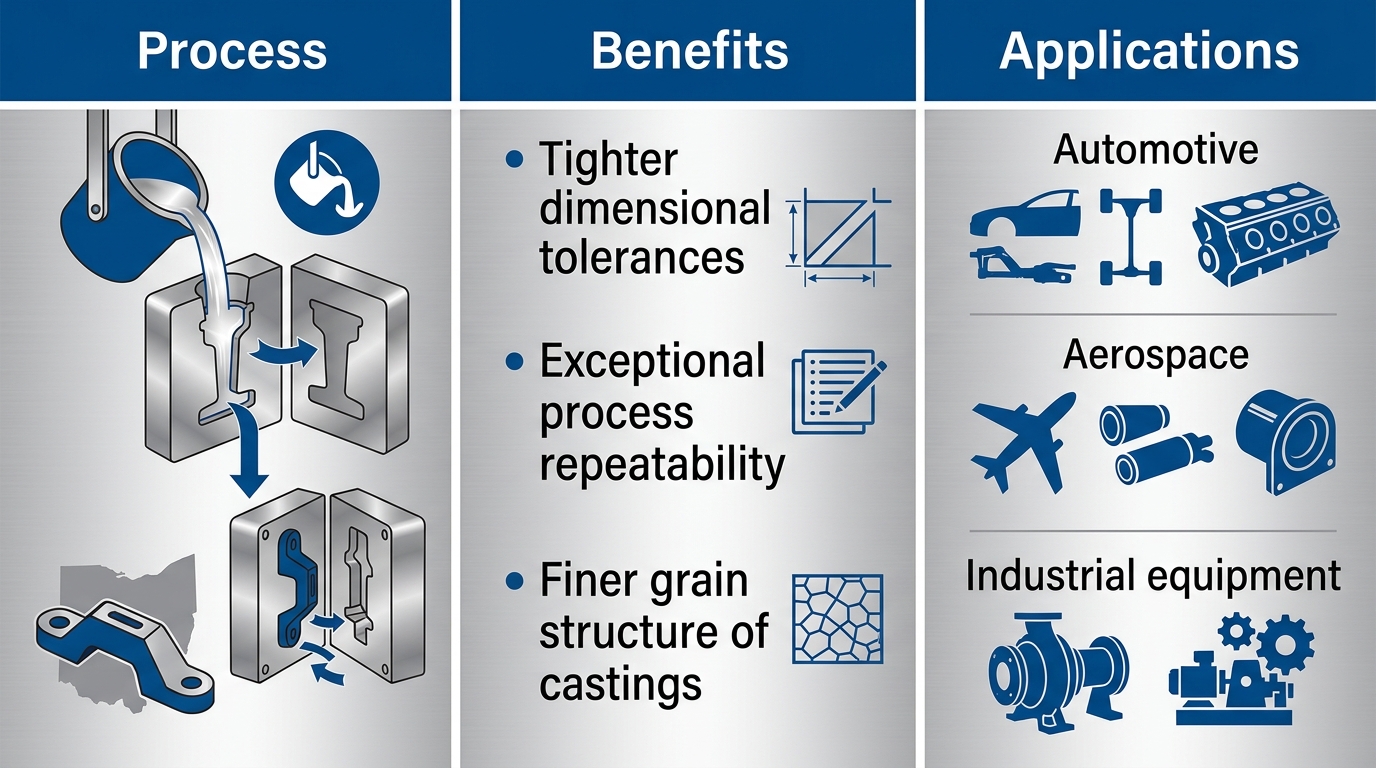
Permanent mold casting process, benefits, and applications overview for Ohio manufacturers.
Ohio manufacturers seeking gravity die casting services turn to partners like Protocast. As a Made in the USA foundry, we offer permanent mold casting alongside sand, investment, and die casting–all under one roof. From prototype to production, we help companies reshore their casting projects, using our in-house engineering and CNC machining to deliver consistent quality. This integrated model supports Ohio’s supply chain from component design to high-volume delivery, setting the stage for a closer look at selecting the right casting method.
How Permanent Mold Casting Works: Tooling, Materials, and Production Volumes
Following our introduction of permanent mold casting as a cost-effective high-volume manufacturing method, we now examine the process, tooling, and production characteristics that make it a favored choice for medium-run aluminum parts. Permanent mold casting is a metal casting process in which molten metal is poured (by gravity or low pressure) into a reusable mold machined from steel or iron. The mold’s durability enables thousands of pours while consistently producing parts with smooth surface finishes and tight dimensional accuracy. Gravity pouring and tilt-pour techniques are two of the most common filling methods, with tilt-pour especially valued for reducing turbulence and air entrapment so that the resulting castings exhibit improved soundness.
At Protocast Inc., we employ gravity die casting services and tilt pour aluminum casting processes to serve the greater Denver area from our Commerce City, Colorado foundry. As a trusted permanent mold casting provider, we combine this capability with our other in-house processes to give original equipment manufacturers a single source for engineered cast components. Typical permanent mold runs range from about 1,000 to 25,000 parts annually, occupying a sweet spot between low-volume sand casting and high-volume die casting. The rapid solidification against the metallic mold produces fine-grain structures, and nearly all common aluminum casting alloys can be heat treated to T6 or T7 conditions to reach their full mechanical potential.
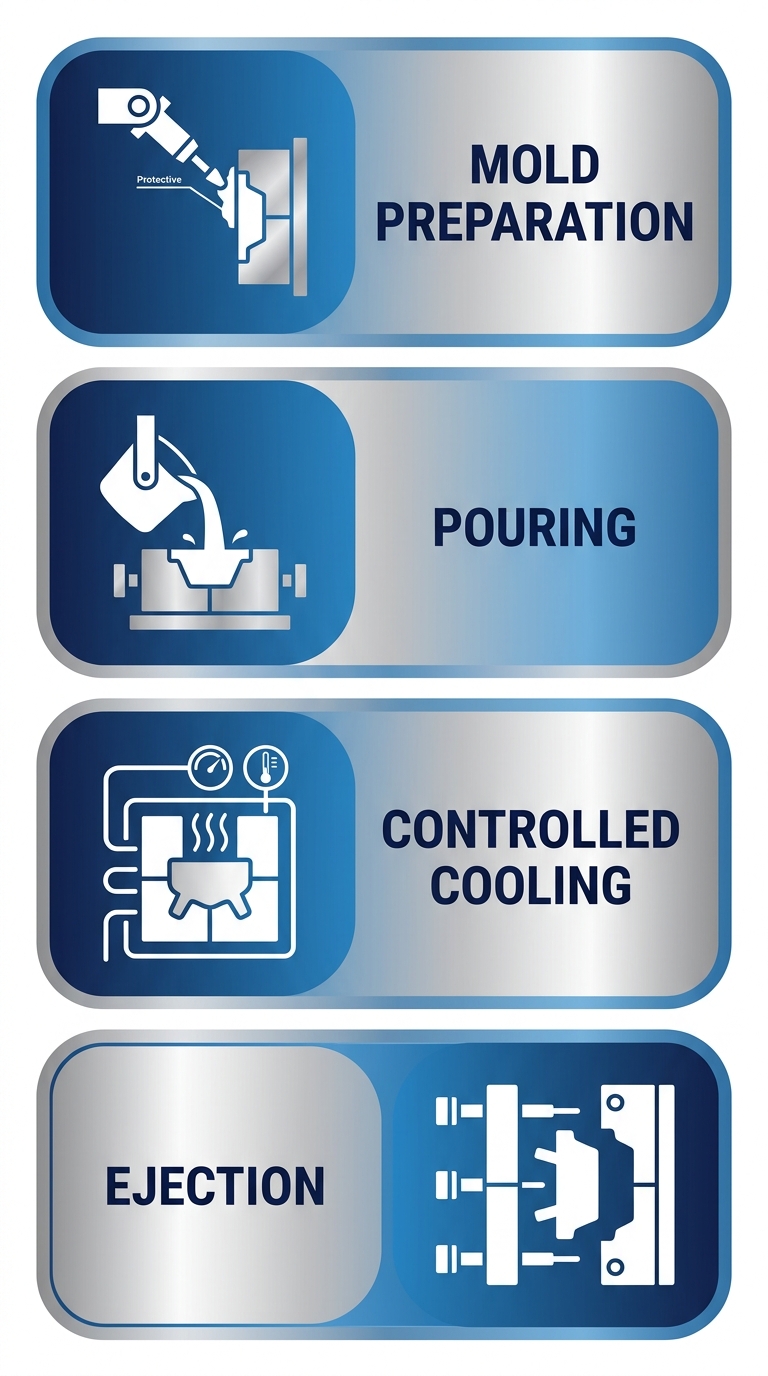
Permanent mold casting process flow from preparation to ejection at Protocast Inc.
Alloy selection is a critical design decision because it directly influences mechanical properties, castability, and the final application. The table below lists four widely used aluminum alloys along with their typical uses and performance characteristics, drawn from the American Foundry Society’s Modern Casting industry benchmarks.
| Alloy | Typical Applications | Mechanical Properties | Castability |
|---|---|---|---|
| 356.0 | Cylinder heads, pump bodies, automotive wheels | Good strength and ductility; 33 ksi tensile | Excellent; preferred for complex shapes |
| 319.0 | Engine blocks, transmission cases, appliances | High strength at elevated temperatures; 32 ksi tensile | Good; suitable for intricate molds |
| A206 | Aerospace brackets, military hardware | Very high strength; 48 ksi tensile (T7) | Moderate; requires careful pouring control |
| 713.0 | Hydraulic valves, aircraft fittings | High strength and corrosion resistance; 32 ksi tensile | Fair; limited to less complex designs |
Alloy 356.0 is the workhorse for general-purpose parts, while 319.0 maintains strength at elevated temperatures, making it ideal for engine block and transmission applications. A206 delivers the highest tensile strength, often specified for aerospace and military hardware, though its castability demands strict pouring control. For parts subject to corrosive environments, 713.0 offers excellent resistance with moderate castability best suited to simpler geometries.
By combining the optimal alloy with our in-house heat treating and CNC machining, we deliver permanent mold castings that meet the tightest engineering specifications. Protocast’s ability to provide multiple casting processes under one roof, supported by a team where nearly half of our employees hold engineering degrees, allows us to take projects from prototype to production while maintaining ISO 9001:2015 and ITAR compliance. Our Made in the USA operation helps domestic and international OEMs reshore their casting projects with confidence.
In the next section, we will explore why permanent mold casting delivers superior mechanical properties and surface finish relative to other casting methods.
Comparing Permanent Mold Casting to Sand, Gravity Die, and Tilt Pour Processes
Our previous overview introduced the casting processes we use at Protocast. To help you select the right method, this section compares Permanent Mold Casting with sand casting, gravity die casting, and tilt pour aluminum. As a full-service casting foundry, we house sand, permanent mold, investment, and die casting capabilities under one roof, allowing us to match each project to the optimal process. Permanent mold casting provides an excellent balance of precision and production efficiency for medium-to-high-volume runs.
| Criteria | Permanent Mold | Sand Casting | Gravity Die Casting | Tilt Pour Aluminum |
|---|---|---|---|---|
| Initial Tooling Cost | Medium ($5,000-$30,000) | Low ($500-$5,000) | Medium ($8,000-$40,000) | Medium-High ($10,000-$50,000) |
| Production Volume Suitability | 1,000-150,000 units | 1-10,000 units | 1,000-100,000 units | 500-50,000 units |
| Surface Finish (Ra) | 125-250 microinches | 250-500 microinches | 125-200 microinches | 100-200 microinches |
| Dimensional Tolerance | ±0.015 in./first inch | ±0.030 in./first inch | ±0.015 in./first inch | ±0.010 in./first inch |
| Cycle Time | 3-10 minutes | 10-60 minutes | 3-8 minutes | 4-12 minutes |
| Mechanical Properties | Excellent (fine grain) | Good (coarser grain) | Excellent (fine grain) | Superior (very fine grain) |
The table highlights key trade-offs: sand casting offers the lowest tooling cost but sacrifices surface finish and cycle time, while permanent mold and gravity die processes tighten tolerances. Tilt pour aluminum delivers superior mechanical properties, though at a higher initial investment. The following subsections explore these comparisons in detail.
Permanent Mold vs Sand Casting: Precision and Cost
When comparing Permanent Mold Casting to sand casting, precision and production volume drive the decision. Permanent mold tooling yields dimensional tolerances of ±0.015 in. per inch and surface finishes from 125 to 250 microinches Ra, according to data from the American Foundry Society’s Modern Casting publication. Sand casting, with tolerances of ±0.030 in. and finishes of 250-500 microinches Ra, costs far less to tool and suits prototypes and runs up to 10,000 units. Cycle times for permanent mold (3-10 min) versus sand (10-60 min) make permanent mold the economical choice for repeatable medium-to-high-volume production beyond 1,000 units. At Protocast, we offer both processes under one roof, so you can select the method that matches your quality and budget requirements without juggling multiple vendors.
Gravity Die Casting Services: Differences from High-Pressure Die Casting
Gravity Die Casting, a gravity-fed variant of permanent mold casting, distinguishes itself from high-pressure die casting through its controlled fill. Metal flows into the reusable steel mold solely under gravity, reducing turbulence and gas entrapment to yield lower internal porosity–critical for pressure-tight components. High-pressure die casting injects metal rapidly, achieving shorter cycle times but frequently trapping gas. Our gravity die casting services hold tolerances of ±0.015 in. and produce fine-grained structures, remaining cost-effective for volumes up to 100,000 units. Typical applications include structural brackets, housings, and parts that require heat treatment or weldability. Where thin-walled, high-volume production dominates, high-pressure die casting is the preferred choice, but gravity die casting offers the integrity needed for engineered components.
Tilt Pour Aluminum Casting: Reducing Turbulence and Porosity
Tilt Pour Aluminum Casting refines the gravity-fed concept by precisely tilting the mold during fill to control metal delivery. This technique virtually eliminates splashing and air entrapment, producing castings with exceptionally low porosity and a uniform, very fine grain structure. Industry benchmarks show tilt pour aluminum achieves surface finishes as low as 100 microinches Ra and dimensional tolerances of ±0.010 in. per inch–the tightest among the four processes. Mechanical properties are superior, with higher ductility and fatigue resistance, making tilt pour ideal for aerospace, medical, and performance-critical applications. The trade-off is higher tooling cost and cycle times of 4-12 minutes compared to gravity die casting, but for parts where integrity is paramount, tilt pour aluminum casting delivers unmatched quality.
With these distinctions in mind, let’s explore how to match your project to the optimal casting method.
Practical Applications and Cost Considerations for Permanent Mold Casting
Permanent mold casting in Ohio and throughout the United States proves its value in a range of demanding, production-oriented applications where dimensional precision, repeatable material properties, and cost efficiency at scale are essential. We help manufacturers evaluate whether this process fits their design requirements by examining three practical dimensions: achievable tolerances and quality control, cost-effectiveness for low-volume and prototype runs, and the method’s proven ability to produce pressure-tight hydraulic components.
Dimensional Tolerances and Quality Control in Permanent Mold Casting
The repeatable solidification conditions that define permanent mold casting enable tight dimensional control, typically reaching tolerances of ±0.005 inch per inch. Surface finishes as fine as 125-250 microinches Ra are common, reducing secondary machining and helping part geometry meet print specifications right out of the mold. These capabilities are underpinned by rigorous quality control practices. In our Commerce City, Colorado facility, we employ CMM inspection to validate critical dimensions, alongside leak testing and radiographic inspection (NDT) to confirm internal integrity. Because we operate ISO 9001:2015- and ITAR-certified systems, every heat-treated batch is supported by documented process controls that give customers engineering-level confidence in each casting. This combination of mold-driven precision and multi-method inspection makes permanent mold a go-to choice for components that must perform consistently across hundreds or thousands of cycles.
Cost-Effectiveness for Low-Volume and Prototype Runs
When evaluating gravity die casting services against sand and die casting, cost per part changes significantly with volume. For very low quantities–such as 100 units–sand casting’s lower tooling investment often results in a lower unit cost. At the same time, our printed sand casting technology may offer a more flexible alternative for rapid prototypes without hard tooling. As volumes climb toward 1,000 to 10,000 units, permanent mold becomes increasingly economical because the higher initial tooling cost is amortized over a larger run, while shorter cycle times and reduced post-processing drive per-unit costs below those of sand casting at typical breakpoints. At 50,000 units, permanent mold sits close to die casting on a unit-cost basis and remains the more practical choice for parts that need superior mechanical properties. The table below illustrates these relative trends using industry benchmarking data from the American Foundry Society’s Modern Casting magazine.
| Volume | Sand Casting | Permanent Mold Casting | Die Casting |
|---|---|---|---|
| 100 units | $50/unit | $80/unit | N/A (minimum volume not met) |
| 1,000 units | $8/unit | $10/unit | $50/unit |
| 10,000 units | $2/unit | $2.50/unit | $4/unit |
| 50,000 units | $0.80/unit | $0.90/unit | $0.60/unit |
The key insight is that permanent mold casting crosses the economic threshold between sand and die casting right in the mid-volume range where many of our customers operate. The process rewards well-designed tooling with steady per-part cost reductions, and because we offer multiple casting processes under one roof, we can objectively guide customers to the most economical path without bias toward any single method.
Suitability for Pressure-Tight Hydraulic Components
Tilt pour aluminum casting is especially valued for parts that must hold pressure without leakage, and it distinguishes permanent mold from simpler gravity-fed approaches. By tilting the mold as metal is introduced, the technique minimizes turbulence and trapped air, producing denser, porosity-free castings. This directly supports applications in hydraulic and fluid power systems where even microscopic voids can cause failure. Typical components manufactured with this approach include aluminum valve bodies, pump housings, and cylinder end-caps–all of which benefit from the process’s ability to deliver consistent wall thickness and fine grain structure. We verify pressure-tight performance with in-house leak testing and radiographic inspection, ensuring that every lot of production parts meets the performance requirements of systems operating at high continuous pressure. For engineers designing critical fluid-handling components, tilt-pour permanent mold offers a repeatable path from prototype qualification to full-scale production.
These characteristics make permanent mold casting a strong candidate for demanding applications, and the next section explores how to design parts to take full advantage of the process.
Mechanical Properties and Aerospace Applications of Permanent Mold Casting
Building on the process overview, the mechanical properties of permanent mold casting consistently outperform sand casting, making it a preferred choice in aerospace applications. The aluminum alloy 356.0-T6, commonly specified for structural aerospace components, clearly demonstrates these advantages. According to data published by Modern Casting, the journal of the American Foundry Society, permanent mold cast 356.0-T6 yields higher tensile and yield strengths, greater elongation, and increased hardness compared to equivalent sand cast material.
The following table summarizes the property differences:
| Property | Permanent Mold | Sand Cast |
|---|---|---|
| Tensile Strength (ksi) | 38 | 33 |
| Yield Strength (ksi) | 27 | 22 |
| Elongation (%) | 5 | 3 |
| Hardness (BHN) | 80 | 70 |
Data source: Modern Casting (American Foundry Society)
The enhanced mechanical properties result from the faster cooling rates inherent in permanent mold casting. Unlike sand molds, which insulate the solidifying metal, permanent metal molds extract heat rapidly, producing a finer grain structure and fewer internal defects. The rapid solidification suppresses the formation of coarse intermetallic phases, yielding a ductile matrix that resists crack propagation. This refined microstructure directly improves tensile strength to 38 ksi, yield strength to 27 ksi, elongation to 5%, and Brinell hardness (BHN) to 80–values that provide a reliable margin of safety in flight-critical applications.
Typical aerospace components produced using this method include engine mounts, structural brackets, landing gear parts, and housings that must withstand high stress and fatigue cycles. Components such as flap tracks, actuator housings, and pylon fittings benefit from the near-net-shape capability and reduced need for post-cast welding, which maintains material integrity. Whether performed via conventional gravity die casting services or the more controlled tilt pour aluminum casting method, permanent mold casting delivers consistent, repeatable properties essential for aerospace certification.
At Protocast Inc., we offer permanent mold casting as part of our turnkey metal casting solutions, supporting projects From Prototype to Production. We help OEMs reshoring their casting projects with Protocast by combining multiple casting processes under one roof and providing in-house engineering support. Our ISO 9001:2015 and ITAR certifications further reinforce our ability to deliver aerospace-grade castings. These mechanical property advantages set the stage for the detailed design guidelines that ensure optimal part performance and manufacturability.
Frequently Asked Questions About Permanent Mold Casting in Ohio
What is permanent mold casting, and how does it benefit Ohio projects?
Permanent mold casting Ohio manufacturers trust uses reusable steel molds to produce parts with fine surface finish, tight tolerances, and consistent properties–ideal for medium-to-high volumes.
How does permanent mold casting compare to gravity die casting?
This process overlaps with gravity die casting services, where metal flows into a mold under gravity. Tilt pour aluminum casting improves fill and reduces turbulence for better integrity.
Is permanent mold casting suitable for aluminum and zinc parts?
Yes, it works exceptionally well with aluminum and zinc alloys, delivering high strength, corrosion resistance, and tight tolerances for critical applications.
Why partner with Protocast for permanent mold casting in Ohio?
As a domestic metal casting partner, Protocast combines multiple casting processes under one roof with full engineering support to take your project from prototype to production–all Made in the USA.
What certifications does Protocast hold for metal casting?
Protocast is ISO 9001:2015 and ITAR certified, meeting rigorous quality and defense compliance standards.
For more specific inquiries, contact Protocast.
Choose a Trusted Permanent Mold Casting Partner for Your Next Project
Understanding the process is just the start; choosing the right partner is critical. When searching for permanent mold casting in Ohio, look for ISO 9001:2015 and ITAR, plus process breadth. Our gravity die casting and tilt pour aluminum casting join sand and investment casting under one roof–streamlining scaling. Modern Casting cites quality systems and process control as critical. With engineering support and CNC machining, we reduce secondary steps. We partner with our customers nationwide from our Colorado foundry, ensuring Made in the USA dependability. Next, explore how Protocast’s permanent mold capabilities meet these standards, including for Ohio projects.
