

Low Pressure Casting for Thin-Wall Aluminum Housings
Thin walls are where gravity runs out. Pour aluminum into a mold and it starts losing heat the instant it touches the surface; in a thin section it can freeze before the cavity is full. Low pressure permanent mold solves this by pushing metal into the die from below and holding it there while it solidifies. Why that works, and what it means for the design of the housing, is below.
Why thin walls are hard
Aluminum casting alloys have a narrow window between pouring temperature and the point where they stop flowing. In a steel die that window closes fast. With gravity, the metal front slows as it climbs and spreads into thin sections, and the last areas to fill are the first to freeze short, leaving misruns or cold shuts. Increasing the pour temperature helps a little and hurts the die and the metal quality. The better answer is to fill from the bottom, keep the front moving, and keep feeding.
What the bottom-up fill does
- Controlled velocity. Pressure is ramped so the metal front rises at a steady, programmed rate through the riser tube and the cavity. No splashing, no folds, no trapped air.
- Continuous feed. Pressure is held after the cavity is full. As the casting shrinks, metal is pushed in from below to replace it, so thin walls and the heavier sections they attach to stay sound.
- Directional solidification. The casting freezes from the top and the far walls back toward the riser tube, which is the last thing to solidify. That is the direction you want: shrinkage ends up in the tube, not the part.
- Less oxide. Aluminum forms an oxide skin the moment it meets air. A quiet fill keeps that skin on the surface instead of folding it into the casting.
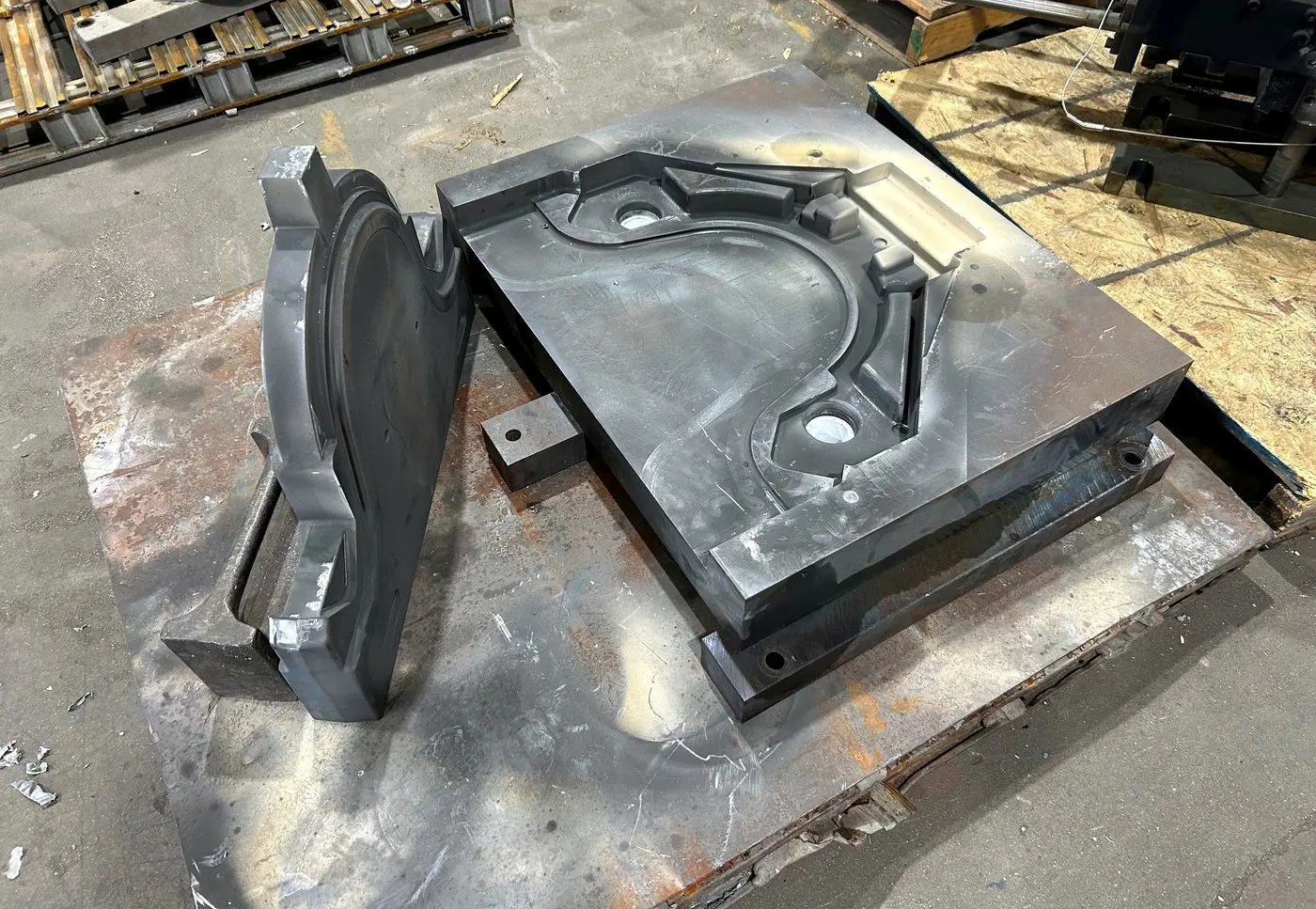
A low pressure die with a slide. The thinner the wall, the more the fill method and the die design matter.
Design rules for a thin-wall housing
| Rule | Why |
|---|---|
| Uniform wall, about 0.125 inch or more | Thin walls fill; the problem is a thin wall next to a thick one, which pulls metal from the thin section as it freezes |
| Ribs at 60 to 80 percent of the wall | Stiffens the housing without creating hot spots at the rib root |
| Generous inside radii | Metal flows around a radius; it hesitates at a sharp corner, and that hesitation becomes a cold shut in a thin wall |
| A clear path from the bottom | The riser tube location is designed with the part; features that block the rising front need attention early |
| Draft on every vertical face | Thin walls grip the steel as they shrink; draft lets them release without tearing |
| Machining stock on sealing faces | Gasket faces and bores are machined; leave stock and let the casting carry the rest as cast |
Typical starting points. The DFM review on your quote replaces them with numbers for your part.
Alloy and heat treatment
356 is the usual choice for thin-wall housings because it flows well and is forgiving in complex geometry. 357 is used where the housing is structural and needs the extra strength. Both are heat treated to T6 in Protocast’s own furnace, typically within 2 to 3 days of casting. Thin walls quench and age quickly and evenly, an advantage of a well-designed low pressure housing that is easy to overlook.
Where thin-wall housings come from
Electronics enclosures, motor and gearbox covers, sensor and instrument housings, lighting housings, and heat sinks all share the same pressures: less weight, less material, more room inside, and a surface that can be finished without much work. Aluminum in a permanent mold answers all four when the walls will fill. The usual history is a high pressure die casting quote that came back with tooling and minimum quantities the program could not support, or a sand prototype that proved the function but not the wall. Low pressure sits between them.
Thin walls and heat treatment, finishing, and machining
Thin-wall housings quench and age quickly and evenly, so T6 is straightforward, but they can distort in the quench if the shape is unsupported; fixtures or racks are used for parts that need it, and machining follows heat treatment so the datum surfaces are cut on the final shape. Powder coat, paint, anodize, and chem film are all common on housings and are available. Machined sealing faces should carry stock, and gasket grooves are usually machined rather than cast.
EMI shielding and pressure tightness
Two requirements show up on thin-wall enclosures more than on any other part. Aluminum’s electrical conductivity makes a cast housing an effective EMI and RFI shield as long as the joint faces are clean and conductive; chem film is the usual finish where shielding matters. And enclosures that are sealed against weather or fluid need a wall with no connected porosity, which is exactly what the quiet, fed fill of low pressure delivers; the pressure-tight guide covers what else goes into it.
How Protocast fits in
Send the model with the wall thicknesses you are worried about and the annual quantity. The simulation will show whether gravity fills the walls or whether the part needs low pressure, and the quote comes back with that recommendation. Finishing for housings, from powder coat to chem film, is available, and machining of sealing faces is done in house.
Frequently asked questions about thin-wall low pressure casting
How thin can a wall be?
Protocast’s typical minimum for permanent mold is 0.125 inch, with exceptions possible depending on geometry. Low pressure makes that minimum achievable over larger areas than gravity can manage.
Would sand casting be easier for a thin housing?
No. Sand pulls heat more slowly than steel, which helps, but the typical minimum wall for sand at Protocast is 0.160 inch and the finish and repeatability are lower. Sand is for prototypes of the housing, not production.
Can a thin-wall housing be pressure tight?
Yes, and low pressure is the process most likely to achieve it as cast. The pressure-tight castings guide covers the details.
Can a thin-wall housing be made in tilt pour instead?
Sometimes, if the thin area is small and the part is otherwise moderate. Over large thin areas, gravity fills unreliably, and low pressure is the better process.
Do thin walls warp during heat treatment?
They can if unsupported in the quench. Racking and fixturing are used where needed, and machining after heat treatment cuts datum surfaces on the final shape.
What finish is used for shielded enclosures?
Chem film is the usual choice where conductivity at the joint faces matters. Anodize is insulating and is used where shielding is not required.
Send the model. Get a quote with engineering feedback.
Have a housing with walls you are not sure will fill? Send the model and the simulation will show you.
- Engineering review with every quote
- Flow simulation before tooling is cut
- Cast, heat treated, machined, and inspected in one building
- Permanent mold tooling cut in house whenever possible
