
Gravity Die Casting, Tilt Pour, Permanent Mold: One Process, Three Names
Tilt pour is the most common way to fill a permanent mold. The steel die starts near horizontal, metal is ladled into a pouring basin, and the machine tilts the die so the metal flows into the cavity under gravity in a smooth, controlled front rather than a splash. The controlled fill reduces turbulence and oxide, which is why tilt pour parts have consistently good soundness for a gravity process. The names come first, because they cause most of the confusion.
The names, sorted out
| Name | Where you hear it | What it means |
|---|---|---|
| Permanent mold casting | North America, the Aluminum Association standards | Any casting in a reusable metal mold; the umbrella term |
| Gravity permanent mold | North American foundries | Permanent mold filled by gravity, as opposed to low pressure |
| Tilt pour permanent mold | Foundries that run tilting machines | Gravity permanent mold where the die rotates during the pour; what Protocast runs |
| Gravity die casting (GDC) | Europe, Asia, and international drawings | Exactly the same as gravity permanent mold |
| Static pour permanent mold | Older practice | Gravity permanent mold poured into a fixed, upright die; more turbulent than tilt |
| Low pressure die casting (LPDC) | Everywhere | Permanent mold filled from below under low pressure; a different fill, same family; its own guide |
| High pressure die casting (HPDC) | Everywhere | A different process: high pressure injection, different tooling, no heat treatment; not what this page describes |
If you have been quoting “gravity die casting” and receiving high pressure die casting answers, or the reverse, the table above is why. Protocast quotes gravity die casting as tilt pour permanent mold, because that is what it is.
How tilt pour works
- Preheat and coat. The die is brought to temperature and sprayed with a refractory mold wash that controls heat transfer and release.
- Set cores and close. Steel cores pull with the die; sand cores for internal passages are set in their prints (semi-permanent mold).
- Ladle into the basin. With the die near horizontal, a measured amount of metal is poured into a basin attached to the die. The metal is not yet in the cavity.
- Tilt. The machine rotates the die toward vertical at a programmed rate. Metal flows from the basin through the gate and up through the cavity as a single controlled front, ahead of the air it displaces.
- Solidify. The steel pulls heat quickly. Risers in the die feed the casting as it shrinks.
- Open, eject, repeat. The die opens, ejector pins push the casting out, and the cycle restarts. Gates and risers are trimmed and remelted.
The reason tilt matters is turbulence. Aluminum forms an oxide skin the instant it meets air, and every splash or fold in a pour buries that skin in the casting as an inclusion. Rotating the die lets the metal run in gently and keeps the oxide on the surface where it belongs. Protocast describes its own method as a more intricate version of tilt pouring, run on a production machine that holds, rotates, opens, and ejects automatically.
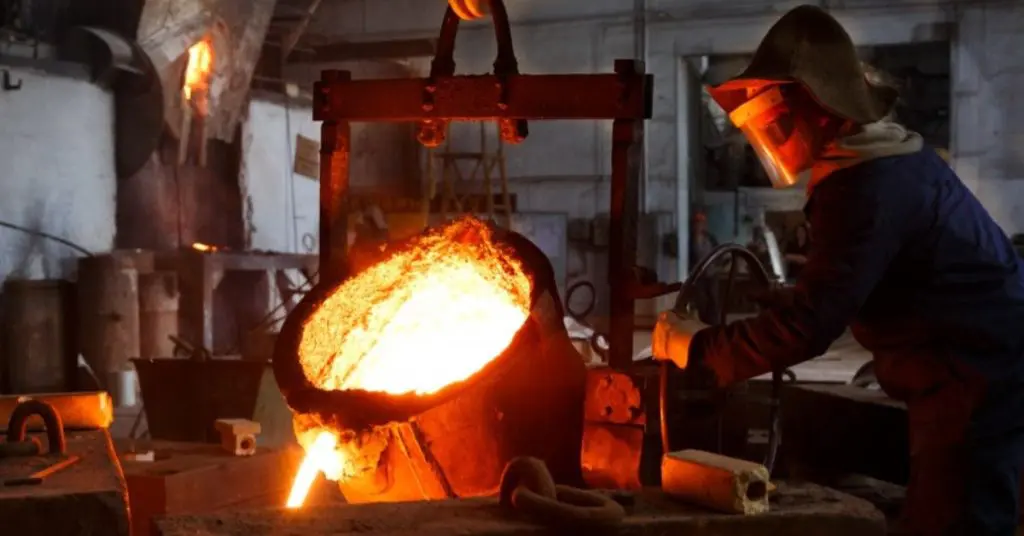
Metal enters under gravity as the die rotates. The controlled front is what separates tilt pour from a static pour.
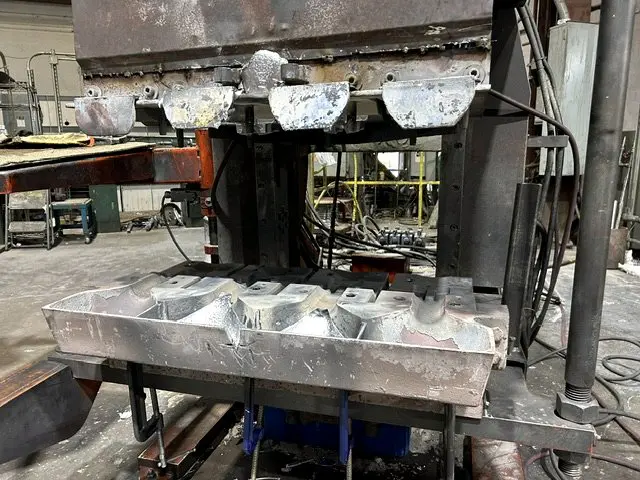
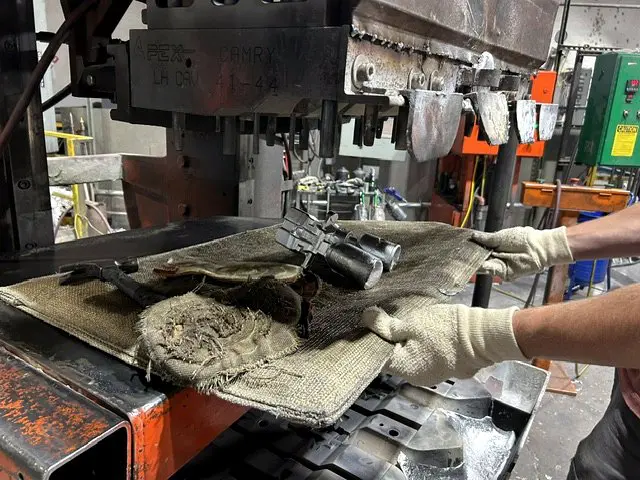
A Protocast tilt pour die opening after the shot, and the castings coming out with their gating still attached.
Where tilt pour fits
- Volume. The full permanent mold range, roughly 300 to 500 pieces a year up to 50,000, shared with low pressure.
- Rate and price. About 50 pieces an hour on a part that suits it, a little faster and a little less per piece than low pressure. Tooling life is the same, about 40,000 shots before refurbishing is required.
- Part types. Housings, brackets, manifolds, covers, pump and valve bodies, and structural parts with moderate wall sections.
- Cores. Steel cores for straight pulls; sand cores (semi-permanent mold) for passages a steel core cannot leave.
- Properties. Heat treatable to T6 and weldable, with the finer grain that steel-die cooling gives.
What to expect
| Item | Typical at Protocast |
|---|---|
| Annual volume (EAU) | Roughly 300 to 500 pieces a year up to about 50,000 |
| Tool life | About 40,000 shots before refurbishment |
| Surface finish | 125 to 250 rms |
| Minimum wall | Typically 0.125 inch |
| Tolerances | Aluminum Association Standards for Aluminum Sand and Permanent Mold Castings |
| Sample lead time | Typically 12 to 20 weeks for raw castings from a new die, plus 1 to 2 weeks for machining |
| Alloys | Aluminum (356, 357) and zinc; in-house T6 heat treat for aluminum |
| Tooling cost | $35,000 to $200,000, most under $100,000; cut in house whenever possible; customer owned |
Figures are typical and depend on geometry and workload.
Tilt pour compared with sand casting and low pressure
| Precision sand | Tilt pour | Low pressure | |
|---|---|---|---|
| Tooling | Pattern; low cost | Steel die; moderate | Steel die plus furnace setup |
| Volume | 1 to a few hundred | 300 to 50,000 | 300 to 50,000 |
| Finish | 350 to 450 rms | 125 to 250 rms | 125 to 250 rms |
| Minimum wall | 0.160 inch | 0.125 inch | 0.125 inch, over larger areas |
| Heavy sections | Good | Good with risers | Best |
| Design changes | Easy | Costly | Costly |
| Samples | 4 to 6 weeks | 12 to 20 weeks | 12 to 20 weeks |
Choose tilt pour when the walls are thick enough for gravity to fill the cavity cleanly. Choose low pressure for thinner walls and heavy sections that need feed pressure. Volume does not decide it; both cover the same range. Prove the design in sand first. When it is not obvious, the flow simulation at the quote stage usually settles it; the comparison guide goes through the decision in detail.
Designing for tilt pour
The permanent mold rules apply: uniform walls of about 0.125 inch or more, roughly 2 degrees of draft on outside walls and more inside, radii on every inside corner, a parting line placed to keep critical features on one side, and machining stock where the drawing needs tighter than as-cast. Tilt pour adds one consideration: the gate and basin sit on one side of the die, so the part is oriented so metal enters at the bottom of the cavity as the die rotates and heavy sections sit where risers can reach them. The design guide covers the rules, and the DFM review applies them to your part.
Common defects and how they are prevented
| Defect | Cause | Prevention |
|---|---|---|
| Oxide inclusions | Turbulence during the pour | Tilt rate programmed for a smooth front; basin and gate design |
| Misrun, cold shut | Thin section froze before fill | Wall thickness, die temperature, coating; low pressure if walls are very thin |
| Shrinkage | Heavy section not fed | Riser placement from simulation; part orientation in the die |
| Hot tears | Casting shrinking onto rigid steel | Inside radii, draft, ejection timing |
| Sticking | Insufficient draft or worn coating | Draft on every vertical face; coating practice |
Applications
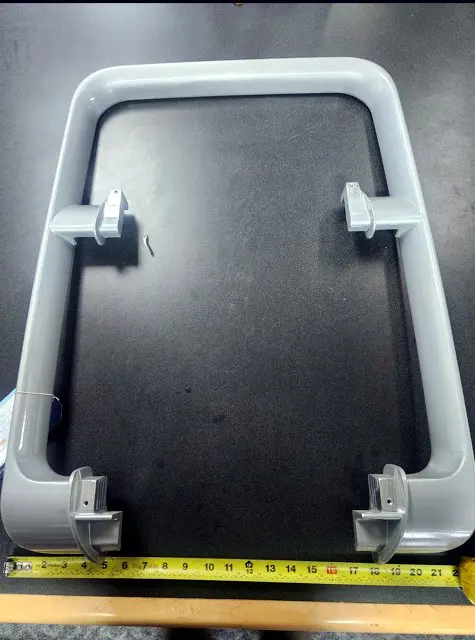
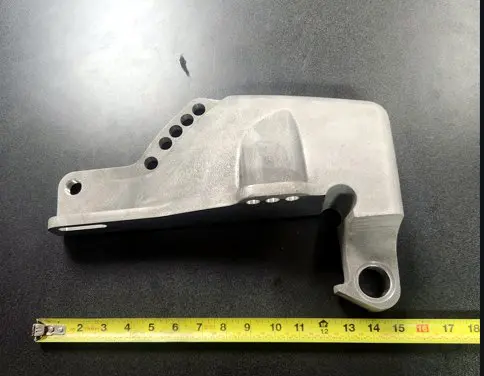
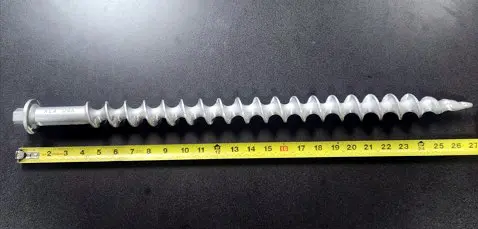
Tilt pour permanent mold is the everyday production process for aluminum parts in the thousands per year: pump and valve housings, gearbox and motor covers, brackets and mounts, manifolds, heat sinks, lighting and enclosure components, and structural parts for aerospace, defense, medical, industrial, agricultural, and automotive customers. Protocast is ISO 9001:2015 certified and ITAR registered; the aerospace and defense guide covers what those programs require.
How Protocast fits in
Protocast runs two production tilt pour machines with a third ready to come online, with sand casting on one side of them for prototypes and low pressure on the other for thinner walls. If you have been quoting “gravity die casting” and getting high pressure die casting answers, or no answers, send the part here. It will be quoted as a tilt pour permanent mold casting, with heat treat, machining, and inspection included where the drawing calls for them.
Frequently asked questions about gravity die casting and tilt pour
Is gravity die casting the same as permanent mold casting?
Yes. Gravity die casting is the common name outside North America for a steel die filled by gravity, which is what gravity or tilt pour permanent mold is.
What is tilt pour casting?
A gravity permanent mold process in which the die rotates from near horizontal toward vertical during the pour, so metal enters the cavity as a smooth, controlled front rather than a splash.
What is the difference between gravity die casting and pressure die casting?
Gravity die casting fills a steel die by gravity and produces heat treatable castings with good mechanical properties at volumes from a few hundred to tens of thousands a year. Pressure die casting injects metal at very high pressure with far more expensive tooling and larger volumes, and the castings generally cannot be heat treated.
What is semi-permanent mold?
A permanent mold with a sand core set in for internal passages a steel core cannot pull out of. The outside keeps the steel-mold finish; the inside gets the geometry of a sand casting.
What volume makes sense for tilt pour?
From roughly 300 to 500 pieces a year up to about 50,000, the same range as low pressure. Below a few hundred a year, sand casting usually costs less.
What tolerances can I expect?
Protocast follows the Aluminum Association Standards for Aluminum Sand and Permanent Mold Castings; tighter features are machined in house.
Is gravity die casting accurate?
Yes. The steel die holds its shape shot after shot, so dimensions repeat across thousands of parts and flatness and concentricity are better than sand. Machined features are machined to print.
What are the disadvantages of gravity die casting?
Tooling costs more than a sand pattern, design changes after the die is cut are expensive, very thin walls over large areas are better suited to low pressure, and the process is limited to non-ferrous alloys at Protocast.
What industries use gravity permanent mold?
Aerospace, defense, medical, industrial equipment, automotive, agriculture, and consumer products, among others.
Send the model. Get a quote with engineering feedback.
Quoting a gravity die casting? Send the model and we will quote it as a permanent mold part with DFM feedback.
- Engineering review with every quote
- Flow simulation before tooling is cut
- Cast, heat treated, machined, and inspected in one building
- Permanent mold tooling cut in house whenever possible
