

Semi-Permanent Mold: Sand Cores in a Steel Die
A steel core can only make a hole it can pull out of. Water jackets, curved oil galleries, undercut pockets, and intersecting passages cannot be formed by steel, and for years the answer was to sand cast the whole part. Semi-permanent mold is the better answer for production: a sand core set into a steel die, so the outside of the casting gets the finish and repeatability of permanent mold and the inside gets whatever geometry the part needs.
How it works
The die is machined exactly as it would be for a permanent mold part, with the external shape, gating, and any straight-pull steel cores. The internal geometry that steel cannot form is made as a sand core in a separate core box. Before each shot the core is set into locating prints in the die, the die closes, the metal is poured, and after ejection the sand is shaken and blasted out of the casting. The core is consumed every shot; the die is not.
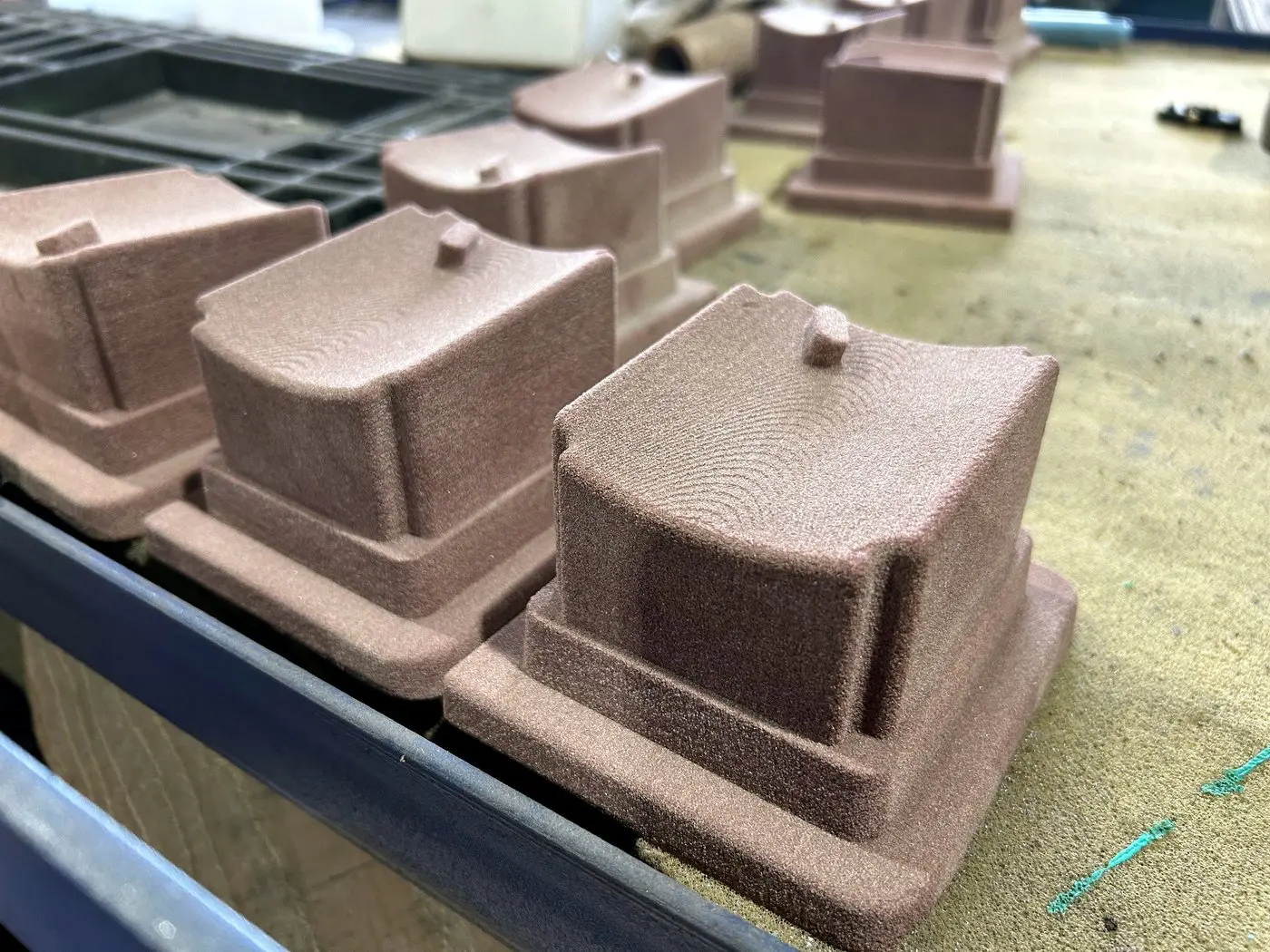
Sand cores, made in a core box or printed, are set into the die before every pour.
What it gives you
- Internal passages. Coolant jackets, oil galleries, air passages, and any channel that curves, turns, or intersects.
- Undercuts. Features behind other features, where a steel core would be trapped.
- Complex cavities. Pockets with re-entrant walls or internal ribs.
- Permanent mold outside. The as-cast surfaces formed by steel are 125 to 250 rms, dimensions are repeatable shot to shot, and the tool runs about 40,000 shots before refurbishment.
What it costs
| Item | Effect |
|---|---|
| Core box tooling | One-time cost, far less than the steel die; sometimes printed sand cores need no box at all |
| Core per shot | A consumable cost added to every casting; scales with core size and complexity |
| Cycle time | Setting the core adds seconds to each cycle |
| Cleaning | Sand removal and blast after casting; passages may be inspected with a borescope |
| Internal finish | Sand-formed surfaces are 350 to 450 rms, like a sand casting; the steel-formed outside stays permanent mold quality |
| Internal tolerance | Sand core tolerances are wider than steel; plan machined features accordingly |
When to use it
Use semi-permanent mold when the part needs internal geometry that steel cannot form and the volume justifies a permanent mold die, roughly 300 to 500 pieces a year or more. Below that, cast the whole part in precision sand or printed sand. If the internal feature can be redesigned as a straight pull, or machined afterward, a fully permanent mold die is simpler and cheaper per shot; the DFM review will say which.
Design notes
- Cores need prints, the extensions that locate them in the die. Leave room for them; they usually become open holes that are plugged or machined.
- Give the core enough section to be handled and set without breaking; very thin sand cores are fragile.
- Make sure every internal cavity has a path for the sand to come out.
- Wall thickness rules still apply. A core placed close to the outside wall creates a thin section that has to fill.
Typical semi-permanent mold parts
Intake and exhaust manifolds, water-cooled housings with jackets, hydraulic manifolds with intersecting galleries, pump bodies with volutes, compressor and gearbox housings with internal oil passages, and heat exchanger components. In each case the outside is a production permanent mold surface and the inside is a passage no steel core could leave. Many of these parts were sand cast for years and moved to semi-permanent mold when volume justified a die.
Making the cores
Cores for a semi-permanent mold are made the same ways cores are made for sand casting. Wherever possible they come from a core box, machined like a pattern and filled with resin-bonded sand, because that is the economical route at any volume. When the geometry is very complex, the core is printed straight from the CAD file instead; a printed core costs more per piece, which is why the core box is the first choice. Either way the cores are coated, inspected, and stored dry until they are set in the die.
Cleaning and inspecting internal passages
After shakeout the passages are blasted clear and, where the drawing requires, inspected with a borescope. Passages that must be free of sand for hydraulic or pneumatic service should say so, and the design should give every cavity an opening large enough to clean through. Pressure and leak testing follows machining, since cored passages are usually part of a pressure boundary.
How Protocast fits in
Protocast has made sand cores since it added sand casting in 2005. Cores come from a core box wherever possible, because a printed core costs more, and are printed when the geometry is very complex. Send the model with the internal passages clearly defined, and the quote will show the core approach along with the die.
Frequently asked questions about semi-permanent mold
Does the sand core affect the outside of the part?
No. The outside is formed by steel and has the same finish and repeatability as a fully permanent mold casting.
Can cores be 3D printed?
Yes. Printed sand cores need no core box, which suits complex passages and low-volume programs. For high volume a core box is usually more economical.
Is semi-permanent mold the same as sand casting with a metal chill?
No. In semi-permanent mold the entire external mold is steel and only the internal cores are sand. A chill is a local piece of metal in an otherwise sand mold.
Are semi-permanent mold castings weaker than fully permanent mold castings?
No. The external walls are formed by steel and have permanent mold properties. Surfaces formed by the sand core have a sand casting finish but the same alloy and heat treatment.
How much does a sand core add to the piece price?
It varies with core size and complexity. The core is a consumable added to every shot, plus the seconds to set it, and the cleaning after. On a production part it is usually a modest share of the piece price.
Can I avoid the core by redesigning?
Sometimes. If the passage can become a straight pull, or be machined, the die is simpler and the piece price lower. The DFM review will say whether that is realistic for your part.
Send the model. Get a quote with engineering feedback.
Have a part with internal passages and production volume? Send the model and we will show you the core approach with the quote.
- Engineering review with every quote
- Flow simulation before tooling is cut
- Cast, heat treated, machined, and inspected in one building
- Permanent mold tooling cut in house whenever possible
