
Permanent Mold Casting: The Production Process Explained
Permanent mold casting pours molten aluminum into a reusable steel die instead of a sand mold that is broken away after every pour. The die gives you the same geometry shot after shot, and because there is no mold to make for each part, the cost per casting falls once the tooling is paid for. This is the production process at Protocast, and it is the umbrella for two ways of filling the die that each have their own page in this hub. This guide covers how the process works, where it fits between sand casting and die casting, what to expect from a permanent mold program, and the questions buyers ask most.
How permanent mold casting works
The mold is machined from steel in two or more sections that close to form the cavity of the part, together with the gating that lets metal in and the risers that feed it as it shrinks. Holes and pockets that pull straight are formed by steel cores; passages that curve or undercut are formed by sand cores set in the die, which is called semi-permanent mold. The die mounts in a machine that clamps it, tilts it for the pour, opens it, and ejects the casting. A typical cycle looks like this:
- Preheat and coat. The die is brought to operating temperature and sprayed with a refractory mold wash. The coating controls how fast heat leaves the metal, protects the steel, and helps the casting release.
- Set cores and close. Any sand cores are placed in their prints, the die closes, and the machine clamps it.
- Pour. In tilt pour, metal is ladled into a basin and the die rotates so the metal enters as a smooth front. In low pressure, metal is pushed up into the die from a furnace beneath it.
- Solidify. The steel pulls heat quickly. The casting freezes from the walls inward and from the far end back toward the risers, which feed shrinkage as it happens.
- Open and eject. The die opens and ejector pins push the casting out. Cycle time depends on part size and section thickness.
- Trim, heat treat, machine, inspect. Gates and risers are removed, the casting is heat treated to T6, machined where the drawing calls for it, and inspected.
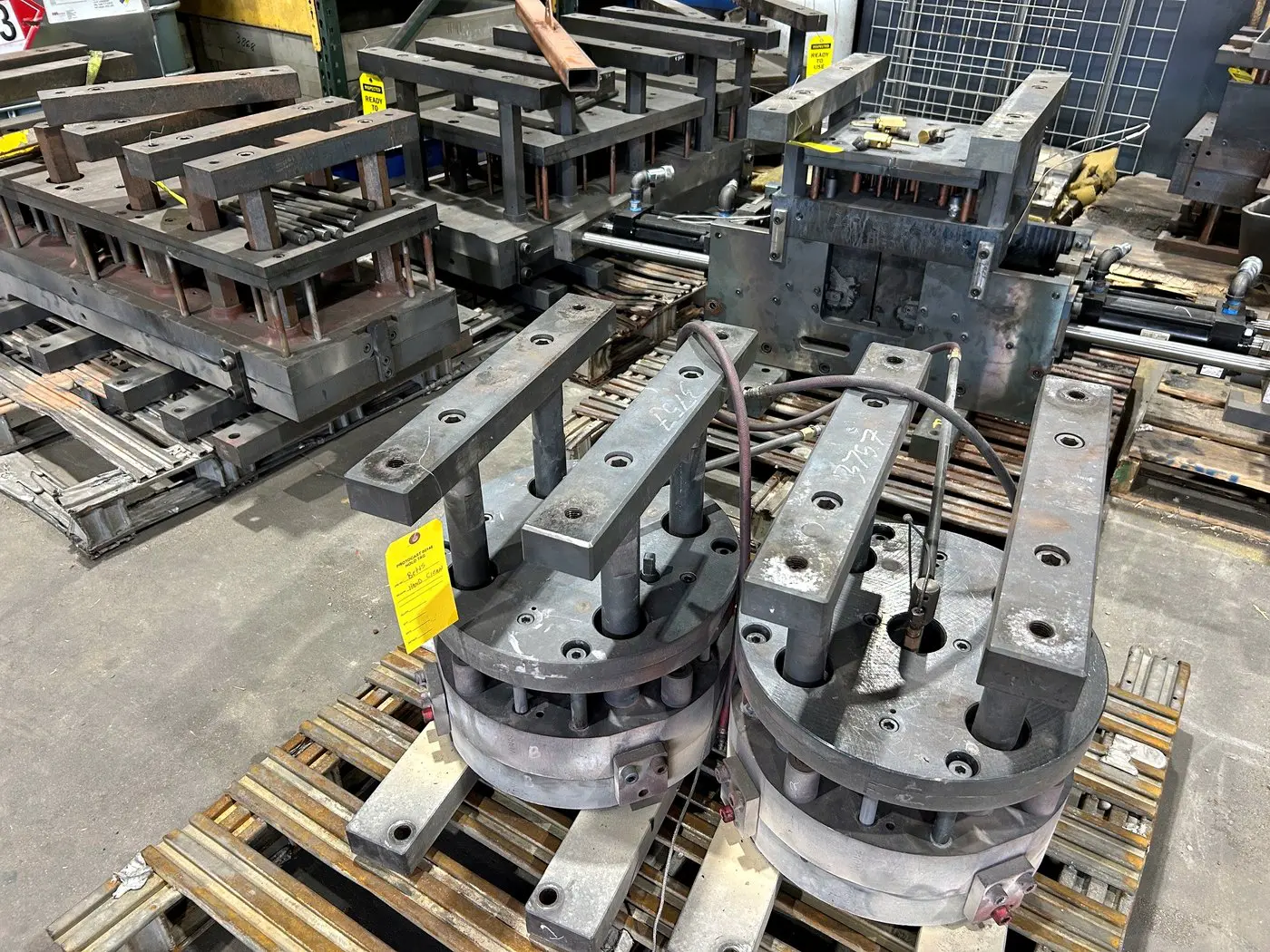
Permanent mold dies between runs at Protocast. Each die belongs to the customer who paid for it and is stored, maintained, and refurbished at the foundry.
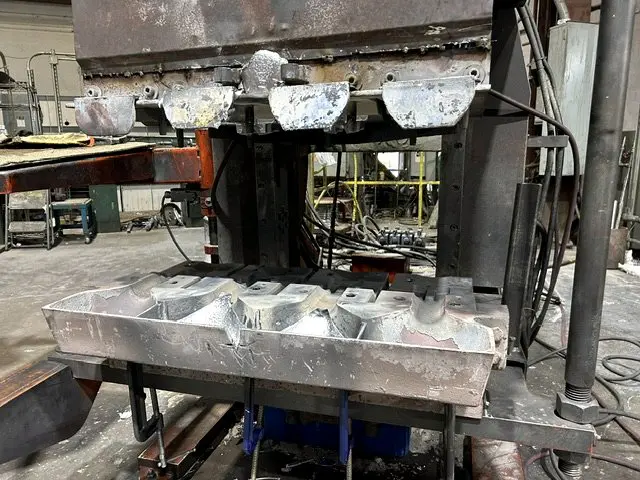
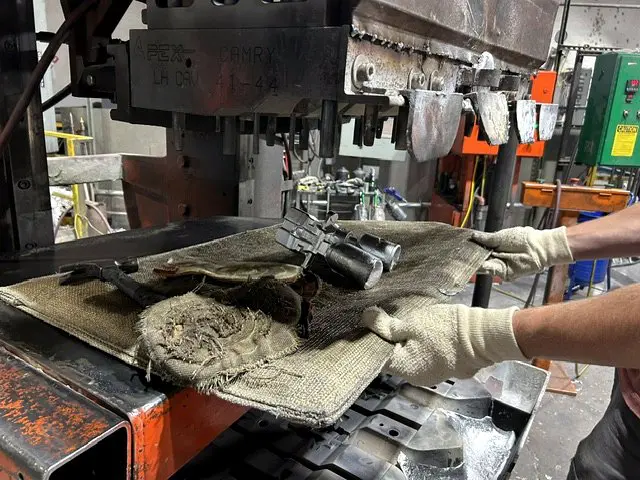
Left: a tilt pour die opening after a shot. Right: the castings coming out, gating still attached.
Two ways to fill the die
“Permanent mold” describes the tooling. What changes underneath it is how the metal gets into the die, and each method has its own guide:
- Tilt pour, also called gravity pour. The die tilts as metal is poured so gravity fills the cavity in a controlled front. The simplest tooling and the most common method. The industry also calls this gravity die casting or gravity permanent mold.
- Low pressure. The alloy is pushed up into the die from a sealed furnace underneath. The pressure fills thin walls and heavy sections that gravity struggles with and keeps feeding the casting as it solidifies. It covers the same volume range as tilt pour; the part decides. Many buyers call this low pressure die casting; it is the same process.
Both use steel tooling. Neither is high pressure die casting, which injects metal at far higher pressure with different tooling and different economics. If you are comparing quotes, that distinction matters more than the name on the quote, and the tilt pour versus low pressure guide walks through choosing between the two.
Where permanent mold sits between sand casting and die casting
Every casting process is a trade between tooling cost and per-part cost. Sand casting has a very low tooling cost and a short path to a first part, but every casting needs a new mold, so the per-part price reaches a floor and stays there regardless of quantity. High pressure die casting has the lowest per-part price but the highest tooling cost, the largest minimum volumes, and castings that generally cannot be heat treated. Permanent mold is the middle: real steel tooling at a fraction of a high-pressure die, per-part prices that fall with volume, and mechanical properties and heat treatability that die casting cannot match.
| Sand casting | Permanent mold | High pressure die casting | |
|---|---|---|---|
| Tooling | Pattern; low cost | Steel die; moderate cost | Steel die; highest cost |
| Volume sweet spot | 1 to a few hundred | 300 to 50,000 and more | Usually 50,000 to 100,000 and up in North America |
| Fill | Gravity or low pressure | Gravity (tilt) or low pressure | High pressure injection |
| Surface finish | 350 to 450 rms | 125 to 250 rms | Smoothest |
| Mechanical properties | Good | Better; finer grain | Variable; trapped gas |
| Heat treatable | Yes | Yes | Generally no |
| Weldable | Yes | Yes | Generally no |
| Design changes | Easy | Moderate | Very costly |
| At Protocast | In house | In house, tilt pour and low pressure | Offered |
Typical figures. The sand versus permanent mold guide walks through the crossover point with numbers.
What to expect from a permanent mold program
| Item | Typical at Protocast |
|---|---|
| Annual volume (EAU) | Roughly 300 to 500 pieces a year up to about 50,000; the same range for tilt pour and low pressure |
| Tool life | About 40,000 shots before refurbishment |
| Tooling cost | $35,000 to $40,000 for small, simple parts; up to $200,000 for large, complex parts with slides; most under $100,000. The customer owns the die. |
| Surface finish | 125 to 250 rms |
| Minimum wall thickness | Typically 0.125″; exceptions possible depending on geometry |
| Tolerances | Aluminum Association Standards for Aluminum Sand and Permanent Mold Castings |
| Sample lead time | Typically 12 to 20 weeks for raw castings from a new die, plus 1 to 2 weeks for machining |
| Tooling source | Cut in Protocast’s own tool room whenever possible; domestic partners when capacity requires |
| Alloys | Aluminum (356, 357 and others) and zinc. Protocast is a non-ferrous foundry. |
| Heat treatment | T6 in house, typically 2 to 3 days from casting |
| Machining | In house; eight CNC machines for permanent mold tooling and post-cast machining |
Figures are typical and depend on geometry, draft, radii, and current workload. Your quote is the number that counts.
Designing a part for permanent mold
A steel die does not forgive the way a sand mold does. The rules are not exotic, and most parts that cast well in sand need only small changes, but they need to be made before the die is cut. Keep walls uniform and no thinner than about 0.125 inch. Put draft on every face parallel to the pull, 2 degrees as a starting point and more on deep pockets and cores. Radius every inside corner, which protects the casting from cracking and the die from heat checking. Place the parting line so critical dimensions sit on one side of it. Leave machining stock on faces that need tighter tolerance than as-cast. The design guide covers each rule with numbers, and the DFM review on every quote applies them to your part.
Semi-permanent mold: sand cores in a steel die
When a part needs internal passages a steel core cannot pull out of, a sand core is set into the steel die before each pour. You keep the finish and repeatability of the steel mold on the outside and get the complex interior of a sand casting. It adds a core to every shot, so it costs a little more per part, and it is often the answer for manifolds and housings with internal galleries. The semi-permanent mold guide covers what it costs and when to use it.
Alloys
Most permanent mold castings at Protocast are poured in 356, an aluminum-silicon casting alloy that flows well, resists hot cracking, and heat treats to a strong, ductile T6 condition. 357 is the same family with more magnesium and tighter chemistry, and it is specified when the part is strength critical, which usually means aerospace, defense, or a highly loaded component. Zinc alloys are also poured for small, detailed parts that do not need heat treatment. Alloy chemistry is verified on an in-house spectrometer. The alloy guide has the published property tables and the trade-offs.
After the casting: heat treat, machining, finishing, inspection
A permanent mold casting rarely ships as cast. Aluminum castings reach their published strength only after T6 heat treatment, which Protocast runs in house on a bottom-drop furnace that handles parts up to 48 by 48 by 60 inches and can take most castings to T6 in 2 to 3 days, often overnight. Machining happens in the same building on eight CNC machines that also cut the permanent mold tooling: tapped holes, sealing faces for gaskets, and any feature a raw casting cannot hold, using fixtures designed around the casting. Before machining, every permanent mold casting goes through the grinding department, where the runner and gate are cut off on a band saw and the gate is ground back by hand; that hand work is part of why permanent mold tolerances sit between sand and high pressure die casting. Anodizing, chem film, and powder coating are available. Dimensional inspection runs on an in-house CMM, and pressure and leak testing, radiographic inspection, fluorescent penetrant inspection, and tensile testing are available when a program requires them.
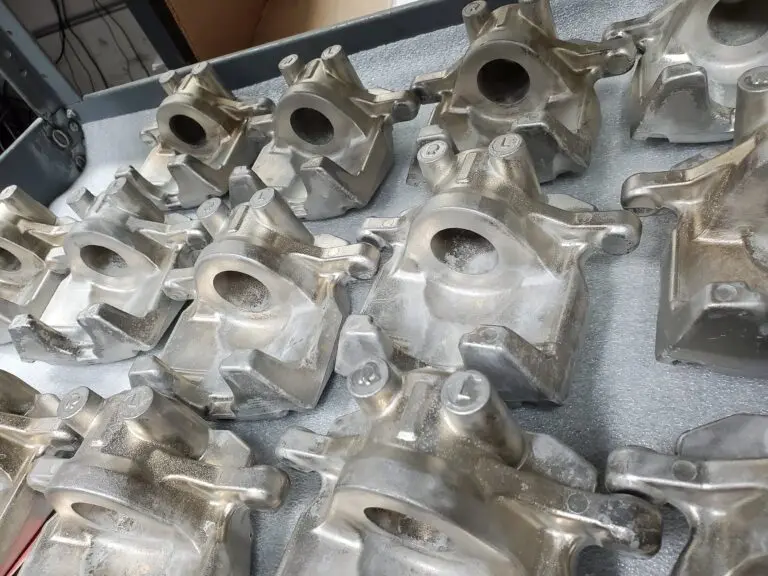
Aluminum castings out of heat treat, headed for the machine shop.
Applications and industries
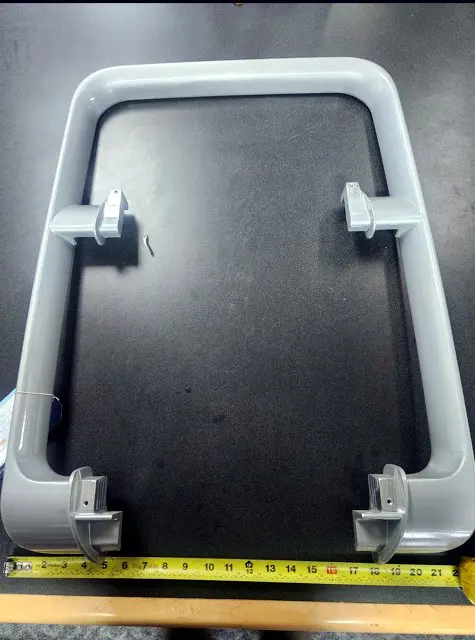
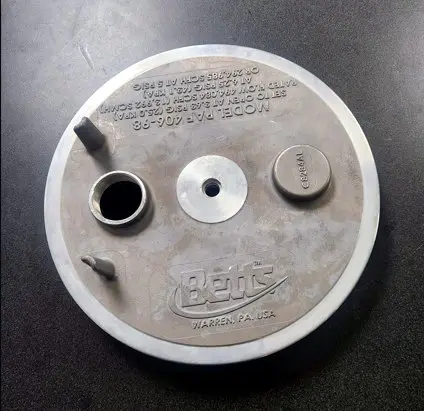
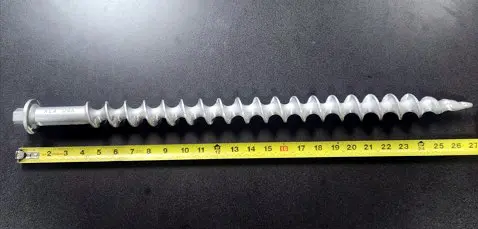
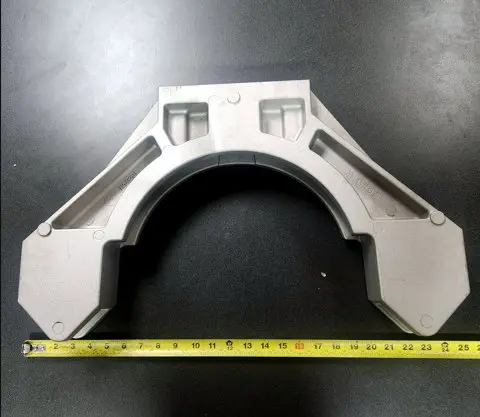
Permanent mold suits parts that need a good surface, consistent dimensions, and real mechanical properties at volumes from a few hundred to tens of thousands a year: the chunkier castings that high pressure die casters in North America usually pass on because the quantities are under 25,000, 50,000, or 100,000 a year. That is the niche Protocast is built around. Typical parts include housings and enclosures, pump and valve bodies, manifolds, brackets and structural supports, covers and end caps, heat sinks, and machine components. Protocast has served aerospace, defense, medical, industrial equipment, automotive, agriculture, and consumer product customers from Commerce City since 1995, and its permanent mold work is ITAR registered and ISO 9001:2015 certified for programs that require it. The aerospace and defense guide covers what those programs ask for.
Common defects and how they are prevented
A well-designed permanent mold program produces very consistent castings, and most problems trace to a handful of causes that are addressed before the die is cut.
| Defect | What it is | How it is prevented |
|---|---|---|
| Shrinkage porosity | Voids where a section froze without being fed | Uniform walls, risers on heavy sections, flow simulation at the quote stage; low pressure for heavy sections |
| Gas porosity | Trapped air or hydrogen | Controlled fill (tilt or low pressure), clean melt practice |
| Misrun and cold shut | Metal froze before the cavity filled or before two fronts joined | Adequate wall thickness, gating design, die temperature and coating; low pressure for thin walls |
| Hot tears | Cracks from the casting shrinking onto rigid steel | Radii on inside corners, draft, timing of ejection |
| Dimensional drift | Parts moving out of tolerance over a run | Die temperature control, coating consistency, scheduled refurbishment around 40,000 shots |
| Surface defects | Flow lines, coating marks | Mold wash practice, gating that fills without turbulence |
What drives the cost
- The die. $35,000 to $40,000 for small, simple parts, up to $200,000 for large parts with slides, most under $100,000. Judged as die cost divided by lifetime volume; see the tooling guide.
- Metal weight. The casting plus its gating, part of which is remelted. Lighter, better-designed parts cost less.
- Cycle time. Heavy sections take longer to freeze; sand cores add setting time.
- Secondary operations. Heat treatment, machining content, finishing, and testing, each quoted as its own line.
- Volume and release pattern. Steady releases run more efficiently than sporadic ones.
Why Protocast is building around permanent mold
Protocast started in 1995 as a prototype foundry, and prototype work has a rhythm to it: every job is small, every customer needs finding again, and the shop is either buried or looking for work. Permanent mold changes that. A production program on blanket order keeps the foundry steady, and a part that starts as a sand prototype here can move to a die here without changing suppliers. Protocast has been investing in permanent mold since 2019 and has kept at it: two tilt pour machines run today with a third ready to come online, and one low pressure machine runs daily with a second being brought into service. The model is simple. Sand casting and printed sand cover new product development and prototypes; a low-production sand tool feeds parts while the permanent mold die is cut over 12 to 20 weeks; then the program moves to the die and stays there.
The reason it works as a niche is that permanent mold foundries are scarce compared with high pressure die casters, and most North American die casters do not want programs under 25,000 pieces a year, or in many cases 50,000 or 100,000. Those programs are exactly what Protocast wants, and for many of them the casting is better for it: a slower, gravity or low pressure fill leaves less porosity and a more uniform grain than high pressure injection, so the part is stronger.
Terms you will see on a quote
- EAU
- Estimated annual usage: the number of pieces per year. It decides whether a part belongs in sand or permanent mold; geometry then decides tilt pour or low pressure.
- Tilt pour / gravity pour
- Filling the die by rotating it so metal enters under gravity as a controlled front.
- Low pressure (LPDC)
- Filling the die from below with a small amount of air pressure from a sealed furnace.
- Semi-permanent mold
- A permanent mold with sand cores for internal geometry.
- Mold wash
- The refractory coating applied to the die surface between shots.
- Riser
- A reservoir in the mold that feeds metal to the casting as it shrinks.
- Draft
- The taper on faces parallel to the die opening so the casting releases.
- Parting line
- Where the die halves meet; visible as a fine line on the casting.
- T6
- Solution heat treated, quenched, and artificially aged; the standard temper for 356 and 357.
- DFM
- Design for manufacturability: the review of your part for how it will cast, machine, and inspect.
- First article
- The first production-representative parts, inspected against the drawing for your approval.
How Protocast fits in
Nearly half of the staff hold engineering degrees, and the same people who review the prototype design the die. Permanent mold dies are cut in Protocast’s own tool room whenever possible, and the customer owns them. The die room, the heat treat furnace, the machine shop, and the CMM are in one 55,000 square foot building, so a permanent mold part never leaves the property between the pour and the shipping dock. Tilt pour and low pressure both run in house, so the fill method is chosen for the part rather than for the machine that happens to be free.
Frequently asked questions about permanent mold casting
What is permanent mold casting?
A casting process that pours molten metal into a reusable steel mold, either by gravity (tilt pour) or by low pressure from below. The mold is used for tens of thousands of castings instead of once.
What is the difference between permanent mold casting and die casting?
Both use steel tooling. High pressure die casting injects metal at very high pressure with much more expensive tooling and larger minimum volumes; the parts look crisp but carry a skin over a core that can be porous, and they generally cannot be heat treated. Permanent mold fills by gravity or low pressure, leaves less porosity and a more uniform grain, is heat treatable and weldable, and makes sense at far lower volumes. Tolerances and surface finish sit between sand casting and high pressure die casting.
What is the difference between permanent mold casting and sand casting?
Sand casting makes a new mold for every part from an inexpensive pattern, so tooling is low and per-part cost is higher. Permanent mold uses one steel die for tens of thousands of parts, so tooling is higher and per-part cost falls with volume, with a better finish and better properties.
What volume makes sense for permanent mold?
From roughly 300 to 500 pieces a year, where it starts to cost less than sand casting, up to about 50,000 a year, with more possible. Tilt pour and low pressure cover the same range; the part decides which. Below a few hundred a year, precision sand or printed sand is usually the better answer.
What does permanent mold tooling cost?
Small, simple parts start around $35,000 to $40,000. Large, complex parts with slides for undercuts can reach $200,000. Most tools Protocast quotes are under $100,000, and the customer owns the die.
Is permanent mold a form of die casting?
In a sense, yes. Both use a steel die; permanent mold fills it by gravity or low pressure instead of high pressure injection. Buyers who search for die casting with a part at 25,000 pieces a year or fewer are usually looking for permanent mold without knowing the name.
What is the expected tool life of permanent mold tooling?
Approximately 40,000 shots before refurbishment.
What tolerances can I expect with permanent mold casting?
Protocast follows the Aluminum Association Standards for Aluminum Sand and Permanent Mold Castings. Tighter tolerances are achieved by machining, which is done in house.
What is the typical surface finish for permanent mold casting?
Typically 125 to 250 rms.
What is the minimum wall thickness for permanent mold castings?
Typically 0.125 inch, but exceptions are possible depending on geometry.
What are typical lead times for permanent mold samples?
Typically 12 to 20 weeks for raw castings from a new die. Add 1 to 2 weeks for secondary machining. Contingent on part geometry and current workload.
What metals can be permanent mold cast?
Protocast pours aluminum alloys, principally 356 and 357, and zinc. It is a non-ferrous foundry and does not pour steel or iron.
Can permanent mold castings be heat treated and welded?
Yes. Because the die is filled without high pressure turbulence, the castings are sound enough to be solution treated to T6 and weld repaired where the specification allows.
Who cuts your permanent mold tools?
Protocast cuts them in its own tool room whenever possible. Domestic tooling partners are used when the shop is at capacity or a design calls for it.
Send the model. Get a quote with engineering feedback.
Have a part that is ready for production volume? Send the model and the annual quantity and we will quote it in permanent mold with DFM feedback.
- Engineering review with every quote
- Flow simulation before tooling is cut
- Cast, heat treated, machined, and inspected in one building
- Permanent mold tooling cut in house whenever possible
