
Aluminum Alloys for Permanent Mold: 356 vs. 357
Most aluminum permanent mold castings are poured in one of two alloys, and the choice is simpler than the data sheets make it look. 356 is the workhorse. 357 is the same family with more magnesium and tighter chemistry, and it trades a little castability for meaningfully higher strength.
The two alloys
Both are aluminum-silicon-magnesium casting alloys with about 7 percent silicon. The silicon is what makes them flow well and resist hot cracking, which is why they are the standard for permanent mold work. Magnesium is what makes them heat treatable: the T6 treatment dissolves magnesium silicide into the aluminum, then precipitates it in a controlled way to harden the metal.
- 356.0 carries 0.20 to 0.45 percent magnesium. It is the general purpose choice: excellent castability, good ductility, good corrosion resistance, and strength that suits the large majority of parts.
- 357.0 carries 0.45 to 0.60 percent magnesium with a tighter iron limit. More magnesium means more strengthening precipitate after heat treatment, so higher tensile and yield strength, at the cost of a little ductility and a slightly narrower process window.
You will also see A356 and A357 on drawings. The “A” versions are the same alloys with tighter chemistry limits (less iron in A356, a beryllium addition in A357), which makes them more stringent to produce and more expensive. Protocast pours 356 and 357 wherever the application allows, and the A versions only when a drawing requires them.
The numbers
These are the Aluminum Association minimums for the two alloys. Permanent mold carries higher minimums than sand for the same alloy because the steel die cools the metal faster and refines the grain, and typical test results run above the minimums in both processes.
| Property | 356.0-T6, sand cast | 356.0-T6, permanent mold | 357.0-T6, permanent mold |
|---|---|---|---|
| Tensile strength, ultimate (minimum) | 30,000 psi | 33,000 psi | 45,000 psi |
| Tensile strength, yield (minimum) | 20,000 psi | 22,000 psi | Not specified |
| Elongation (minimum) | 3.0 percent | 3.0 percent | 3.0 percent |
| Density | 2.68 g/cc (0.097 lb/cubic inch) | ||
| Magnesium | 0.20 to 0.45 percent | 0.45 to 0.60 percent | |
| Silicon | 6.5 to 7.5 percent | ||
| Iron, maximum | 0.6 percent | 0.15 percent | |
| T6 heat treatment | Solution treat near 1,000 F, water quench, then age at roughly 310 to 340 F for a few hours; Protocast runs it in house | ||
Aluminum Association Standards for Aluminum Sand and Permanent Mold Castings. Not for design; use your drawing specification and test bars from your own castings.
When 356 is the right call
Almost always, unless a specification says otherwise. It is the more forgiving alloy to cast, which means fewer defects in complex geometry, thin walls fill more reliably, and heat treatment is less sensitive to timing. It welds and machines well and it anodizes acceptably. For pump housings, brackets, covers, manifolds, enclosures, and most industrial and commercial parts, 356-T6 delivers more strength than the design uses.
When 357 is worth it
Choose 357 when the part is strength-limited and you would otherwise add wall thickness or weight to make 356 work, or when the customer’s specification calls for it. Aerospace and defense drawings often do, because 357 has a long history in structural castings and its tighter chemistry gives more consistent properties. The practical trade-offs: it is a little less tolerant of thin, complex geometry, it needs the heat treatment done right, and premium chemistry costs more per pound. On a highly loaded part those costs are small next to the weight saved.
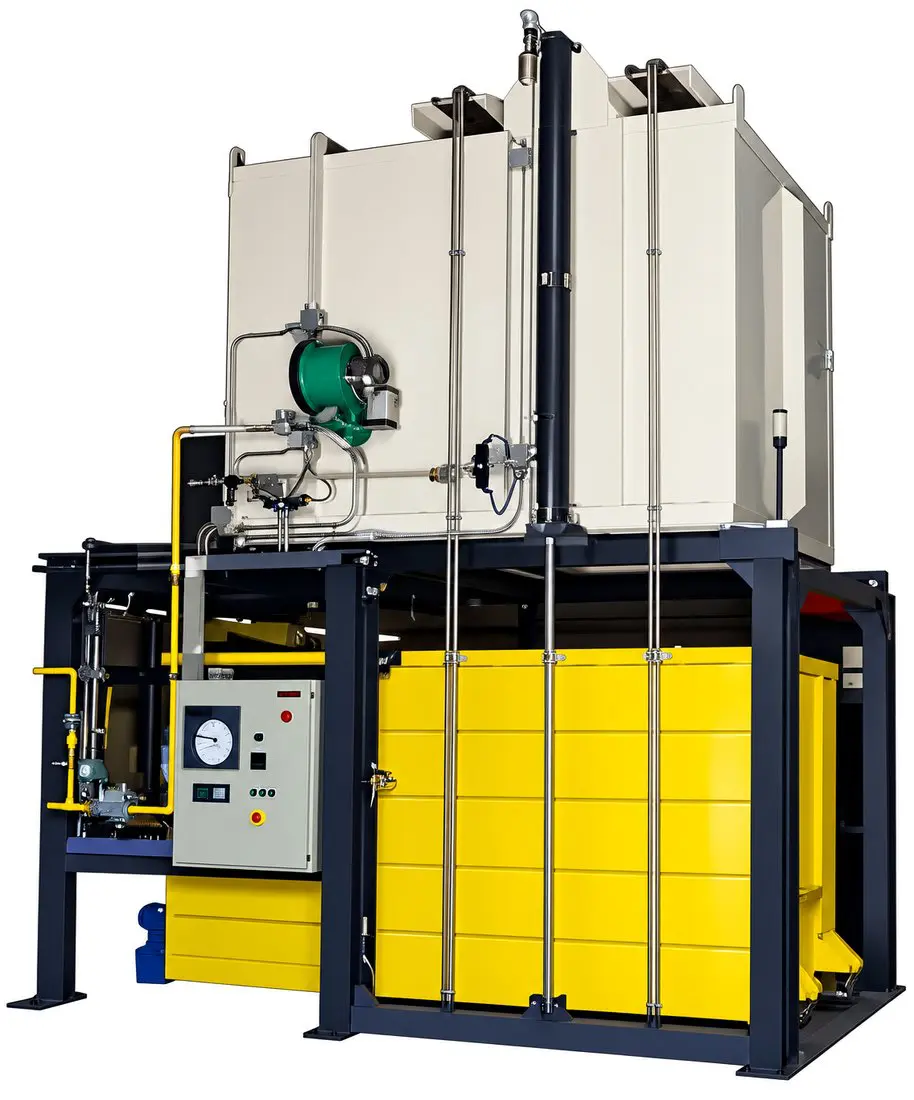
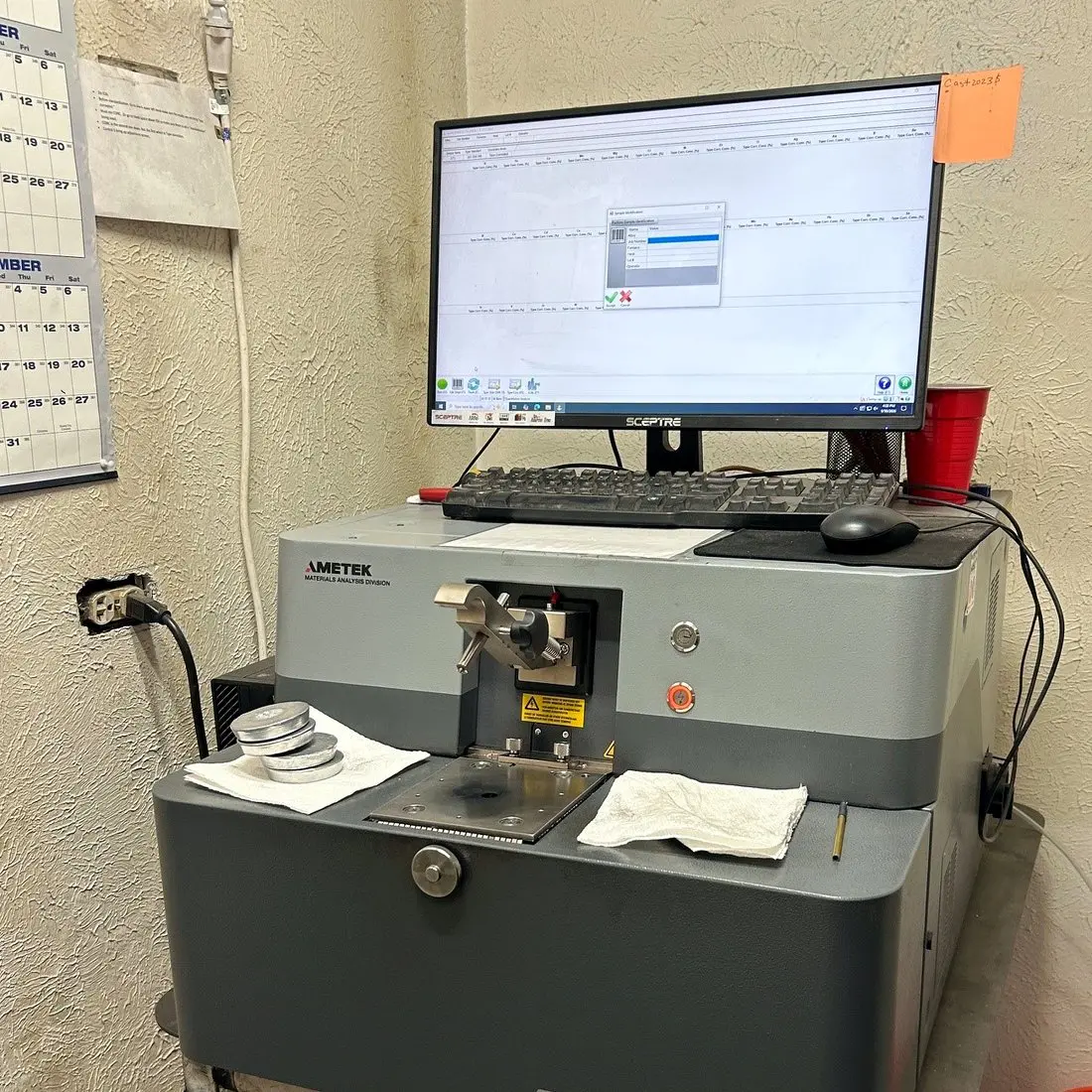
Left: the bottom-drop T6 furnace with its quench tank. Right: the in-house spectrometer that verifies alloy chemistry.
Heat treatment: where the strength comes from
Neither alloy reaches its published strength as cast. The T6 treatment is a solution soak near 1000 F, a quench, and an aging cycle at a few hundred degrees. Protocast runs this in house on a bottom-drop furnace that handles parts up to 48 by 48 by 60 inches and can take most aluminum castings to T6 in 2 to 3 days from receipt, often overnight. Doing it in the same building as the foundry and the machine shop means the schedule is not waiting on a truck.
Reading a property table
The figures in the Aluminum Association standards carry two words that matter. “Minimum” means every properly produced casting should meet or exceed the number; design to minimums. “Typical” means an average from test bars and will not be met by every casting. For 356.0-T6 the sand cast minimums are 30,000 psi tensile, 20,000 psi yield, and 3 percent elongation; in permanent mold they rise to 33,000, 22,000, and 3 percent. The tighter-chemistry A versions carry higher minimums still (A356.0-T61 permanent mold is listed at 37,000, 26,000, and 5 percent), which is what the premium buys and why a drawing should only call for them when the design needs them. Separately cast test bars usually run higher than properties cut from a casting’s heavy section. If a specification calls for properties from designated areas of the casting, say so at the quote so the gating and heat treatment are designed for it.
Other alloys Protocast pours
| Alloy | Where it fits |
|---|---|
| 356.0 | The default for permanent mold and sand: castability, ductility, corrosion resistance, T6 strength for most parts |
| 357.0 | Strength-critical parts; aerospace and defense specifications; higher tensile and yield |
| Zinc alloys | Small, detailed, thin-wall parts that do not need heat treatment; good hardness and dimensional stability; property tables on the Zinc alloy page |
Protocast is a non-ferrous foundry. Steel, iron, and stainless are not poured. Other aluminum alloys can be discussed on request.
Heat treatment tempers, briefly
As cast (F) means no heat treatment. T5 is aging only, without a solution treatment, and gives a modest increase in strength. T6 is solution treated, quenched, and artificially aged for full strength; it is the standard for 356 and 357 and what Protocast runs. T7 is over-aged for dimensional stability at the cost of some strength and is specified when a part sees elevated temperature in service. If a drawing says T6, the casting is heat treated; if it says nothing, ask, because an untreated 356 casting has a fraction of the strength the alloy is known for.
How Protocast fits in
Protocast is a non-ferrous foundry, and aluminum is about 85 percent of what it pours; zinc is offered for the small, detailed parts that suit it. 356 first, 357 second, and other alloys on request. Chemistry is checked by sparking the casting on an in-house spectrometer, and tensile test bars are cast with your parts and tested when a program requires certified properties. If the drawing does not specify an alloy, the quote will recommend one and say why.
Frequently asked questions about 356 and 357
Is 357 much harder to cast than 356?
Not much, but it is less forgiving. Thin, complex geometry and tight heat treatment timing matter more with 357. In a permanent mold with proper gating both alloys cast well.
Can I switch from 356 to 357 without changing the die?
Usually yes. Shrinkage behavior is similar. Gating may need a small adjustment, and heat treatment parameters change.
Do permanent mold castings really test higher than sand castings in the same alloy?
Yes. Faster cooling in the steel die produces a finer structure, so permanent mold 356-T6 typically shows higher tensile and yield strength and better elongation than the sand cast minimums.
What about zinc?
Protocast also pours zinc alloys, which suit thin-wall, high-detail parts that do not need heat treatment. Ask when the part is small, detailed, and not weight critical.
What temper should I specify?
T6 for nearly all 356 and 357 structural parts. T5 where a small strength increase without a solution treatment is enough. T7 where dimensional stability at temperature matters more than peak strength.
Does the alloy affect the surface finish?
Not meaningfully. Finish comes from the mold. Anodized appearance does vary with silicon content; both 356 and 357 anodize to a gray tone.
Can you certify chemistry?
Yes. Chemistry is verified on an in-house spectrometer and a certification can be provided with the shipment.
Send the model. Get a quote with engineering feedback.
Not sure which alloy your part needs? Send the drawing and the load case, and the quote will come back with a recommendation.
- Engineering review with every quote
- Flow simulation before tooling is cut
- Cast, heat treated, machined, and inspected in one building
- Permanent mold tooling cut in house whenever possible
