
Tilt Pour vs. Low Pressure: Which Permanent Mold Process Fits Your Part
Both processes pour aluminum into a steel die. The difference is how the metal gets there, and that one difference decides which parts each process makes best. It does not decide the volume: at Protocast the two processes share the same annual quantity range, and the part itself picks the process. This guide puts the two side by side so the decision is made on geometry, not on the name.
How each one fills
Tilt pour. The die starts near horizontal. Metal is ladled into a pouring basin, and the machine rotates the die toward vertical so the metal runs into the cavity in a smooth, controlled front. Gravity does the work. Protocast runs two production tilt-pour machines that clamp, tilt, open, and eject automatically, with a third ready to come online.
Low pressure. The die sits above a sealed, heated holding furnace. A small amount of air pressure, typically 0.3 to 0.7 bar or about 4 to 10 psi, pushes metal up a riser tube into the cavity from the bottom. The fill is slow and free of turbulence, and the pressure is held while the casting solidifies so metal keeps feeding shrinkage from below. Protocast runs one low pressure machine daily, in house, with a second being brought into service.
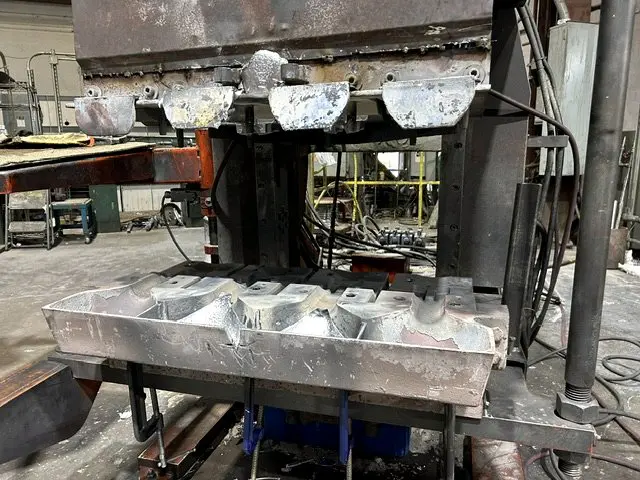
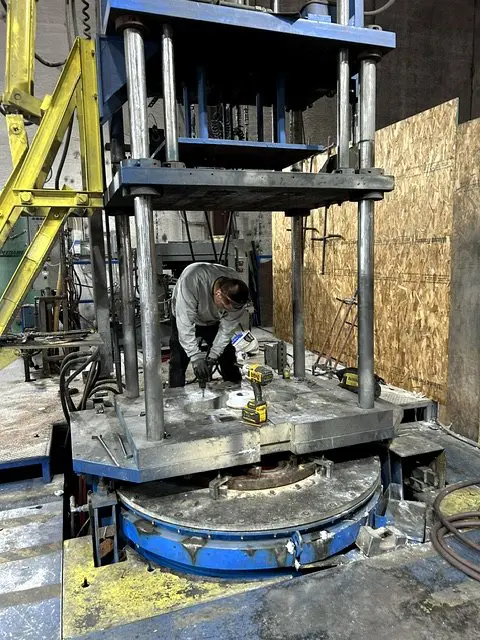
Left: a tilt pour die opening after the shot. Right: a low pressure machine, with the pressurized holding furnace sitting under the die.
What the fill method changes
| Tilt pour (gravity) | Low pressure | |
|---|---|---|
| Annual volume range | The same: roughly 300 to 500 pieces a year at the low end, 50,000 and more at the high end | |
| What decides it | Thicker walls and heavier sections that gravity fills well | Thinner walls that need pressure to fill |
| Typical rate | About 50 pieces an hour | About 40 pieces an hour |
| Piece price | Comparable; slightly lower on parts suited to gravity | Comparable; slightly higher because of the slower cycle |
| Heavy sections | Fed by risers in the die | Fed by pressure from below |
| Pressure tightness | Good with proper gating | Better; non-turbulent fill means less entrained air |
| Yield (metal poured vs. part) | Gating and risers are cut off and remelted | Higher; little gating, and the riser tube drains back |
| Tooling | Die designed for gravity fill | Die designed for bottom fill over the furnace |
| Surface finish | 125 to 250 rms in both | |
| Tool life | About 40,000 shots in both before refurbishment | |
Typical figures for Protocast. Geometry and workload move them.
Choose tilt pour when
- Wall sections are thicker and reasonably uniform, so gravity alone fills the cavity cleanly.
- The part is a bracket, cover, housing, or structural piece without large thin areas.
- Cycle rate matters: about 50 pieces an hour on a part that suits it.
Choose low pressure when
- The part has thin walls over a large area that gravity would not fill before the metal froze.
- A heavy boss or flange needs continuous feed to stay sound.
- The part must hold pressure or fluid, or will be x-rayed.
- The drawing calls for low pressure die casting; the term describes this process, not high pressure.
What neither of them is
High pressure die casting injects metal at very high pressure into a die built for it, with much higher tooling cost and much larger minimum volumes. It makes thin, detailed parts fast, and the parts look crisp, but the fast turbulent fill leaves a dense skin over a core that can be porous, so the castings generally cannot be heat treated or welded and have lower mechanical properties. Tilt pour and low pressure both produce heat treatable, weldable castings with good properties at volumes far below where high pressure die casting makes sense. Protocast also offers high pressure die casting for programs that need it; this hub covers the permanent mold processes.
Two parts, two answers
Hand Protocast a part and ask for a permanent mold quote, and the first thing the engineers look at is the walls. A beefier part with thicker sections is a tilt pour part: gravity alone fills it cleanly, the machine runs about 50 pieces an hour, and the piece price reflects that. A part with thinner walls is a low pressure part: it needs pressure from below to fill those walls before they freeze, the cycle is closer to 40 an hour, and the piece price is a little higher. Nothing about the annual quantity enters into it. Both processes cover the same range.
When a part could be made either way, the answer is the process that is most economical for the customer, because that is also the quote most likely to win the work. Most parts are clear-cut once the geometry is on the table; for the ones that are not, the simulation settles it.
What the simulation looks at
Flow simulation models the metal entering the cavity and shows where the front slows, where it might freeze short, and where air could be trapped. Solidification simulation shows the order in which sections freeze and where shrinkage will land if a section is not fed. For a borderline part, the simulation is run both ways, as a tilt pour with risers and as a bottom fill under pressure, and the comparison usually makes the decision obvious. Protocast runs this at the quote stage on most parts, before any steel is cut.
How the costs compare
Pricing between the two processes is fairly similar. Tilt pour runs a little faster, about 50 pieces an hour on a part that suits it, so the piece price is slightly lower. Low pressure runs closer to 40 an hour, so the piece price is slightly higher, and in return it makes parts gravity cannot. Tooling for either is a hardened steel die in the same cost range. The mistake is choosing on price alone: a thin-walled part quoted in tilt pour to save a little per piece will scrap its way back to low pressure.
How Protocast fits in
Because both processes run on Protocast’s own machines, the recommendation is made on the part rather than on which machine is free. Send the model with the annual quantity and the walls you are concerned about, and the quote will recommend a fill method and say why. If a part could be made either way, the quote goes with the process that is most economical for you.
Frequently asked questions about tilt pour and low pressure
Can the same die run on both processes?
No. A low pressure die is designed for bottom fill and mounts over the furnace. A tilt pour die has a pouring basin and gating for gravity. A part can move from one to the other with a new die.
Is low pressure always better quality?
Not always. For thicker sections, tilt pour produces excellent castings at a slightly lower piece price. Low pressure earns its slower cycle on thin walls, heavy sections, and pressure-tight parts.
Does low pressure mean lower strength?
No. Low pressure refers to the gentle fill, not the properties. Both processes produce castings that are heat treated to T6 and test to the same alloy specifications.
Does volume decide between tilt pour and low pressure?
No. Both cover the same range at Protocast, from a few hundred pieces a year to 50,000. Part geometry, weight, and wall thickness decide.
Can a part start in tilt pour and move to low pressure?
Yes, with a new die designed for bottom fill. The model, alloy, heat treatment, and machining fixtures carry over.
Is one process faster to get samples from?
Both are 12 to 20 weeks for first samples from a new die at Protocast. A low pressure die may take slightly longer to try out because the pressure ramp is tuned along with the gating.
Which process has less scrap?
On parts that suit gravity, both are low. On thin-wall or pressure-tight parts, low pressure’s controlled fill typically gives lower scrap, which is part of its economics at volume.
Send the model. Get a quote with engineering feedback.
Have a part on the line between the two? Send it and let the flow simulation make the call.
- Engineering review with every quote
- Flow simulation before tooling is cut
- Cast, heat treated, machined, and inspected in one building
- Permanent mold tooling cut in house whenever possible
