
Die Casting vs. Permanent Mold: Which Process Does Your Part Need?
Many buyers send an RFQ for “die casting” when what they need is a permanent mold casting. Both processes use a steel die, so the confusion is understandable, but they fill that die in very different ways, and the difference shows up in the part, the tooling bill, and the volume where each one makes sense. This guide explains how to tell which one your part needs before you send the drawing.
Same steel die, different fill
High pressure die casting (HPDC) forces molten metal into a closed die at high velocity and pressure. The cavity fills in a fraction of a second and the part freezes almost immediately. That speed is what makes the process so productive at high volume, and it is also what traps air: the metal arrives so fast that gas has nowhere to go.
Permanent mold fills the die gently. In tilt pour, the die rotates so the metal enters as a smooth front under gravity. In low pressure, metal rises into the die from a sealed furnace below at a controlled rate, and pressure is held while the casting freezes. Either way, the fill is quiet, and the casting that comes out is dense through the wall.
When a buyer says “die casting,” it is worth asking which of these they mean. In the industry, “gravity die casting” and “low pressure die casting” are other names for permanent mold. “Die casting” on its own usually means high pressure.
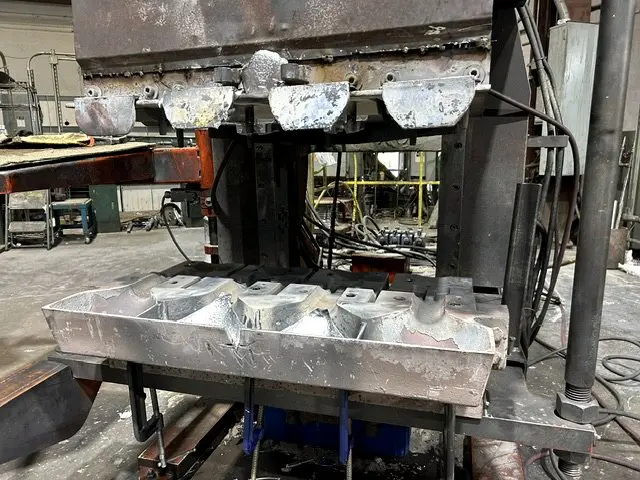
A tilt pour die at Protocast opening after the shot. Permanent mold uses a steel die like die casting, but fills it by gravity or low pressure.
How the two compare
| Permanent mold (tilt pour or low pressure) | High pressure die casting | |
|---|---|---|
| How the die fills | Gravity or low pressure, quiet fill | High velocity injection |
| Typical annual volume | From roughly 300 to 500 pieces a year up to 50,000 to 75,000 | Most North American die casters look for well above 100,000 |
| Internal soundness | Dense, low porosity | Entrapped gas porosity is common |
| Heat treatment | Heat treatable to T6 | Generally not heat treated; trapped gas can blister |
| Weldability | Weldable | Limited by porosity |
| Minimum wall | Typically 0.125 inch; low pressure down to about 0.060 inch in some areas, depending on span | Thinner walls possible |
| Tolerances and finish | Tighter than sand, broader than die casting; 125 to 250 rms as cast | Tightest of the casting processes; smoothest finish |
| Tooling | Steel die, $35,000 to $200,000, most under $100,000; customer owned | Usually costs more and takes longer to build |
| Typical alloys | 356 and 357 aluminum | Die casting alloys such as A380 |
Typical figures for Protocast permanent mold. Part size, geometry, and requirements move them.
Why permanent mold parts are stronger
Strength in a casting comes from two things: a sound structure with few voids, and a fine grain. Permanent mold gives you both. The quiet fill keeps gas out, the steel die pulls heat out quickly to refine the grain, and because the casting is sound, it can be solution treated and aged to the T6 condition. A 356 permanent mold casting in T6 has a published minimum tensile strength of 33,000 psi, and 357 reaches 45,000 psi. The 356 vs. 357 guide has the full table.
A high pressure die casting is fast and precise, but the gas trapped during injection stays in the part. Heat treating at solution temperature makes that gas expand, which is why die castings are usually used as cast. If the part needs to be heat treated, welded, or held to a pressure test, that porosity matters.
Where high pressure die casting is the right call
Die casting earns its place when the volume is high enough to spread the tooling cost over a very large number of parts, the walls are thin, and the part will be used as cast. Consumer products, small enclosures, and high-volume housings are typical. Protocast offers high pressure die casting for programs that fit that profile, and the quote will say plainly when a part is better suited to die casting than permanent mold.
Where permanent mold is the better value
- Volumes from a few hundred to 50,000 to 75,000 a year. Most high pressure die casting shops will not quote a part below about 20,000 a year. A part at 25,000 to 50,000 a year fits permanent mold well. The per-part price also drops well below sand once volume is steady.
- Parts that need strength. Structural brackets, housings under load, and anything specified in T6.
- Pressure-tight parts. Manifolds, valve bodies, and pump housings. See pressure-tight castings.
- Parts that will be welded or machined heavily. Machining into a die casting can open subsurface porosity; a permanent mold casting is sound below the skin.
- Heavier sections. Thick walls and heavy bosses feed well in tilt pour and low pressure.
Tolerances: what to expect
Permanent mold holds tighter tolerances and a better finish than sand casting, but it does not hold die casting tolerances. Protocast works to the Aluminum Association standards: plus or minus 0.015 inch for the first inch on a permanent mold casting, plus 0.002 inch for each inch after that. Sand castings start at plus or minus 0.030 inch for the first inch. Features that need tighter control are machined, and Protocast machines castings in house on CNC equipment. Put the tolerances and surface finish you actually need on the drawing, so the quote reflects the real requirement rather than a general one.
How Protocast fits in
Protocast runs tilt pour and low pressure permanent mold in house in Commerce City, Colorado, cuts its permanent mold dies in its own tool room whenever capacity allows, heat treats to T6 on site, and machines the finished castings under one roof. High pressure die casting is offered for parts that call for it. When you send a drawing, the quote comes back with a recommendation on process, not just a price, and flow simulation on most parts before any tooling is cut.
Frequently asked questions
Is gravity die casting the same as permanent mold casting?
Yes. Gravity die casting, tilt pour, and permanent mold are names for the same process: a reusable steel die filled under gravity. Low pressure die casting is the same family, filled from below under low pressure.
Is die casting cheaper than permanent mold?
Per part at very high volume, often yes. Overall, it depends on volume. Die casting tooling usually costs more, so at a few hundred to tens of thousands of parts a year, permanent mold is often the lower total cost.
Can die castings be heat treated?
Generally not to T6. Gas trapped during high pressure injection expands at solution temperature and can blister the part. Permanent mold castings are sound enough to heat treat routinely.
Can I move a part from die casting to permanent mold?
Often, yes. Most die cast designs need some changes for permanent mold, usually slightly thicker walls and more draft. Permanent mold usually needs 1 to 3 degrees of draft. Send the model and Protocast’s engineering review will point out what would need to change.
Does Protocast offer high pressure die casting?
Yes. Die casting is offered for programs where it is the better fit, typically very high volumes of thin-walled parts used as cast.
Send the model. Get a quote with engineering feedback.
Not sure whether your part is a die casting or a permanent mold casting? Send the model and the annual volume, and the quote will recommend the process and explain why.
- Engineering review with every quote
- Flow simulation before tooling is cut
- Cast, heat treated, and machined in one building
- Permanent mold tooling cut in house whenever possible
