
Permanent Mold vs. Sand Casting: When Production Volume Justifies the Tooling
Sand tooling is cheap and permanent mold tooling is not, yet at the right volume the steel die is the less expensive path. Most production programs at Protocast start in sand and move to permanent mold, and the question is always the same: when? This guide walks through where the crossover sits, what changes in the part, and how to make the move without re-engineering.
How each process works
Sand casting packs a fine, resin-bonded sand around a pattern to form a mold. The mold is poured once and broken away from the casting, so every part needs a fresh mold. The pattern itself, cut from urethane modeling board, is inexpensive and fast to make, which is why Protocast can turn a first sand casting in days. Printed sand molds take this further: the mold is printed directly from the CAD file with no pattern at all.
Permanent mold casting replaces the sand with a machined steel die. Metal is poured in by tilting the die (tilt pour, also called gravity pour) or pushed up into it from below (low pressure). The die opens, the casting is ejected, and the die is ready for the next shot. Making that die is the cost. Using it is cheap.
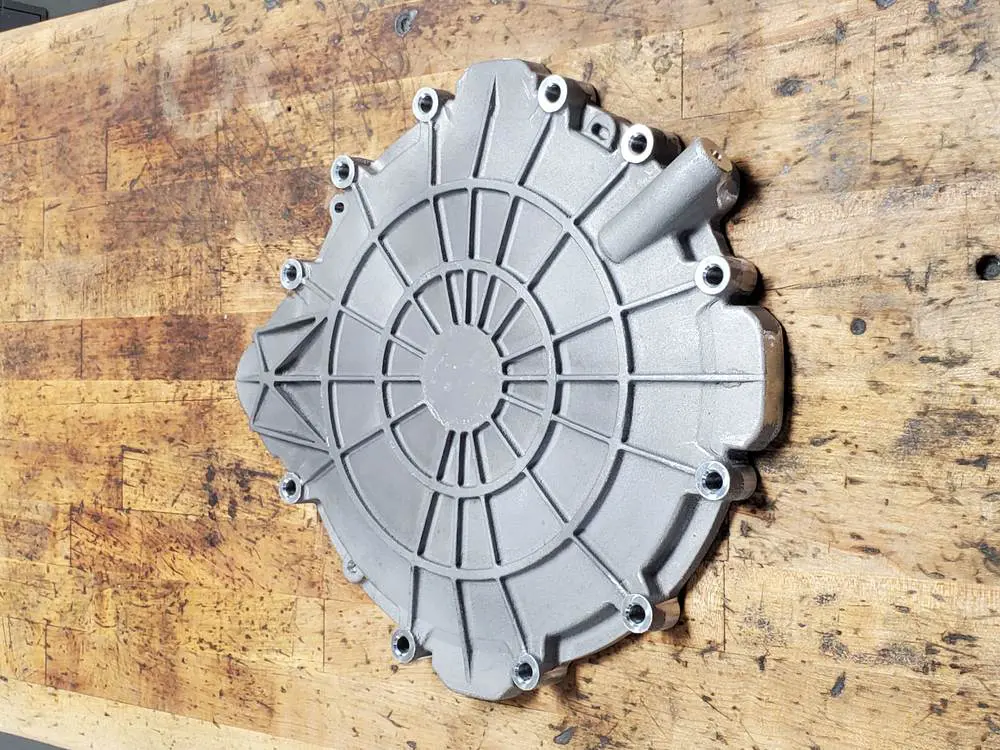
A permanent mold housing. The finish and dimensional repeatability come from the steel die.
Where the crossover happens
Think of the total cost of a program as tooling plus per-part cost times quantity. Sand tooling is small and the per-part cost is flat, because each mold is made by hand. Permanent mold tooling is a real capital expense, but each shot costs less because the mold work is gone.
Plot the two lines and they cross. Below the crossover, sand is cheaper. Above it, permanent mold is cheaper, and the gap widens every year the program runs. Protocast’s rule of thumb is that the crossover lands around 300 to 500 pieces a year, and permanent mold stays the right answer up to about 50,000 a year in either tilt pour or low pressure. Three things move the line:
- Part size and complexity. A big, complex die costs more, so the crossover moves up. A small, simple die moves it down.
- Machining content. Permanent mold parts come out closer to net shape with a better surface, so machining time drops. On heavily machined parts that saving alone can justify the die.
- Program life. A die good for about 40,000 shots before refurbishment, spread over a multi-year program is a small line item per part. The same die for a one-time run of 800 pieces is not.
How the two processes compare
| Sand casting | Permanent mold | |
|---|---|---|
| Tooling | Pattern in modeling board; low cost, fast | Machined steel die; $35,000 to $200,000, cut in house whenever possible |
| Tool life | About 500 pieces per pattern | About 40,000 shots before refurbishment |
| Sweet spot | Prototypes and short runs; large parts | Roughly 300 to 50,000 pieces a year |
| Surface finish | 350 to 450 rms | 125 to 250 rms |
| Minimum wall | Typically 0.160″ | Typically 0.125″ |
| Tolerances | Both follow the Aluminum Association Standards; permanent mold holds them more consistently part to part | |
| Sample lead time | Typically 4 to 6 weeks (rapid options in days) | Typically 12 to 20 weeks for first samples |
| Mechanical properties | Good; best for thick sections | Better; faster cooling in steel gives a finer grain |
| Design changes | Easy; modify or recut the pattern | Costly; freeze the design first |
Typical figures. Geometry, draft, radii, and workload move every one of them.
When is sand casting still the right call?
- The design is not frozen. Changing a pattern is a small job. Changing a steel die is not.
- You need parts in days, not months. Precision sand and printed sand both get to a first casting long before a die can be cut.
- Low volume. Under a few hundred pieces a year, the die never pays back.
- Large or thick-walled parts. Sand supports bigger castings and heavier sections; printed sand molds go up to roughly 70″ x 39″ x 27″.
- Complex internal geometry. Printed sand handles cores and undercuts that a steel die cannot pull out of, including shapes that used to require investment casting.
When does permanent mold win?
- Volume with a future. A few hundred pieces a year or more, over more than one year.
- Finish and cosmetics matter. The steel die gives a smoother, more uniform surface straight out of the mold.
- Repeatability matters. Every shot comes from the same cavity, so dimensions and machining stock stay consistent across thousands of parts.
- Strength matters. Faster solidification in steel gives permanent mold parts better mechanical properties than the same alloy in sand, and they heat treat well.
- Thin walls. Low pressure permanent mold fills walls that sand and gravity struggle with.
The typical path: prototype in sand, produce in permanent mold
This is the prototype-to-production model Protocast is built around. The first parts are cast in precision sand or printed sand while the design settles. Engineering reviews the casting for draft, radii, wall thickness, and gating with a permanent mold die in mind, so the eventual move does not require a redesign. Once the design is frozen and volume is confirmed, the die is cut, first samples are run, and the program transitions with the same alloy, the same heat treat, and the same machining fixtures already proven on the sand parts.
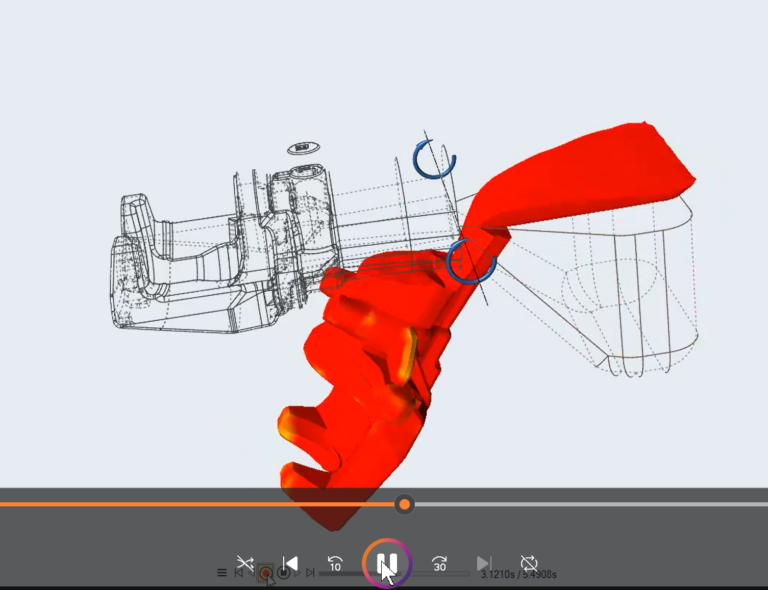
Flow simulation is run on most parts at the quote stage, which is where the sand-to-permanent-mold conversation usually starts.
How it went for one medical cart program
A medical device company came to Protocast with five new castings for a cart and an order for 14 prototype sets. Protocast cut five sand tools at about $10,000 each, cast and machined the parts, and the customer built and tested its prototype machines. A few months later the order was 50 sets, then 200, each time off the same sand tools. That is also where sand casting runs out of road: every casting still needs its own mold, its own resin, and its own cleanup, so the part price stayed in the $250 to $600 range no matter how many were ordered.
When the customer came back ready to commit to 1,500 sets, the conversation turned to permanent mold. Dies for the five parts ran $50,000 to $80,000 each, and the cast and machined part price came down to roughly $100. At a few hundred dollars saved per part, the tooling paid for itself within the first thousand or so pieces. The program has run at around a thousand parts a year since; it never reached 5,000 a year, and it never needed to for the die to make sense.
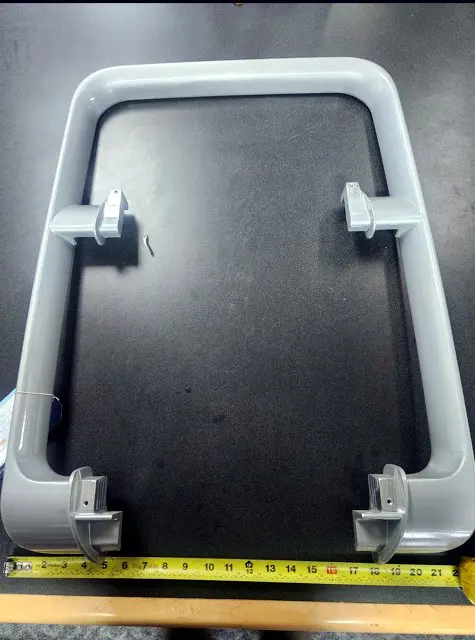
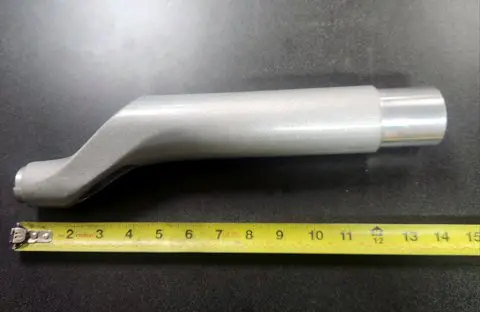
Two of the cart parts in production: the handle, tilt pour permanent mold at about 20 lb, and the monitor tube, low pressure permanent mold at about 2 lb.
What changes in the part itself
The move is not only about cost. The casting that comes out of a steel die is a different object from the one that came out of sand, and the drawing should expect that.
- Mechanical properties improve. Faster cooling in steel refines the grain. Permanent mold 356-T6 typically tests above the sand cast minimums in tensile strength, yield, and elongation.
- Surface improves. From 350 to 450 rms in sand to 125 to 250 rms in permanent mold, which can eliminate finishing operations and reduce machining stock.
- Dimensions tighten and repeat. Sand molds move a little; steel does not. Flatness, concentricity, and feature location hold better and, more importantly, hold the same across thousands of parts.
- Minimum wall drops. From about 0.160 inch in sand to about 0.125 inch in permanent mold.
- Design flexibility drops. Draft becomes mandatory, sharp inside corners are out, and internal passages need sand cores in the die (semi-permanent mold) or a redesign to straight pulls.
Mistakes to avoid at the transition
- Cutting the die before the design is frozen. The most expensive mistake in permanent mold. Prove fit and function in sand first.
- Prototyping in sand without permanent mold rules. A sand prototype with no draft and sharp corners proves the function but not the manufacturability. Design the prototype for the die from the start.
- Ignoring machining stock. Permanent mold parts come closer to net shape; the drawing should take advantage of it rather than carrying sand-era stock allowances.
- Forgetting heat treatment and testing. Both are the same as in sand, but they need to be in the quote so first samples are run to the full specification.
- Comparing piece price alone. Compare total program cost: tooling plus piece price times volume, over the years the program will run.
How Protocast fits in
Ask for both quotes early. Knowing the permanent mold price during the prototype stage lets you make the volume decision with real numbers instead of guessing, and because Protocast runs both processes, the move from one to the other does not mean a new supplier, a new alloy, or a new machining setup.
Frequently asked questions about sand versus permanent mold
Can a part designed for sand casting move to permanent mold without changes?
Often, but not always. Draft angles, radii, and wall thickness minimums are slightly different, and the gating is designed differently. If the sand casting was reviewed with permanent mold in mind, the move is usually straightforward.
What does a permanent mold die cost?
Small, simple parts start around $35,000 to $40,000; large, complex parts with slides can reach $200,000; most tools Protocast quotes are under $100,000. Judge it as die cost divided by expected lifetime volume: on a multi-year program it is a small fraction of the part price.
Is permanent mold the same as die casting?
No. Both use steel tooling, but high pressure die casting injects metal at high pressure with much more expensive tooling and larger minimum volumes. Permanent mold fills by gravity or low pressure, delivers better mechanical properties, and makes sense at far lower volumes.
How long until first samples?
Typically 12 to 20 weeks for raw permanent mold castings, plus 1 to 2 weeks if machining is required, depending on geometry and current workload.
At what quantity does permanent mold become cheaper than sand casting?
Protocast’s rule of thumb is around 300 to 500 pieces a year. Large, complex parts push that number up; small, simple parts pull it down.
Is sand casting stronger than permanent mold casting?
No. The same alloy heat treated to the same temper is stronger in permanent mold, because the steel die cools it faster and refines the grain.
Can I run the same part in both processes at the same time?
Yes, and it is common during a transition: sand castings bridge the gap while the permanent mold die is built and qualified.
Which process has better tolerances?
Both follow the Aluminum Association Standards, but permanent mold holds dimensions more consistently from part to part, and flatness and concentricity are better.
Send the model. Get a quote with engineering feedback.
Not sure which side of the line your part is on? Send the model once and we will price it in sand and in permanent mold.
- Engineering review with every quote
- Flow simulation before tooling is cut
- Cast, heat treated, machined, and inspected in one building
- Permanent mold tooling cut in house whenever possible
