

August 5, 2026 | Protocast Inc
3D Printed Sand Casting Kentucky
Table of Contents
The Power of 3D Printed Sand Casting in Kentucky
Building on traditional sand casting methods, 3D printed sand casting eliminates the need for hard tooling entirely. As the American Foundry Society notes, sand casting is a foundational metalcasting process, but additive techniques like printed sand casting, also known as additive sand casting, and binder jetting sand molds deliver faster lead times and design freedom. This technology lets you produce complex geometries cost-effectively, even for low-volume runs–critical for Kentucky’s automotive, aerospace, and industrial sectors.
Our rapid prototype casting capabilities, supported by ISO 9001:2015 and ITAR certification, enable us to take your project from prototype to production, all under one roof. By reshoring casting projects with Protocast, you support Made in the USA manufacturing while partnering with a domestic foundry that provides multiple casting processes under one roof for complete project flexibility.
1. Eliminating Traditional Pattern Costs
3D printed sand casting offers a direct path to bypass one of metal casting’s most expensive and time-consuming barriers: the traditional pattern. According to the American Foundry Society, pattern creation can cost thousands of dollars and take weeks to produce, delaying prototyping and short-run production. By printing sand molds directly from a digital file using binder jetting sand molds, we eliminate the need for a physical pattern entirely. This patternless approach transforms rapid prototype casting–lead times shrink from weeks to days, and design iterations become digital adjustments rather than costly pattern re-cuts.
At Protocast Inc. in Commerce City, Colorado, we provide multiple casting processes under one roof, all benefiting from pattern elimination where cost and speed matter most. Our in-house engineering support and Made in the USA manufacturing empower customers to reshore their casting projects with confidence. From Prototype to Production, pattern elimination reduces upfront barriers and accelerates project timelines. Contact us to learn how our metal casting services can eliminate pattern costs for your next project, and read on to discover additional ways Protocast streamlines casting lead and cost.
2. Drastically Reducing Lead Times
Traditional sand casting relies on pattern and tooling creation, adding four to eight weeks before the first pour. In contrast, 3D printed sand casting eliminates tooling, enabling molds in days.
This additive approach — binder jetting sand molds — deposits a liquid binder layer by layer to build a sand mold directly from CAD data, bypassing tooling completely.
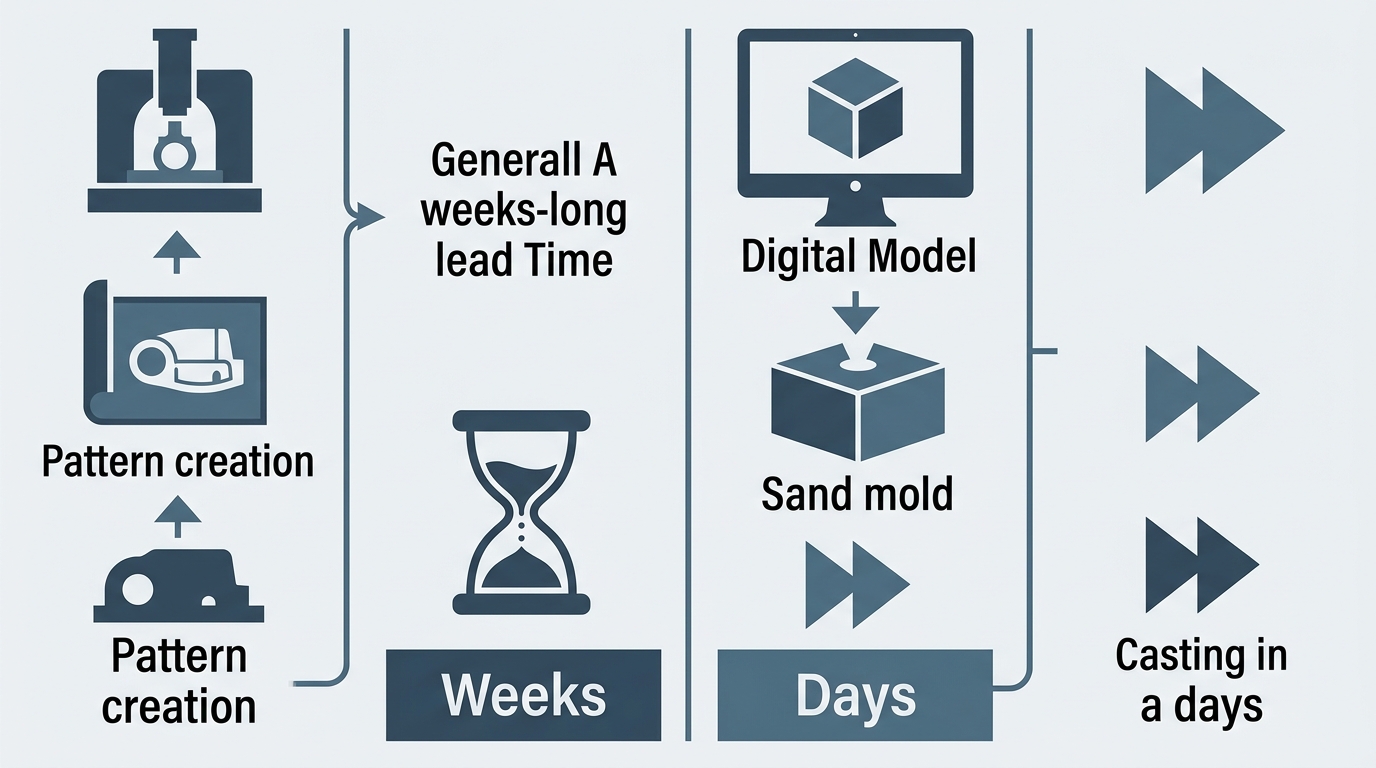
Side-by-side lead time comparison: traditional vs. 3D printed sand casting.
With rapid prototype casting, we partner with our customers to deliver functional metal castings in as little as one to two weeks. Our multiple casting processes under one roof — sand, investment, and permanent mold — eliminate inter-process shipping delays.
OEMs reshoring their casting projects with Protocast avoid overseas transit times, and our Made in the USA supply chain further shortens lead times. The ‘From Prototype to Production’ path scales initial low-volume runs to full production without tooling redesign, using the same sand casting for machine parts process. As the Society of Manufacturing Engineers notes, additive manufacturing not only cuts lead times but also improves dimensional accuracy and reduces scrap.
3. Enabling Complex Geometries
Beyond the basics, the precision sand casting process excels at producing complex geometries that enhance component performance–features like deep undercuts, thin-walled sections, and intricate internal channels. These design elements are often critical for fluid routing in aerospace manifolds or lightweighting in automotive structures. According to authoritative industry guidelines from the American Foundry Society, a well-engineered core and pattern system makes such complexity routinely achievable.
The capability is further amplified by binder jetting sand molds, an additive manufacturing approach that prints sand molds directly from 3D CAD data. This creates fully enclosed passages and consolidated cores that are impossible to produce with traditional tooling. When combined with rapid prototype casting, our engineers in the greater Denver area can iterate on these sophisticated designs quickly–validating fill, solidification, and performance before committing to production tooling.
Having investment casting, permanent mold, and die casting all under one roof means we can objectively contrast achievable complexity across methods. While investment casting offers exceptional detail, precision sand casting often delivers comparable internal intricacy for much larger components. This ‘multiple processes’ advantage is central to how we partner with our customers, guiding them From Prototype to Production with the best process for the geometry at hand.
4. Cost-Effective Low-Volume Production
The search for 3D printed sand casting in Kentucky highlights a shift toward tool-less manufacturing that we deliver. By printing binder jetting sand molds directly from a digital model, we eliminate the hard tooling expense that makes traditional low-volume runs cost-prohibitive. Rapid prototype casting then bridges the gap between design validation and short-run production — our engineers prepare print-ready molds from your CAD file and cast functional parts without a permanent tooling commitment.
The Society of Manufacturing Engineers confirms that removing tooling is a primary lever for cutting lead times and upfront investment in small batches. This philosophy anchors our precision sand casting services, where the same mold data that proves out a prototype transfers instantly to production quantities. Because we hold multiple casting processes under one roof, we can match the method to the volume and maintain a true From Prototype to Production workflow — keeping per-part economics favorable as orders scale.
5. Binder Jetting Accuracy and Repeatability
Building on the previous section, binder jetting accuracy delivers sand molds with ±0.005 in/in tolerances and fine surface finish–benchmarks set by the American Foundry Society. Compared to green sand molding, this precision reduces or eliminates secondary machining by producing near-net-shape molds from the printer.
Binder jetting repeatability ensures identical mold geometry from shot to shot, producing uniform castings across high-volume runs. This consistency eliminates manual variations, making it possible to achieve repeatable rapid prototype casting without tooling changes.
This process precision surpasses traditional sand and investment casting for complex geometries, making binder jetting the go-to method for intricate, lightweight parts. At Protocast, we leverage our in-house binder jetting sand molds as part of multiple casting processes under one roof in Commerce City, Colorado, delivering Made in the USA quality to every order.
For automotive work, that accuracy supports precision sand casting automotive parts, leading into aerospace and medical applications we’ll cover next.
6. Versatile Material Compatibility
Protocast’s multiple casting processes under one roof enable us to work with a broad spectrum of materials, giving our customers the flexibility to select the optimal alloy for their application. Industry-standard knowledge from the Society of Manufacturing Engineers (SME) confirms that matching alloy to process maximizes structural integrity and cost-efficiency. Our primary material families include aluminum alloys (356, A356, 319, 413) for sand, investment, and permanent mold casting, and zinc alloys (Zamak 3, 5, 7) for die casting and investment casting.
For rapid material validation, we utilize 3D printed sand casting via binder jetting sand molds to produce complex geometries in hours, enabling rapid prototype casting with the same alloys used in production. This accelerates testing while eliminating tooling costs. As a Made in the USA foundry, all processes are ISO 9001:2015 and ITAR certified, ensuring consistent quality. We also offer CNC machining, welding, and part modification services for post-casting adjustments.
7. Seamless Transition to Production
From Prototype to Production, we ensure a smooth and logical scale-up by leveraging the industry’s broadest suite of casting processes all housed under a single roof. The American Foundry Society recognizes that consolidating multiple casting methods with one domestic partner dramatically reduces the risk and administrative complexity typically encountered when a project moves from low-volume validation to serial manufacturing. By maintaining sand, investment, permanent mold, and die casting capabilities in Commerce City, Colorado, we eliminate the delays and quality disconnects that occur during a multi-vendor handoff.
Our engineering team provides direct design support and part modification services during this critical transition, refining geometry and material specifications without requiring our customers to onboard a new supplier. This continuity means optimized manufacturability and consistent metallurgical properties whether we are producing five or five thousand units. As we scale, in-house secondary operations including CNC machining, heat treating, CMM inspection, and non-destructive testing keep the entire value stream under one ISO 9001:2015 and ITAR-registered quality system.
8. Rapid Functional Metal Prototypes
After understanding the main casting processes, we can focus on how we combine these methods with additive manufacturing to deliver functional prototypes fast. Rapid functional metal prototypes are near-production-quality metal parts produced using 3D-printed sand molds or binder jetting in as little as days. This compresses the design-to-testing cycle compared to conventional hard-tooled prototyping.
The following table compares the two approaches:
| Criteria | Traditional Hard-Tooled | Rapid Functional Prototype (3D Printed) |
|---|---|---|
| Lead Time | 4-8 Weeks | 1-2 Weeks |
| Tooling Cost | High Upfront | Zero/Minimal |
| Design Iteration | Costly/Slow | Digital/Fast |
3D-printed sand casting eliminates the need for expensive, time-consuming hard tooling, allowing engineers to validate fit, performance, and manufacturability before committing to production tooling. According to the Society of Manufacturing Engineers, additive-based sand casting shortens lead times, enabling rapid iteration without new hard tooling.
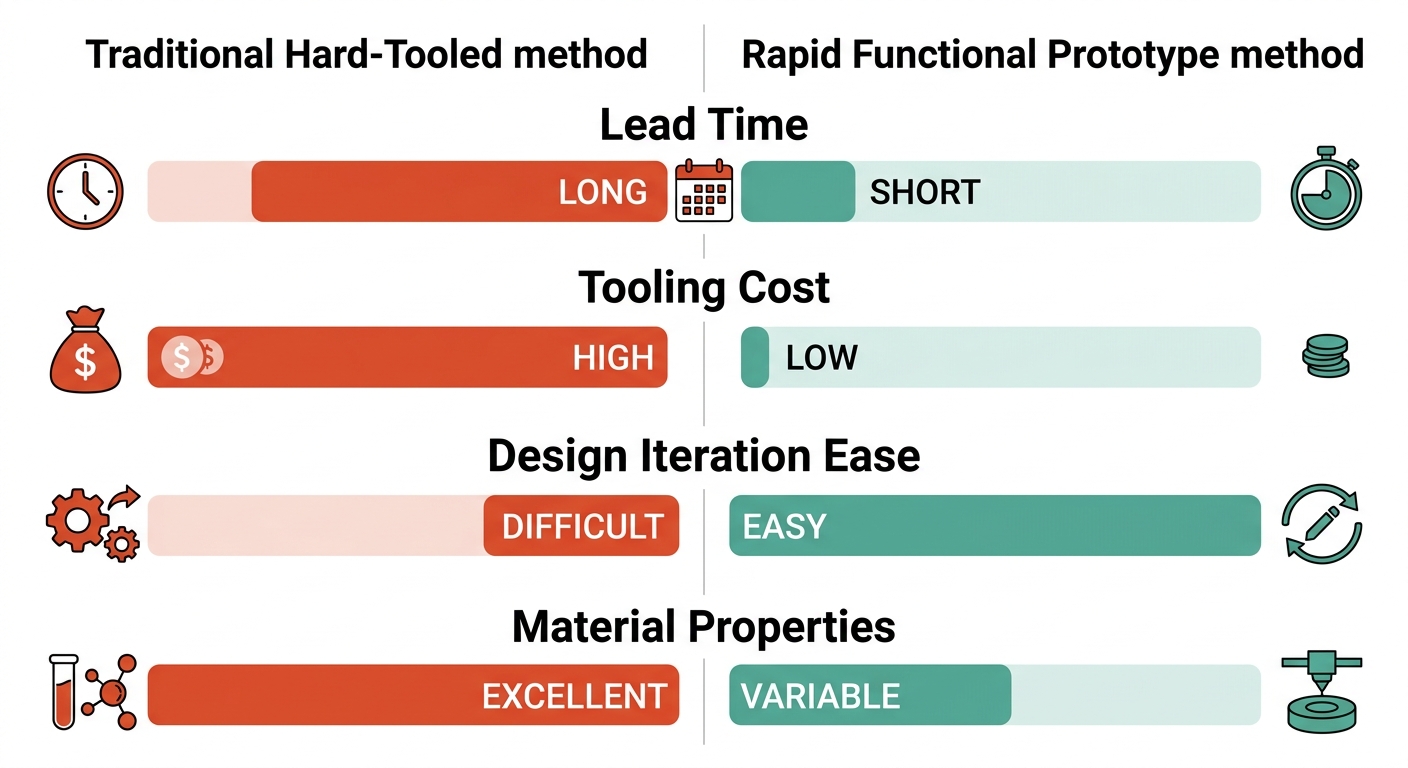
Comparison of traditional vs. rapid functional prototypes in metal casting.
Unlock the Potential of 3D Printed Sand Casting
Building on our comprehensive metal casting capabilities, we leverage 3D printed sand casting to eliminate the need for traditional tooling. This additive sand casting process uses binder jetting technology to build sand molds layer by layer, unlocking complex internal geometries and draft-free designs that are impossible with conventional methods. According to the Society of Manufacturing Engineers, such binder jetting sand molds reduce lead times from weeks to days for prototype and low-volume production runs.
