


August 5, 2026 | Protocast Inc
Aluminum Sand Casting Kentucky
Table of Contents
Aluminum Sand Casting in Kentucky for Prototype and Production Parts
For aluminum sand casting Kentucky projects, we offer a comprehensive solution that bridges prototype development and full-scale production. The process involves pouring molten aluminum into a sand mold to create parts with excellent mechanical properties and fine surface detail. By using A356 aluminum casting, an alloy known for its superior fluidity and strength, we achieve consistent quality for both low-volume prototypes and higher-volume production runs.
Following American Foundry Society guidelines, our approach to aluminum sand casting in Kentucky ensures dimensional accuracy and repeatability. Our precision sand casting process delivers tight tolerances and excellent surface finishes, meeting the most demanding Kentucky manufacturing requirements. As a full-service foundry, our precision casting services include sand, investment, and permanent mold casting, allowing us to select the optimal method for every project and transition seamlessly from prototype to production, all under one roof. Our ISO 9001:2015 and ITAR certifications underscore our commitment to rigorous quality control and precision.
Key advantages of sand cast aluminum parts for Kentucky clients:
- From Prototype to Production – Move quickly from initial design validation to high-quality production runs without changing suppliers.
- Multiple Casting Processes Under One Roof – We optimize manufacturing by selecting the best process for each part’s requirements.
- Made in the USA – Companies reshoring their casting projects with Protocast benefit from shorter lead times, domestic quality, and reduced supply chain risk.
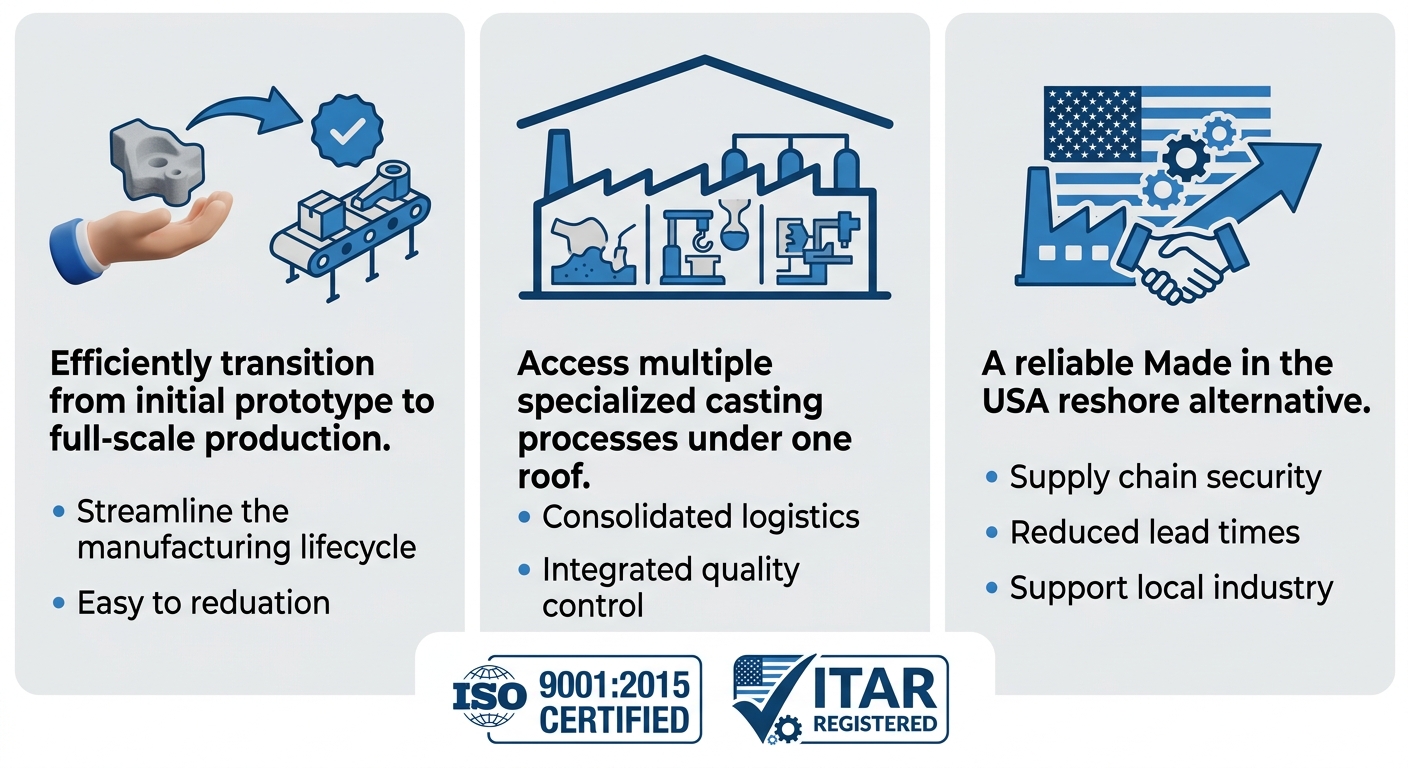
Key advantages of aluminum sand casting in Kentucky from Protocast Inc.
For companies throughout Kentucky, aluminum sand casting services for Kentucky manufacturing needs deliver cost-effective precision without the expense of hard tooling. Whether you need a single prototype or a medium-volume run, our in-house engineering support and rapid turnaround help you bring products to market faster. The power of reshoring, combined with Made in the USA quality, positions Kentucky manufacturers for long-term competitive advantage.
How Aluminum Sand Casting Works and Where It Excels
Having discussed the range of casting processes, we now focus on aluminum sand casting–a versatile and cost-effective method. In sand casting of aluminum, a disposable sand mold is used to form complex metal parts, making it suitable for everything from single prototypes to medium-volume production runs.
The aluminum sand casting process follows these steps:
- Pattern creation: A reusable pattern is made from wood, plastic, or 3D printing.
- Mold assembly: Sand and binder form a mold around the pattern, which is removed to create a cavity.
- Melting and pouring: Molten aluminum, typically A356 alloy, is poured into the mold.
- Solidification and shakeout: The metal solidifies, then the mold is broken to release the casting.
- Cleaning and inspection: Excess sand is removed, and the part is dimensionally inspected to ISO 8062.
Low tooling costs and fast lead times make sand casting ideal for prototypes. It handles parts from ounces to thousands of pounds, achieves CT7-CT10 tolerances per AFS, and these sand casting advantages support low-to-medium volumes.
At Protocast, we have multiple casting processes under one roof. The table below compares sand casting, die casting, and investment casting:
| Parameter | Sand Casting | Die Casting | Investment Casting |
|---|---|---|---|
| Tooling Cost | Low (patterns can be wood, plastic, or 3D-printed) | High (steel dies) | Moderate (wax injection dies) |
| Lead Time | Fast (days to weeks) | Slow (weeks to months) | Moderate (weeks) |
| Production Volume | Low to medium (1-10,000 units/year) | High (10,000+ units/year) | Low to medium (1-5,000 units/year) |
| Part Size Range | Small to very large (ounces to thousands of pounds) | Small to medium (typically under 50 lbs) | Small to medium (typically under 50 lbs) |
| Dimensional Tolerance | CT7-CT10 per ISO 8062 | CT4-CT6 per ISO 8062 | CT5-CT7 per ISO 8062 |
| Surface Finish (Ra) | 250-500 micro-inches | 32-120 micro-inches | 63-125 micro-inches |
| Part Complexity | Moderate (core assemblies for internal passages) | Limited (requires draft angles) | High (intricate shapes, thin walls) |
| Best For | Prototypes, large parts, low-to-medium volume production | High-volume automotive, consumer products | Complex geometries, aerospace, jewelry |
Sand casting provides the lowest tooling cost and fastest lead time–ideal for prototypes and large parts. Its part-size flexibility and low initial investment make it the preferred method for low-to-medium volumes, embodying our From Prototype to Production approach.
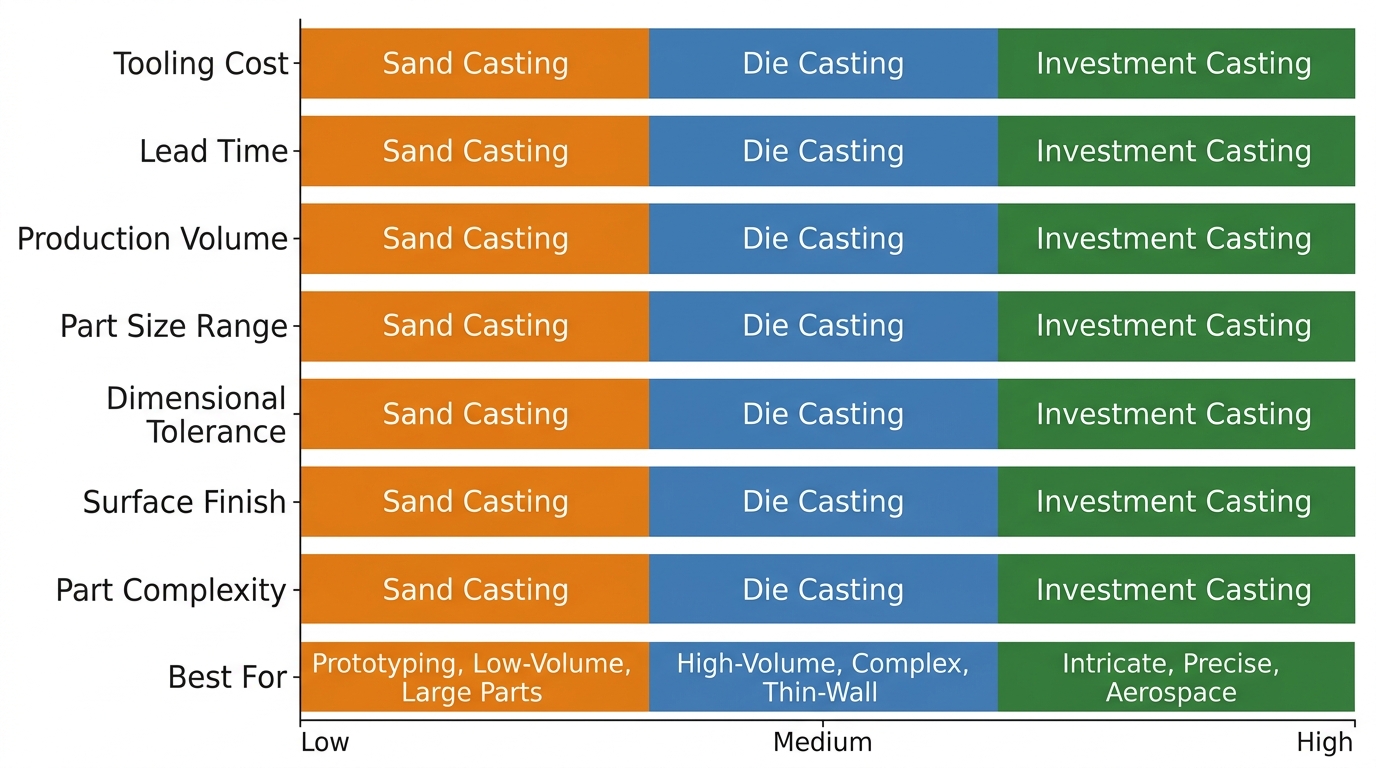
Aluminum casting method comparison across eight key production parameters.
Common sand casting applications include engine blocks, heavy machinery parts, pump housings, and architectural elements. We commonly rely on A356 aluminum casting for its excellent fluidity and mechanical properties, ensuring sound castings even in complex geometries.
These attributes make sand casting ideal for projects from prototype to production. In the following section, we explore how Protocast’s engineering support optimizes the sand casting process.
A356 Aluminum: Mechanical Properties and Aerospace-Grade Sand Casting
In A356 aluminum casting, the alloy’s response to T6 heat treatment sets it apart from many foundry alloys. Its combination of castability and mechanical performance makes it a go-to material for structural and pressure-tight components in aerospace and automotive applications. This section examines the mechanical properties, alloy specifications, and industrial preferences that define A356 aluminum.
Mechanical Properties of A356 After T6 Heat Treatment
The T6 heat treatment, comprising solution treatment followed by artificial aging, transforms the as-cast microstructure of A356 aluminum casting to achieve a desirable balance of strength and ductility. After T6 heat treatment, the alloy exhibits a minimum tensile strength of 39 ksi (269 MPa) and yield strength of 27 ksi (186 MPa), with elongation typically between 3% and 5%. Hardness values range from 80 to 90 HBW, reflecting the fine distribution of Mgâ‚‚Si precipitates. The solution treatment homogenizes the silicon and magnesium within the aluminum matrix, while the subsequent artificial aging precipitates these elements as coherent particles that hinder dislocation motion. Because sand casting provides slower solidification rates, the microstructure is more uniform and responsive to heat treatment compared to faster processes. This refinement enhances fatigue performance and pressure tightness, making A356 aluminum casting reliable for critical structural components that must withstand cyclic loading and fluid pressure. Engineers specify A356 for housings, brackets, and pump bodies where consistent mechanical properties are essential.
Why A356 Is Preferred for Aerospace and Automotive Sand Casting
A356 alloy owes its broad adoption in aerospace and automotive sand casting to a rare combination of foundry-friendly properties and post-cast performance. With 6.5-7.5% silicon, A356 aluminum casting exhibits exceptional fluidity, enabling it to faithfully reproduce fine details and thin walls in precision sand casting without cold shuts or misruns. The alloy’s corrosion resistance, derived from its dense oxide layer, withstands road salt, moisture, and chemical exposure, making it ideal for engine blocks, pump housings, and airframe brackets. Its weldability permits TIG and MIG repair of casting defects or joining to other assemblies without compromising mechanical integrity. In comparison, 319 aluminum, with its higher copper content, offers better machinability but sacrifices ductility and corrosion performance. The similar 356 alloy matches A356’s fluidity but typically delivers lower tensile and yield strength after T6 treatment. This superior heat treatment response allows A356 sand casting to achieve 39-41 ksi tensile strength and 27-30 ksi yield, outperforming both alternates in pressure-tight and fatigue-critical applications.
Differences Between A356.0 and A356.2 Alloy Specifications
The A356 family includes two primary specifications: A356.0 and A356.2, distinguished mainly by iron and magnesium limits. The following table, based on ASTM B26 and AMS 4218 and documented by the American Foundry Society, summarizes the chemical composition and minimum mechanical properties for each.
| Property | A356.0 | A356.2 |
|---|---|---|
| Silicon (Si) % | 6.5-7.5 | 6.5-7.5 |
| Magnesium (Mg) % | 0.25-0.45 | 0.30-0.45 |
| Iron (Fe) max % | 0.20 | 0.12 |
| Titanium (Ti) % | 0.20 max | 0.20 max |
| Tensile Strength (T6) | 39 ksi min | 41 ksi min |
| Yield Strength (T6) | 27 ksi min | 30 ksi min |
| Elongation (T6) % | 3.0 min | 5.0 min |
| Primary Applications | General structural, automotive, industrial | Aerospace, military, critical safety components |
In A356 aluminum casting, the specification choice directly influences ductility and strength. A356.2’s lower iron content minimizes brittle intermetallic phases, raising elongation to 5% minimum, while its tighter magnesium range increases tensile and yield strength — critical for aerospace and defense. A356.0 remains a cost-effective choice for general industrial and automotive applications. Our prototype casting services at Protocast Inc., a Made in the USA foundry, let you test both variants and go from prototype to production with expert metallurgical support.
With a clear understanding of A356’s properties, the next section details the sand casting process used to produce these high-performance components.
Lead Times, CNC Machining, and Heat Treatment for Aluminum Sand Castings
Building on the fundamentals of aluminum sand casting explored previously, we now examine the lead times and secondary services that deliver a finished casting. Our facility combines multiple casting processes under one roof with complete CNC machining, heat treating, and inspection capabilities–making us a single-source partner from prototype to production.
Typical Lead Times for Aluminum Sand Casting Projects
The lead time for an aluminum sand casting project depends on the casting’s geometry, pattern complexity, and whether it is a prototype or a full production run. For a first-article prototype, the process begins with a purchase order and then moves through pattern design and fabrication–often using rapid tooling or machined patterns–mold preparation, pouring, cooling, and finishing. Depending on the scope of sand casting applications, a prototype can be ready in as little as two to three weeks, while production runs with more elaborate tooling and multiple finishing steps typically span six to eight weeks.
Prototype tooling is often simpler, which shortens pattern fabrication, whereas production tooling incorporates features like multiple cavities and durable materials. After pouring, large, heavy-wall castings require longer cooling cycles to prevent distortion. Our in-house secondary services then compress the post-casting timeline because parts never leave the facility for heat treating or CNC machining. Customers from across the country, including those looking for aluminum sand casting in Kentucky, benefit from our integrated scheduling and communication. For urgent requirements, we often prioritize pattern fabrication and align machine capacity to compress lead times.
In-House CNC Machining and Heat Treating Capabilities
To ensure quality and speed, we perform secondary services in-house. We operate three dedicated CNC machines that provide post-casting dimensional precision for critical features such as mating surfaces, bearing bores, and threaded holes. By machining after solidification and heat treatment, we achieve tight tolerances that cannot be reliably cast to net shape.
Our in-house T6 heat treatment capability–solution heat treatment followed by artificial aging–optimizes the tensile strength and elongation of aluminum alloys like A356. According to American Foundry Society standards, the T6 process delivers a balanced combination of strength and ductility essential for structural components. Because both machining and heat treating happen under our roof, we eliminate the logistics, shipping, and multi-vendor coordination that can add weeks to a project schedule.
In addition to machining and heat treating, we perform CMM inspection, NDT, pressure testing, and welding in-house. The table below highlights how each service supports casting quality.
| Service | Equipment / Method | Benefit for Castings |
|---|---|---|
| CNC Machining | Three dedicated CNC machines | Post-casting dimensional precision and feature creation for mating surfaces and threaded holes |
| Heat Treating | In-house T6 solution and aging furnaces | Optimized tensile strength and elongation without outsourcing delays or added logistics |
| CMM Inspection | Coordinate measuring machine | Verification of critical dimensions for quality assurance and first-article approval |
| NDT Services | Radiography (X-ray) and dye penetrant inspection | Detection of internal porosity and surface discontinuities to ensure structural integrity |
| Pressure / Leak Testing | Dedicated test fixtures | Validation of pressure-tight component integrity for hydraulic and pneumatic applications |
| Welding and Repair | TIG welding capability | Salvage, modification, and part modification to meet final specifications |
Having these services integrated under one roof eliminates communication delays and gives us complete control over the final product. For companies reshoring their casting projects with Protocast, our integrated services offer a competitive alternative to offshore supply chains.
Quality Assurance Through In-House Inspection and Testing
Our commitment to quality extends beyond machining and heat treating to a full spectrum of inspection and testing services. These processes validate that every aluminum sand casting meets dimensional, structural, and pressure-integrity requirements before it reaches your assembly line.
CMM inspection is the first line of dimensional verification. Using a coordinate measuring machine, our quality team checks critical dimensions against the CAD model, generating a detailed report for first-article approval or ongoing lot acceptance. Pressure and leak testing confirm that castings intended for hydraulic or pneumatic applications are pressure-tight. We build dedicated test fixtures that simulate operating conditions, ensuring every component performs reliably.
For internal integrity, we employ nondestructive testing (NDT) methods such as radiography (X-ray) and dye penetrant inspection. Radiography reveals subsurface porosity, while dye penetrant highlights surface cracks or laps. Both methods follow ASTM and industry standards to guarantee structural soundness. Finally, TIG welding capability allows us to perform weld repair or part modification when needed, saving otherwise scrap castings and getting them back into specification without sending them to an outside shop.
These integrated capabilities help deliver castings that meet exact specifications from prototype to production.
Precision Sand Casting Tolerances, Surface Finish, and Quality Standards
Building on the fundamentals of precision sand casting, we can achieve consistent dimensional tolerance of ±0.030 in. for the first inch and ±0.002 in./in. thereafter. The surface finish for precision sand cast components typically falls within a Ra range of 125-500 micro-inches. For an alloy like A356 aluminum casting, these capabilities ensure intricate features and robust performance in demanding applications. Our process accommodates parts from ounces to thousands of pounds, making it ideal for large structural components including pump housings, engine blocks, and valve bodies. These measurable parameters are consistently achieved when casting procedures follow recognized industry standards.
Adherence to ASTM B26/B26M-21 and guidelines from the American Foundry Society ensures that every precision sand casting meets rigorous quality benchmarks. As an ISO 9001:2015 and ITAR certified foundry, we integrate these standards into every project, delivering repeatable dimensional accuracy and material integrity. Our engineering team supports you from prototype to production, leveraging multiple casting processes under one roof to select the best method for your part.
The following table compares precision sand casting and investment casting for large component manufacturing across critical decision factors.
| Factor | Precision Sand Casting | Investment Casting |
|---|---|---|
| Maximum Part Size | Virtually unlimited (ounces to thousands of pounds) | Limited (typically under 50 lbs) |
| Tooling Cost | $2,000 – $20,000 (3D-printed or machined patterns) | $5,000 – $40,000 (wax injection dies) |
| Production Lead Time | 2-6 weeks for first articles | 4-10 weeks for first articles |
| Surface Finish (Ra) | 125-500 micro-inches | 60-125 micro-inches |
| Dimensional Tolerance | +/- 0.030 in. first inch, +/- 0.002 in./in. thereafter | +/- 0.005 in. first inch, +/- 0.001 in./in. thereafter |
| Minimum Order Quantity | 1 prototype; low-volume runs economical | Typically 50+ due to tooling amortization |
| Best Suited For | Large structural components, pump housings, engine blocks, valve bodies | Small intricate parts, turbine blades, impellers, aerospace brackets |
Tolerance data from ASTM B26/B26M-21; comparison metrics based on American Foundry Society reference materials and industry standards.
Precision sand casting offers advantages for larger parts where investment casting becomes cost-prohibitive or physically impossible due to size constraints. While investment casting delivers tighter dimensional tolerances and finer surface finishes, its part size limits and higher tooling amortization often make it less practical for components exceeding 50 pounds. For structural castings that demand mechanical integrity, precision sand casting is the preferred route in our foundry. For deeper insights into precision sand casting processes, visit our metal casting blog. Understanding these quality parameters helps you specify the right process for your application, and our team is ready to guide you through material selection and design optimization.
Common Questions About Aluminum Sand Casting Answered
With the fundamentals of metal casting covered, let’s address some common questions about aluminum sand casting in Kentucky.
What Is Aluminum Sand Casting?
According to the American Foundry Society (AFS), aluminum sand casting involves pouring molten aluminum into a sand mold to create a part. The mold is broken away after solidification.
What Are the Key Advantages?
Key advantages include design flexibility, cost-effectiveness for low-to-mid volumes, and the ability to cast large parts.
What Applications Use Aluminum Sand Castings?
Common applications include automotive parts, industrial machinery, architectural hardware, and prototypes. Parts often use A356 aluminum for strength and heat-treatability.
How Precise Is Aluminum Sand Casting?
For tight tolerances, precision sand casting achieves smooth finishes and accuracy. With multiple processes under one roof, we tailor the method to your project’s needs.
These answers cover the essentials; the next section details the sand casting process. Many companies are reshoring casting projects with Protocast for Made in the USA quality.
Partnering with Protocast for End-to-End Aluminum Sand Casting Solutions
When you partner with Protocast for aluminum sand casting, you gain a single-source partner handling everything from prototype to production under one roof. We combine precision sand casting for tight-tolerance, complex geometries with complementary casting processes to select the best method for your project. Using materials like A356 aluminum alloy, our engineering team collaborates with you through design and testing. For OEMs seeking Made in the USA quality and a reshoring alternative, Protocast delivers dependable sand casting solutions backed by ISO 9001:2015 and ITAR certifications.
