
Permanent Mold Tooling: Cost, Life, and Refurbishment
The die is the biggest decision in permanent mold casting. It is the line item that makes buyers hesitate, the reason the per-part price falls, and the asset that keeps producing years after the first purchase order. Here is what goes into one, what it costs, why it lasts as long as it does, what refurbishment means, and who cuts it.
What a permanent mold die is
A permanent mold is two or more steel blocks machined so that, when closed, they form the cavity of the part along with the gating and risers that feed it. Cores for holes and pockets are steel where the geometry allows a straight pull, and sand where it does not. The die mounts in a machine that clamps it shut, tilts it for the pour, opens it, and ejects the casting. Between shots the die is coated with a refractory mold wash that controls how fast heat leaves the metal and protects the steel from the aluminum.
Most of the cost is machining time in hardened steel. Aluminum cuts fast; a steel block hard enough to survive tens of thousands of shots cuts slowly, and the cavity, gating, vents, ejector pin holes, cooling, and core pulls all come out of it. A single-cavity die for a small bracket is a modest tool. A multi-cavity die for a large housing with slides and several sand cores is not.
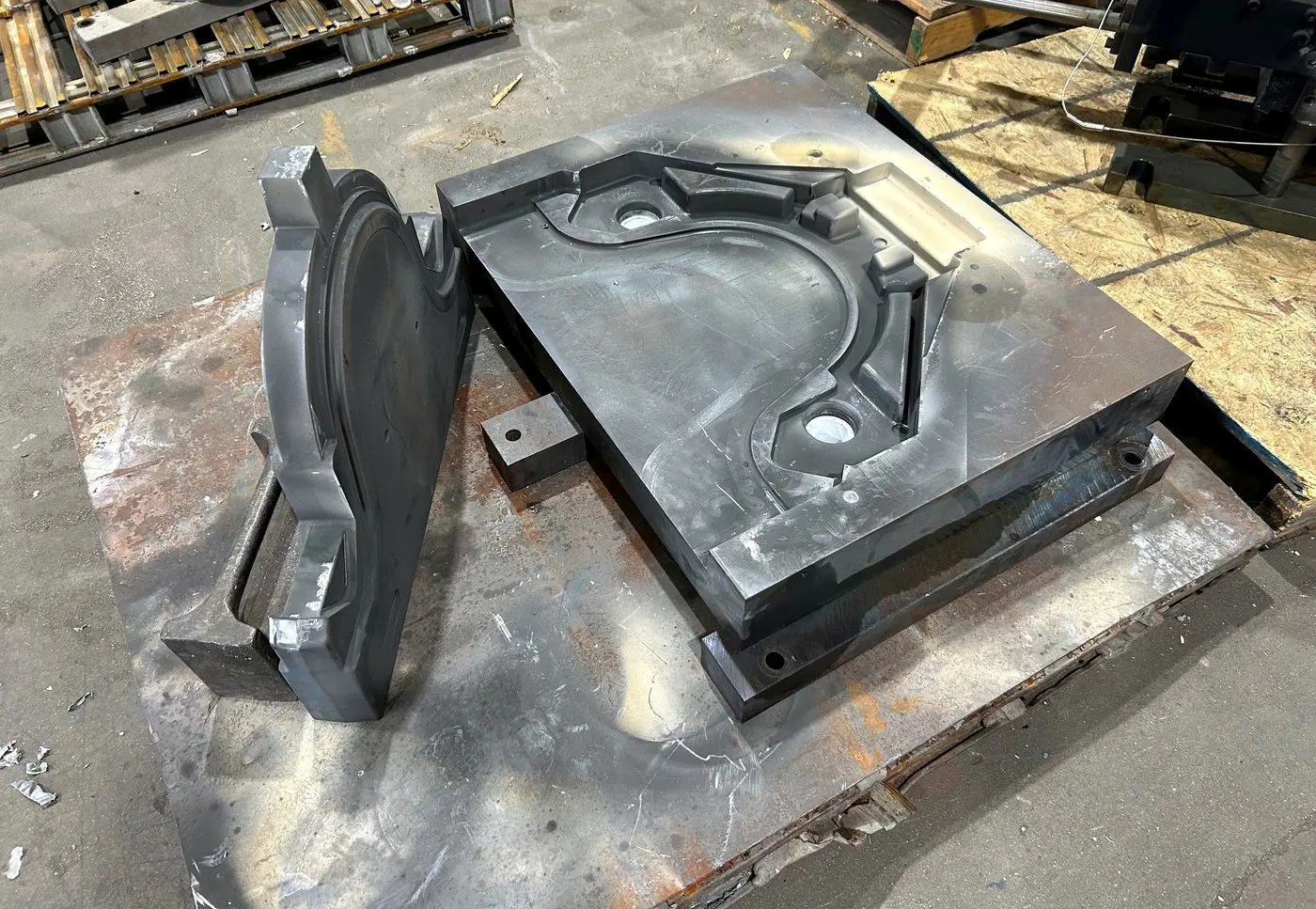
A low pressure permanent mold die with a slide, cut in the Protocast tool room. Slides and cores are what move a die from the low end of the cost range toward the high end.
What a die costs
Protocast publishes ranges because buyers need them to plan. Small parts with simple geometry start around $35,000 to $40,000. A permanent mold rarely comes in below that, because the steel itself is expensive and it has to be hardened to last. Large parts with moving slides for undercuts and multiple cores can reach $200,000. Most of the tools that cross the sales desk are under $100,000, so the middle of that range is where a typical housing or bracket lands.
| Part | Typical die cost |
|---|---|
| Small, simple geometry, single cavity | $35,000 to $40,000 |
| Typical housing, bracket, or manifold | Under $100,000 |
| Large or complex, slides for undercuts, multiple cores | Up to $200,000 |
Ranges from Protocast. Every quote is built from the part.
For comparison, a precision sand pattern for the same part might be about $10,000. The trade is in the piece price: a sand casting that costs $250 to $300 each can come down to a fraction of that in permanent mold once the die is paid for, which is why the sand versus permanent mold guide puts the crossover at only a few hundred pieces a year.
Why it lasts about 40,000 shots
Aluminum is poured at roughly 1,250 to 1,450 degrees Fahrenheit. Every shot heats the cavity surface and every ejection lets it cool, so the steel cycles thermally thousands of times. Eventually fine heat-check cracks appear at the surface, edges and gate areas wear, and dimensions drift. Protocast’s rule of thumb is about 40,000 shots before refurbishment. The die does not have to be replaced at that point; it comes off the machine for attention and goes back to work. Several things move that number:
- Mold wash and preheat discipline. A die that is preheated properly and coated consistently sees less thermal shock and lasts longer.
- Part geometry. Sharp inside corners and thin steel sections between cavity features are where heat checking starts. Generous radii in the part design protect the die as much as they protect the casting.
- Alloy. The aluminum casting alloys Protocast pours, 356 and 357 among them, are kind to tooling compared with some higher-copper or higher-iron alloys.
- Run length. Long continuous runs at a stable temperature wear a die more slowly than frequent short runs that cycle it hot and cold.
What refurbishment involves
Refurbishment is not a new die. It is welding and re-machining worn areas, polishing heat-checked surfaces, replacing ejector pins and core pins, and re-qualifying the first castings against the drawing. The work is a fraction of the original tooling cost and, done at the right time, returns the die to full production for another long run. The same tool room that cut the die handles it.
Who cuts the die
Permanent mold dies are cut in Protocast’s own tool room whenever possible, on the same group of eight CNC machines that handle post-cast machining. Domestic tooling partners are still used when the shop is at capacity or when a particular design is one the tool room would rather not take on, so the answer to “who cuts it” is Protocast first, a domestic partner when needed. Three practical points follow from that.
- Engineering changes. A die cut in the building can be revised in days, with the toolmaker and the foundry in the same conversation.
- Tryout. First shots, gating adjustments, and requalification happen where the die was made.
- The die stays put. The customer owns it, Protocast stores and maintains it, and it never travels between runs.
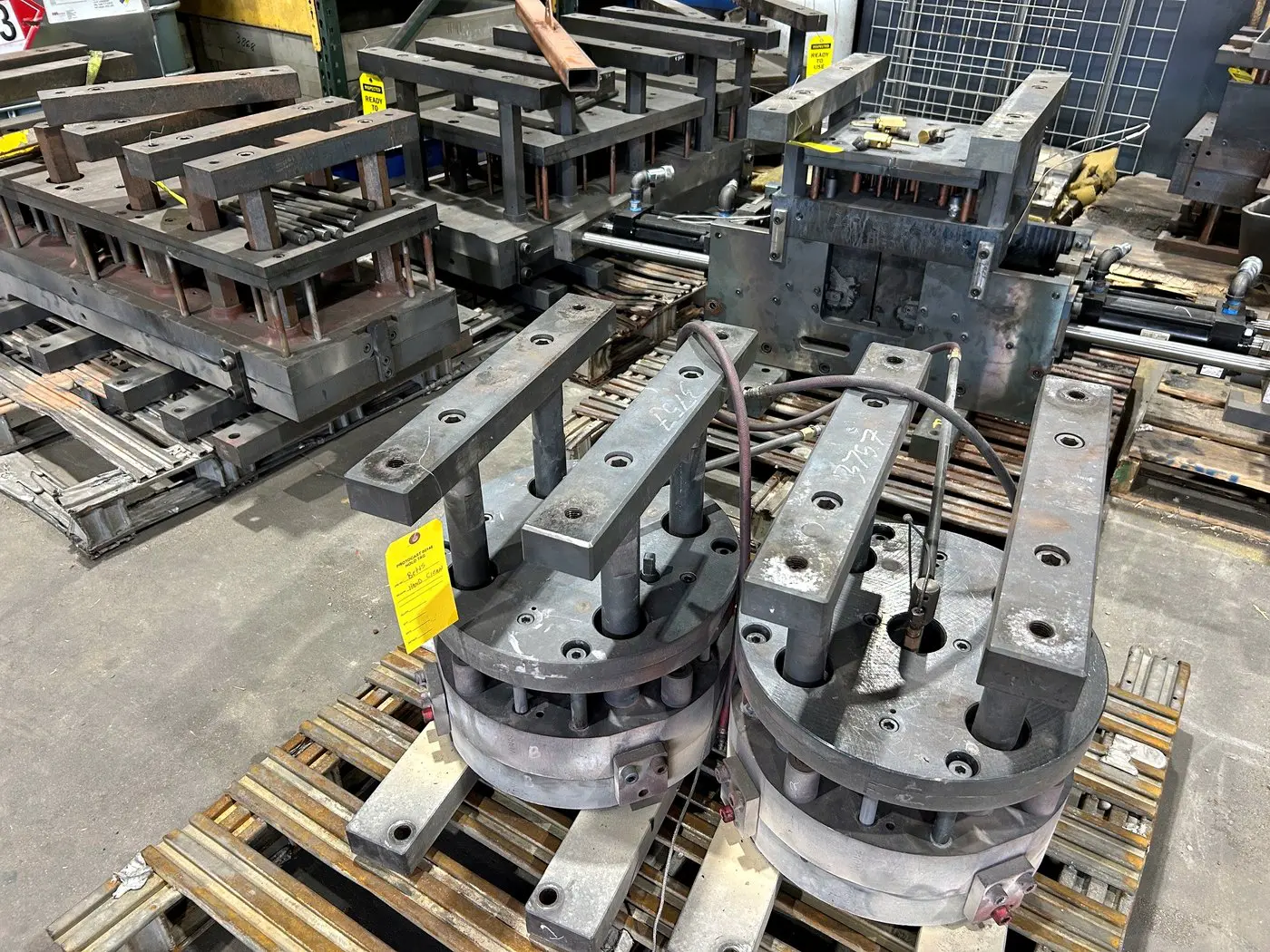
Customer-owned dies between runs. They are stored, maintained, and refurbished at the foundry.
Who owns the die
The customer does. The purchase order for tooling buys the die outright, and it stays at the foundry for production. Ask for the ownership terms in writing with the quote; they are standard, and having them on paper matters on a multi-year program.
How to think about the cost
Divide the die cost by the volume you expect it to produce. A die good for 40,000 shots before refurbishment on a program running 5,000 pieces a year covers eight years of production, and the tooling contribution per part is small. The same die for a one-time run of 200 pieces is expensive per part, and that is the case where sand casting or printed sand is the better answer. The sand versus permanent mold guide shows where the crossover usually sits.
| Question | What it does to the die |
|---|---|
| How many cavities? | More cavities mean a lower per-part cycle cost and a larger, more expensive die. |
| Steel cores or sand cores? | Sand cores add a per-shot cost but keep the die simpler; steel cores add die cost and cycle faster. |
| Slides for undercuts? | Moving sections in the die are what push a tool toward the top of the range. |
| How much machining stock? | A little stock on critical faces protects the machined dimension; too much wastes metal and cycle time. |
| Is the design frozen? | Changes after the die is cut cost real money. Freeze it in sand first. |
What is inside a permanent mold die
| Component | What it does |
|---|---|
| Cavity blocks | The steel halves machined with the negative of the part; the largest cost |
| Gating and basin | The path metal follows from the pour into the cavity; tuned at tryout |
| Risers | Reservoirs that feed the casting as it shrinks; sized from simulation |
| Vents | Fine channels that let air out ahead of the metal |
| Steel cores and slides | Form holes and pockets that pull straight; slides pull sideways |
| Core prints | Pockets that locate sand cores in a semi-permanent mold |
| Ejector pins | Push the casting out when the die opens; replaced at refurbishment |
| Cooling and heating | Channels or inserts that control die temperature in heavy and thin areas |
| Mounting and clamping | Fits the die to the tilt-pour or low pressure machine |
Tooling questions to settle before the quote
- Cavity count. One cavity is the simplest die. Two or four cavities cut the per-shot cost on small parts but raise die cost and require a balanced gating design.
- Cast-in inserts. Steel or bronze inserts can be placed in the die and cast into the part, for wear surfaces or threads. They add handling per shot.
- Identification. Part numbers, cavity numbers, date wheels, and logos can be cut into the die and appear on every casting.
- Family tooling. Related parts can sometimes share a die base with interchangeable inserts, which spreads the cost across a product line.
- Machining fixtures. Designed alongside the die so the datum surfaces cast cleanly and locate reliably.
Caring for a die between runs
A permanent mold die at rest is cleaned of coating residue, inspected for heat checking and wear, lightly oiled, and stored on site. Before the next run it is preheated on a schedule, recoated, and the first shots are checked against the last qualified samples. This routine, more than anything else, is what carries a die to and past the 40,000-shot mark, and it is one reason to keep the die where the parts are made.
How Protocast fits in
Protocast has cut its own tooling since 2005, first patterns and matchplates, and later permanent mold dies as well. Eight CNC machines cut permanent mold tooling and machine castings; three more are kept for sand pattern tooling only, because the pattern board throws dust that would contaminate the coolant on the machines that cut steel. When a program is ready to move from sand to permanent mold, the engineers who reviewed the prototype design the die.
Frequently asked questions about permanent mold tooling
What does a permanent mold die cost?
Small, simple parts start around $35,000 to $40,000. Large, complex parts with slides can reach $200,000. Most tools Protocast quotes are under $100,000.
Who owns the die?
The customer. The tooling purchase order buys the die outright, and it stays at the foundry for production.
Who cuts the die?
Protocast cuts permanent mold dies in its own tool room whenever possible. Domestic tooling partners are used when the shop is at capacity or a design calls for it.
What happens at 40,000 shots?
The die is inspected, refurbished, and requalified. Refurbishment is a fraction of the cost of a new tool, and the die is not replaced.
Can a permanent mold die be modified later?
Adding metal to the casting (removing steel from the die) is usually straightforward. Removing metal from the casting (adding steel to the die) means welding and re-machining, which is possible but more involved.
How long does it take to build a die?
It depends on size and complexity. Typical first samples from a new permanent mold die at Protocast are 12 to 20 weeks from order.
Can I move my die to another foundry later?
Tooling the customer owns can be moved. In practice, dies are designed around a specific machine, gating practice, and mold wash, so a move usually means a requalification.
Do multi-cavity dies save money?
On small parts at high volume, yes: the die cost rises, but the per-shot cost falls because several parts are made per cycle. On larger parts, single cavity is usually the right answer.
What is the difference between a permanent mold die and a die casting die?
A die casting die must withstand very high injection pressure and is built heavier from hardened tool steel with elaborate cooling, at a much higher cost. A permanent mold die sees only gravity or low pressure and is simpler and less expensive.
Send the model. Get a quote with engineering feedback.
Ready to see what a die would cost for your part? Send the model and the annual volume, and the quote will show the tooling and the per-part price together.
- Engineering review with every quote
- Flow simulation before tooling is cut
- Cast, heat treated, machined, and inspected in one building
- Permanent mold tooling cut in house whenever possible
