
Replacing Investment Casting with Printed Sand
Investment casting owned a specific corner of the market: small, complex, low-volume parts with fine detail and internal cores, made without hard tooling. Protocast offered it from 2008, building castings directly from 3D printed patterns rather than wax tooling, and discontinued it in 2026. Printed sand casting now does that job, and this guide explains why, where the two overlap, and what changes for a part that used to be investment cast.
What investment casting did well
A pattern in wax or printed resin, coated in ceramic shell, melted out, and poured. Close dimensional tolerance, fine surface detail, thin walls, complex cores, and no draft, all with no hard tooling. Its limits were cost, part size, and cycle time: the shell process is slow and labor intensive, sizes are limited by what a shell can hold, and it was almost always the most expensive way to make a part.
What printed sand does instead
The mold is printed straight from the CAD file: no pattern, no shell, no draft, and internal cores printed as part of the mold or as separate pieces. Complex cores and undercuts that once required investment casting are routine. The size ceiling is roughly 70 by 39 by 27 inches per mold, far beyond a wax-pattern process, and molds can be ready in as little as 5 days. The casting is a sand casting, with the surface finish and mechanical properties of one, and tolerances closer to air-set sand than to green sand.
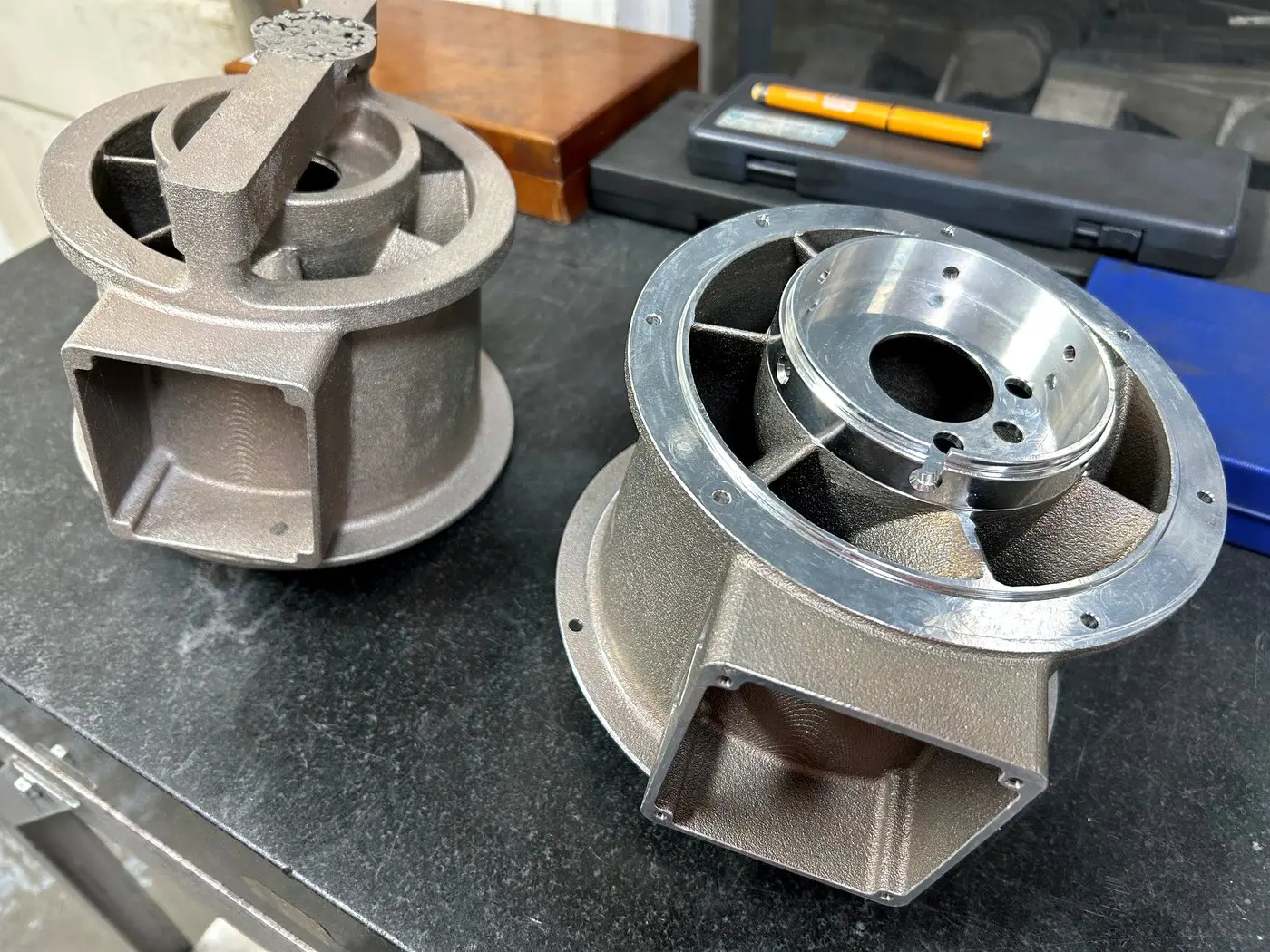
A printed sand casting as poured and after machining. The surfaces that used to justify a ceramic shell are machined to print.
Side by side
| Investment casting (discontinued) | Printed sand casting | |
|---|---|---|
| Tooling | None (printed patterns) | None |
| Complex cores and undercuts | Yes | Yes |
| Surface finish | Smooth, fine detail | Sand casting finish, 350 to 450 rms range |
| Tolerance | Close | Close to air-set sand; machine critical features |
| Part size | Small to medium | Small to very large, about 70 by 39 by 27 inches per mold |
| Lead time | Weeks; shell building is slow | Molds in as little as 5 days |
| Cost per part | Highest of the casting processes | Lower; sand and binder, no shell |
| Path to production | Stayed investment cast, or retooled | Same model moves to precision sand or a permanent mold die |
What changes for a part that used to be investment cast
- Surface. Cosmetic surfaces that relied on investment-cast smoothness may need a finishing operation or a machined face. Say which surfaces matter and the quote will address them.
- Fine detail. Very small features, thin fins, and sharp lettering that a shell reproduced may need to be machined or simplified. Most functional parts do not have them.
- Tolerance. Plan to machine the critical dimensions. Protocast machines its own castings, so this is a line on the quote rather than another supplier.
- Everything else gets easier. Larger parts, faster molds, cheaper castings, and a direct path to permanent mold when the volume arrives.
When a permanent mold die is the better replacement
If the reason for investment casting was finish and repeatability rather than tooling-free flexibility, and the volume is a few hundred pieces a year or more, a permanent mold die is the stronger replacement: 125 to 250 rms as cast, consistent dimensions, and better mechanical properties, at a per-part price well below investment casting. Printed sand can prove the design first.
Investment-cast features and their printed sand equivalents
| Investment-cast feature | In printed sand |
|---|---|
| Internal passages from ceramic cores | Printed as part of the mold; often simpler |
| Zero-draft walls | Same; nothing is drawn from a printed mold |
| Thin walls below 0.160 inch | Thicken to about 0.160 inch, or move to permanent mold for 0.125 inch |
| Fine surface detail and lettering | Coarser; machine or simplify where it matters |
| Net-shape tolerances | Machine critical features; leave stock |
| Small parts in clusters | Multiple cavities per printed mold |
| Large parts beyond shell capacity | Now possible, to about 70 by 39 by 27 inches |
Reviewing an investment-cast drawing for printed sand
Most investment-cast drawings carry tolerances and finish callouts the shell process could meet as cast. Go through the drawing feature by feature and decide which of them actually matter to fit and function. Those get machined, and the drawing gets machining stock. The rest can carry sand casting tolerances and finish, which is usually most of the part. Minimum wall should be checked against 0.160 inch. Then the part is a printed sand casting with a machining operation, at a lower cost and a shorter lead time than the shell process it replaces.
Moving to production afterward
Investment casting was often chosen because tooling could not be justified, and programs stayed there long after volume grew. Printed sand does not lock a part in. When the quantity climbs, the same model cuts a precision sand pattern for hundreds a year or a permanent mold die for thousands, with finish and repeatability that investment casting could not match at that volume.
How Protocast fits in
Protocast offered investment casting for years and knows what the parts look like. Ones that were investment cast in aluminum are the parts printed sand is for; ones cast in steel or other ferrous alloys are outside its scope. Send the model, the quantity, and a note on which surfaces and dimensions are critical, and the quote will show the printed sand route and, where it applies, the permanent mold alternative.
Frequently asked questions about replacing investment casting
Why did Protocast discontinue investment casting?
It was labor intensive, requests had dwindled, and printed sand casting had already taken over the same complex, tooling-free work at lower cost, in less time, and at larger sizes. Anything Protocast rapid investment cast can be done in printed sand.
Will my investment-cast part look the same in printed sand?
The geometry will be the same. The surface will be a sand casting surface. Cosmetic faces can be machined or finished, and the quote will call that out.
Can you still cast small, intricate parts?
Yes, in printed sand for low volumes and in permanent mold for production. Extremely fine detail may be better machined.
Do you cast steel or stainless?
No. Protocast pours aluminum and zinc only.
Is printed sand as accurate as investment casting?
No as cast. Investment casting held closer as-cast tolerances. Printed sand holds air-set sand tolerances, and critical features are machined, which Protocast does in house.
What about parts that were investment cast in steel?
Protocast pours aluminum and zinc only. Steel investment castings are outside its scope.
Can printed sand make thin walls like investment casting?
Down to about 0.160 inch. Thinner walls are a permanent mold job at 0.125 inch, and low pressure for thin walls over large areas.
Send the model. Get a quote with engineering feedback.
Have a part that used to be investment cast? Send the model and the critical surfaces and we will show you the printed sand route.
- Engineering review with every quote
- Flow simulation before tooling is cut
- Cast, heat treated, machined, and inspected in one building
- Permanent mold tooling cut in house whenever possible
