
Printed Sand Casting: No Tooling, Complex Geometry, Molds in Days
Printed sand casting takes the pattern out of sand casting. Instead of machining a pattern and packing sand around it, a printer builds the mold directly from the CAD file, layer by layer, sand and binder. There is no tooling to make, no draft required, and no limit on internal geometry beyond getting the sand back out.
How it works
The mold is designed in software: the part cavity, the gating, the risers, and any cores, all as one digital model or as a few pieces that assemble. The printer spreads a thin layer of sand across the build bed and a print head deposits binder where the mold should be solid. The bed drops, another layer is spread, and the process repeats until the mold is complete. Loose sand is removed, the mold pieces are assembled, and the mold is poured like any other sand mold. After the casting cools, the mold is broken away.
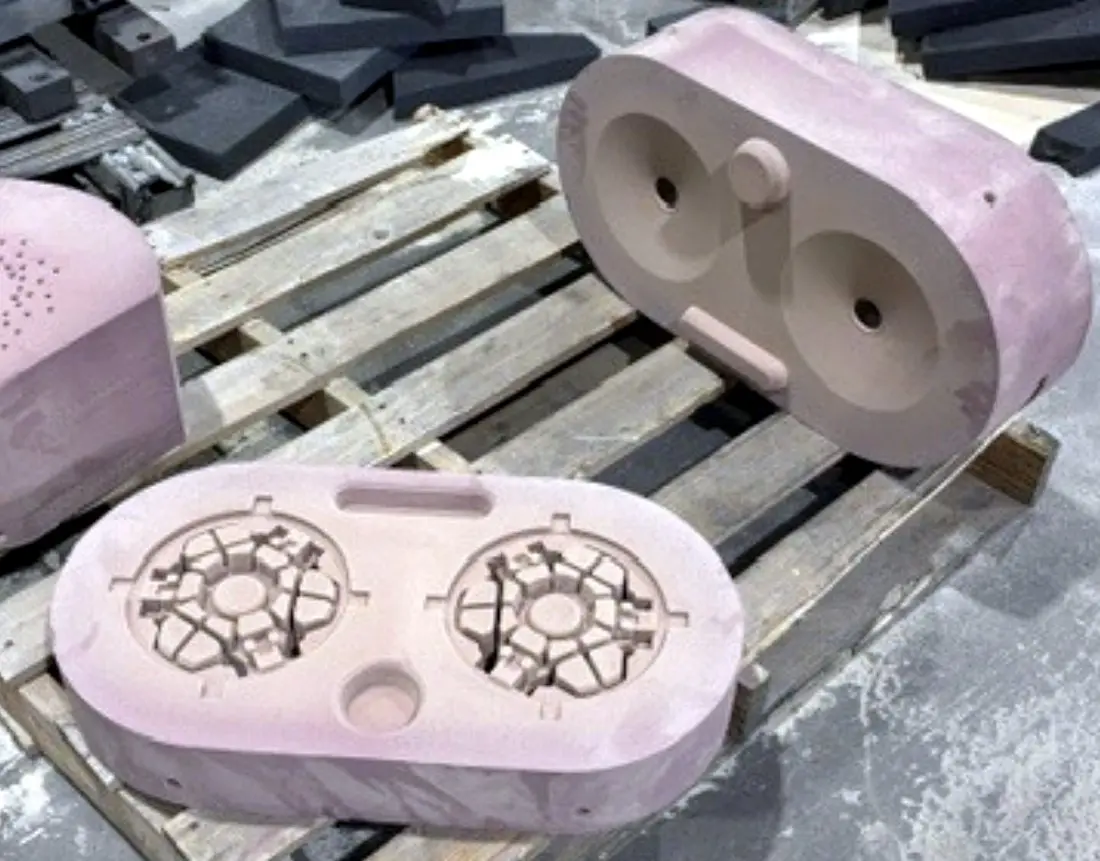
A printed sand mold at Protocast, both halves open. The cavity, gating, and core prints are printed straight from the CAD file, with no pattern.
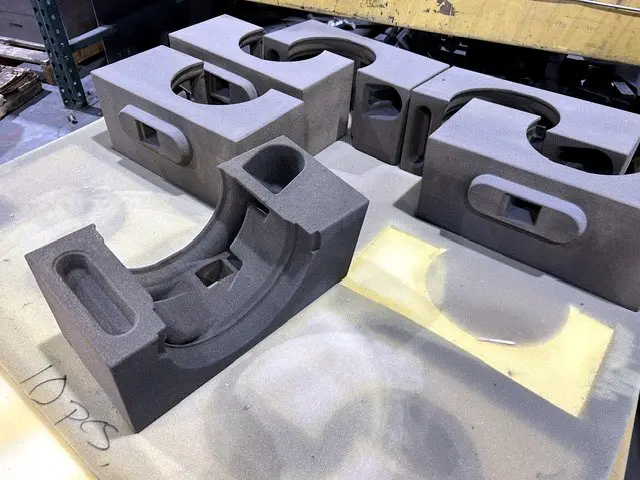
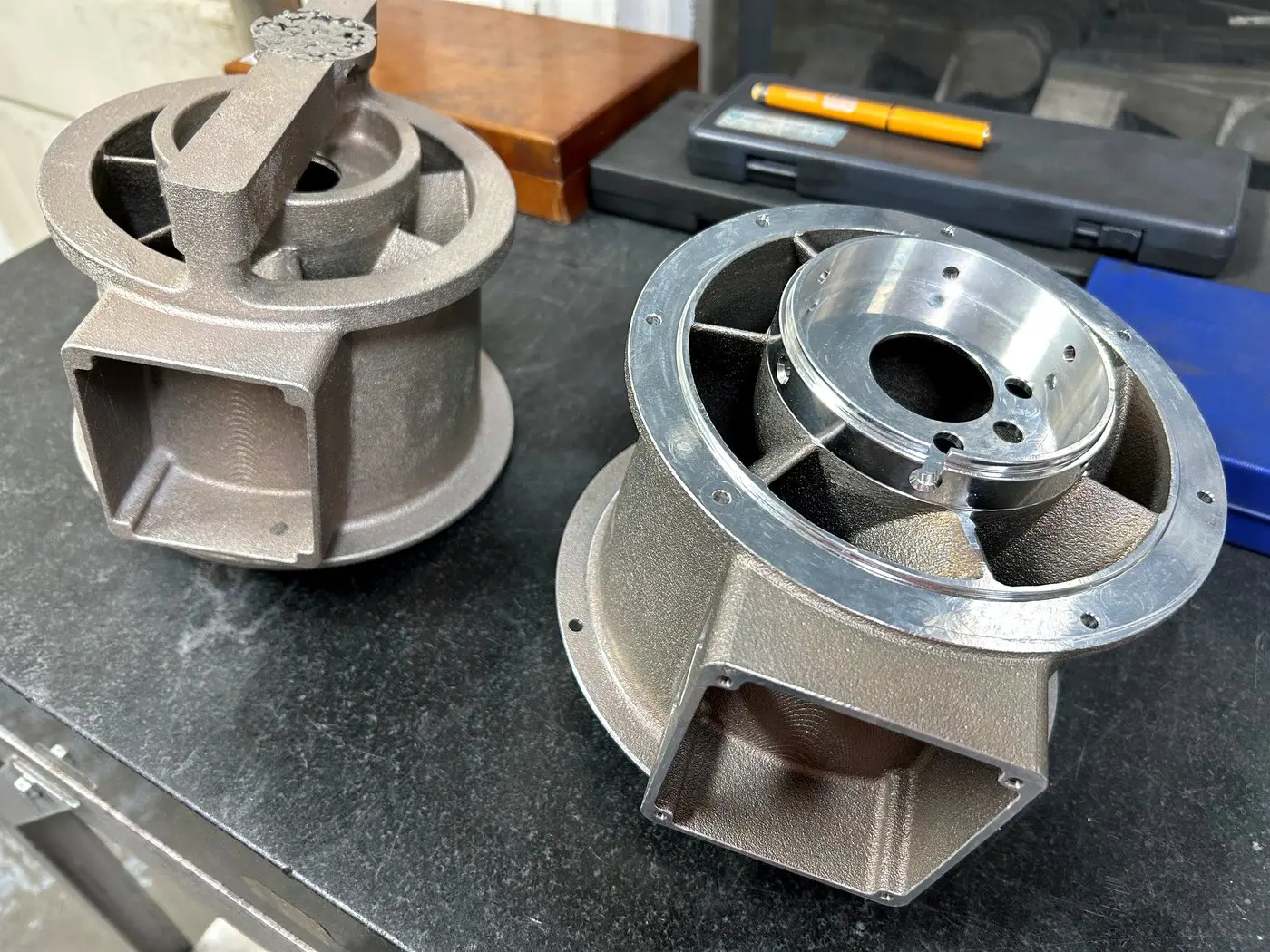
Left: printed sand cores. Right: a printed sand casting as poured and after machining.
What it changes
| Traditional sand casting | Printed sand casting | |
|---|---|---|
| Tooling | Machined pattern and core boxes | None |
| First mold | After the pattern is cut, typically 4 to 6 weeks to samples | Molds in as little as 5 days |
| Draft | Required so the pattern can be drawn from the sand | Not required; nothing is drawn |
| Internal geometry | Limited by what core boxes can form | Any passage the sand can be shaken out of |
| Design changes | Modify or recut the pattern | Edit the file and print again |
| Mold size | Very few limits | About 70 by 39 by 27 inches per mold; multiple molds per build |
| Surface finish | 350 to 450 rms | Consistent with traditional sand; tolerances closer to air-set sand |
| Best quantity | Short runs through production | One to a few hundred |
Typical figures for Protocast. Geometry and workload move them.
When printed sand is the right choice
- Complex geometry. Internal passages, undercuts, and cores that would take several core boxes or could not be made at all.
- No time for tooling. A first casting in days, straight from the file.
- Low quantity. One to a few hundred pieces, where a pattern would never pay for itself.
- Large parts. Molds up to about 70 by 39 by 27 inches, well beyond what wax-pattern processes can handle.
- Designs still changing. Every iteration is a new print, not a new tool.
- Cores for other processes. Printed cores can go into a precision sand mold or a permanent mold die (semi-permanent mold) when a core box is not justified.
When it is not
Printed sand is a per-mold cost every time. Once a part is proven and the quantity climbs into the hundreds per year, a machined pattern in precision sand usually costs less per casting, and from about 300 to 500 a year a permanent mold die costs less still and delivers a better surface and tighter repeatability. The model that printed the mold is the same model that cuts the pattern or the die, so nothing is lost in the move.
What it replaced
Protocast offered investment casting from 2008 and discontinued it in 2026, after printed sand had taken over the same work. Printed sand now covers the same ground: the complex, low-volume, tooling-free parts that used to go to wax, and larger parts that never fit a wax pattern process. The investment casting guide covers the transition in detail.
Designing for a printed mold
Because nothing is drawn from the sand, the usual constraints of pattern-making disappear: no draft, no parting line compromises, no core boxes. What remains are the constraints of sand and metal. Walls should still be about 0.160 inch or more. Sand must be removable from every internal cavity, so passages need an opening. Very fine or fragile mold features can break during handling, so thin fins and deep narrow slots are better machined. Gating and risers are part of the printed mold and are designed the same way as any sand casting, with solidification simulated before printing. Large molds are printed in sections that key together, and the print orientation is chosen for the best surface on the faces that matter.
Printed sand for cores in other processes
Cores print as readily as molds. A printed core set in a precision sand mold gives a complex interior without a core box, useful when the exterior is simple and the pattern already exists. A printed core set in a permanent mold die (semi-permanent mold) gives a production part with a printed interior, useful for development and for low-volume production where a core box is not justified. The same file drives all three.
Where printed sand saves the most
- Legacy and obsolete parts. A scanned or reverse-engineered part becomes a mold with no pattern to build and no tooling to store.
- Development iterations. Three variants of a manifold can be printed and poured in one week instead of three patterns over two months.
- Bridge production. Parts to cover the weeks while a permanent mold die is built.
- One-offs and spares. A single casting is a normal order.
How Protocast fits in
Protocast has offered printed sand casting since 2017. Printed sand castings are poured in the same foundry, heat treated in the same furnace, and machined in the same shop as everything else, so a printed sand prototype comes back as a finished, inspected part rather than a raw casting. Send the model and the quantity, and the quote will say whether printed sand, precision sand, or a die is the right route.
Frequently asked questions about printed sand casting
Is a printed sand casting as strong as a regular sand casting?
Yes. The mechanical properties are consistent with traditional sand castings in the same alloy and heat treatment. The mold material is sand either way.
What tolerances does printed sand hold?
Tolerances are much closer to air-set sand casting tolerances than to green sand. Machined features are machined to print.
Can you print just the cores?
Yes. Printed cores are used in precision sand molds and in permanent mold dies when the geometry is complex or the quantity does not justify a core box.
How large a part can you cast?
Printed molds go up to about 70 by 39 by 27 inches, and large molds can be printed in sections and assembled.
How accurate is a printed sand mold?
Tolerances are close to air-set sand casting tolerances and well inside green sand. Machined features are machined to print.
What is the surface finish of a printed sand casting?
Consistent with traditional sand castings. The printed mold has a fine layered texture that is not usually visible on the casting after cleaning.
Can you print molds for zinc?
Yes. Printed sand molds are poured with the same aluminum and zinc alloys as precision sand molds.
Is printed sand cheaper than a pattern?
Per mold, no; there is a print cost every time. Per program, yes at low quantities, because there is no pattern to build and nothing to store or maintain.
Send the model. Get a quote with engineering feedback.
Have a complex part and no tooling budget? Send the model and we will tell you whether it can be printed and poured this month.
- Engineering review with every quote
- Flow simulation before tooling is cut
- Cast, heat treated, machined, and inspected in one building
- Permanent mold tooling cut in house whenever possible
