

Pressure-Tight Castings: Why Fill Method Matters
A casting that holds fluid or gas has to be sound all the way through the wall, not just on the surface. Porosity that would never matter in a bracket becomes a leak path in a manifold, a pump body, or a hydraulic housing. The way the metal enters the die is the biggest single factor in whether a casting is pressure tight, and this guide explains why, and what else goes into it.
The two kinds of porosity
- Gas porosity is air or hydrogen trapped in the metal. Air gets in when metal splashes, folds, or races through a gate. Hydrogen comes from the melt itself and from moisture, and it comes out of solution as the metal freezes. Gas pores are round and scattered.
- Shrinkage porosity happens where a section solidifies after the metal that should have fed it has already frozen. Aluminum shrinks several percent as it goes from liquid to solid, and if nothing feeds that shrinkage, it becomes a void. Shrinkage pores are irregular and cluster at hot spots: heavy bosses, junctions, and isolated thick sections.
Either kind can connect through a wall and leak. Gas porosity is controlled by the fill and by melt treatment. Shrinkage porosity is controlled by feeding and by directional solidification. The fill method affects both.
Why low pressure is the first choice
In low pressure permanent mold the metal rises into the die through a tube from a sealed furnace, at a programmed rate, with no free surface tumbling and no air being folded in. Pressure is held while the casting freezes, so metal is pushed in from below to feed shrinkage until the last section solidifies. The casting freezes from the far walls back toward the tube, which is the definition of directional solidification. The result is a casting with less gas, less shrinkage, and a consistent internal quality, which is why low pressure is the process most often specified for parts that will be pressure tested or x-rayed.
What tilt pour can do
Tilt pour is a gravity process, but it is a controlled one. The die rotates so the metal enters as a smooth front rather than a drop, which is much quieter than pouring into a static mold. With gating designed to fill from the bottom of the cavity and risers placed to feed the heavy sections, tilt pour castings are regularly made pressure tight. For thicker, moderate sections it is often the right answer. For thin walls, heavy isolated sections, or parts that must pass a stringent leak test as cast, low pressure has the edge.
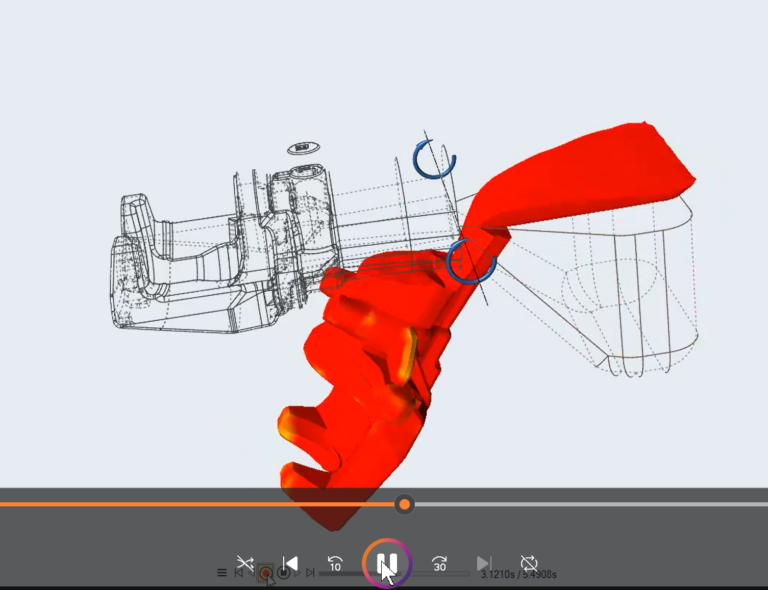
Flow and solidification simulation shows where shrinkage would land before the die is cut. On a pressure-tight part this is not optional.
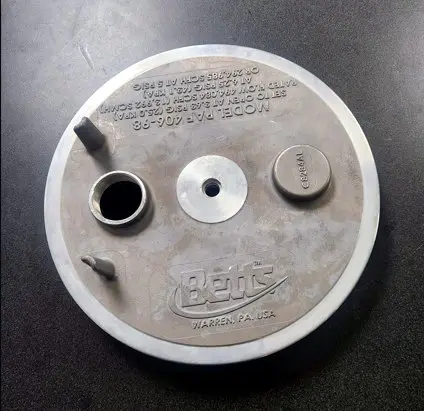
A pressure relief valve body Protocast pours in low pressure permanent mold: about 4 lb, 30,000 a year, and it has to hold pressure every time.
Everything else that matters
| Factor | What Protocast does about it |
|---|---|
| Melt quality | Clean melt practice keeps hydrogen down; chemistry is checked on the in-house spectrometer |
| Design | Uniform walls and radiused junctions leave fewer hot spots to feed; DFM review flags them before tooling |
| Simulation | EKK flow and solidification simulation run on most parts at the quote stage |
| Heat treatment | T6 in house; a sound casting stays sound through heat treat, a porous one can blister |
| Machining | Machining can open subsurface porosity; sealing faces are planned with that in mind |
| Testing | Pressure and leak testing to customer-defined procedures; x-ray, fluorescent penetrant inspection, and sectioning available |
Testing and what to specify
Tell the foundry at the quote stage what the part must hold: the pressure, the medium (air, water, oil), the duration, and the acceptance criteria. Protocast has experience with a variety of customer-defined pressure and leak tests, and radiographic testing, fluorescent penetrant inspection, ultrasonic, and sectioned examination are available when a program calls for them. If impregnation is acceptable as a backstop for a small percentage of parts, say so; if it is not, the process will be designed so it is not needed.
What “pressure tight” means on a drawing
A pressure requirement is only useful when it is specific. The test pressure, the medium (air, water, oil, helium), the hold time, the acceptable leak rate, and whether the test is on the raw casting or the machined part all change what the foundry has to achieve. A part that must hold 30 psi air for 30 seconds with no visible bubbles is a different job from one that must hold hydraulic pressure at 3,000 psi or pass a helium leak test at a specified rate. State the requirement on the drawing and at the quote, and say whether impregnation is acceptable, because that decides how conservative the process design needs to be.
Designing a part to hold pressure
- Wall thickness with margin. Porosity that is harmless in a thick wall can connect through a thin one. Keep walls uniform and avoid thin sections across pressure boundaries.
- Keep machining away from the boundary. Machining into a wall exposes subsurface porosity. Where a bore or face must be machined through a pressure wall, leave extra wall behind it.
- Radius internal junctions. Sharp corners are hot spots where shrinkage collects.
- Put heavy sections where they can be fed. Toward the riser tube in low pressure, under a riser in tilt pour.
- Make the seal face machined. Cast surfaces do not seal against gaskets reliably; machine the face and leave stock for it.
Testing methods
| Method | What it finds | Where it is used |
|---|---|---|
| Air under water | Leak paths, by bubbles | The most common production test: the casting is fixtured, openings are sealed, shop air is applied, and the part goes into a vat of water |
| Pressure decay | Leak rate, by pressure drop over time | Quantified acceptance criteria |
| Hydrostatic | Strength and leaks under liquid pressure | Hydraulic and fluid-power parts |
| Helium leak test | Very small leak rates | Aerospace, vacuum, and refrigeration parts |
| Radiography | Internal porosity before machining | Qualification and critical parts; available |
| Sectioning | Internal quality on a sacrificial part | Process qualification |
How Protocast fits in
Pressure-tight work rewards having the foundry, heat treat, and machine shop in one building, because a leak found at test can be traced back through every step, and the low pressure machine that makes most of these parts runs in house. Send the model with the pressure requirement and the annual quantity, and the quote will recommend a fill method and a test plan.
Frequently asked questions about pressure-tight castings
Can a sand casting be pressure tight?
Yes, with good gating and feeding, and prototypes of pressure-tight parts are often proven in sand. For production, permanent mold and especially low pressure give a more consistent result.
What is impregnation?
A vacuum process that seals microporosity with a resin after casting and machining. It is a common and accepted backstop, but a well-designed low pressure casting rarely needs it.
Does heat treatment cause leaks?
Heat treatment does not create porosity, but it can expose it: gas trapped near the surface can blister during the solution soak. A sound casting comes through T6 clean.
Do you x-ray parts?
Radiographic testing is available when a program requires it, along with fluorescent penetrant inspection, ultrasonic, and sectioned examination.
What pressure can an aluminum casting hold?
It depends on wall thickness and design far more than on the process. Hydraulic components cast in aluminum are designed for thousands of psi; the foundry designs the casting to the requirement you specify.
Should I test the raw casting or the machined part?
Test the machined part, because machining can open subsurface porosity. Testing raw castings early in a program is useful for process qualification.
Does zinc cast pressure tight?
Zinc alloys can be very sound in thin sections, and small zinc housings are often pressure tight as cast. Ask when the part is small and does not need heat treatment.
Send the model. Get a quote with engineering feedback.
Have a manifold, housing, or pump body that has to hold pressure? Send the model and the test requirement together.
- Engineering review with every quote
- Flow simulation before tooling is cut
- Cast, heat treated, machined, and inspected in one building
- Permanent mold tooling cut in house whenever possible
