
Prototype Castings: What to Send and What You Get Back
The fastest quotes and the best first castings come from complete requests. Most of what a foundry needs already exists; it only has to arrive together. What follows is the list, what the quote comes back with, and what happens between the purchase order and the part in your hand.
What to send
| Item | Why it matters |
|---|---|
| 3D model | STEP is universal; native SolidWorks or similar is fine. The model drives the simulation, the pattern or printed mold, and the machining program. |
| Drawing, if it exists | Tolerances, datums, surface finish callouts, and notes. If there is no drawing, Protocast offers drafting and print generation. |
| Alloy, or the application | 356 covers most parts; 357 for strength-critical work; zinc for small, detailed parts. If you are not sure, describe the loads and environment and the quote will recommend one. |
| Quantity now, and annual volume later | Decides the process: printed sand for a few, precision sand for dozens to hundreds, permanent mold from a few hundred a year and up. Sharing the future volume lets the prototype be designed for the production process. |
| Critical dimensions and surfaces | Tells the foundry where to leave machining stock and where as-cast is fine. |
| Heat treatment and finishing | T6 is in house. Anodizing, chem film, and powder coating are available. |
| Testing requirements | Pressure or leak test, x-ray, fluorescent penetrant inspection, tensile bars, certifications. Known at the quote, built into the plan. |
| Target date | Lets the foundry choose the process that gets there. |
What comes back
- A process recommendation. Printed sand, precision sand, or permanent mold, and why. Sometimes two quotes, so the volume decision is made with real numbers.
- DFM feedback. Most quotes are returned with it: walls, draft, radii, cores, parting line, machining stock. Protocast does not engineer castings for customers, but it will tell you what will make yours cast better.
- A flow simulation check. Most parts are verified with EKK flow simulation at the quote level, which shows how the mold fills and where shrinkage would land.
- Price and lead time for the casting, heat treatment, machining, and testing as separate lines, so you can see what each adds.
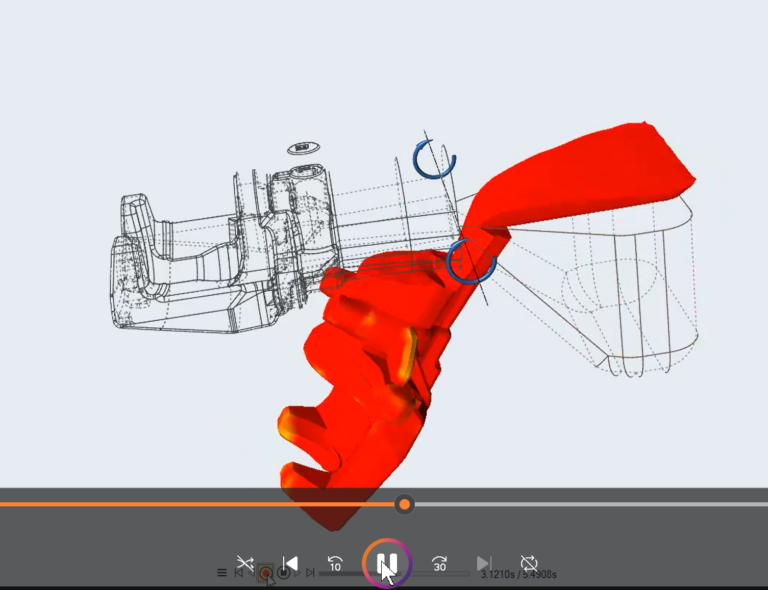
Flow simulation runs on most parts before a quote goes out.
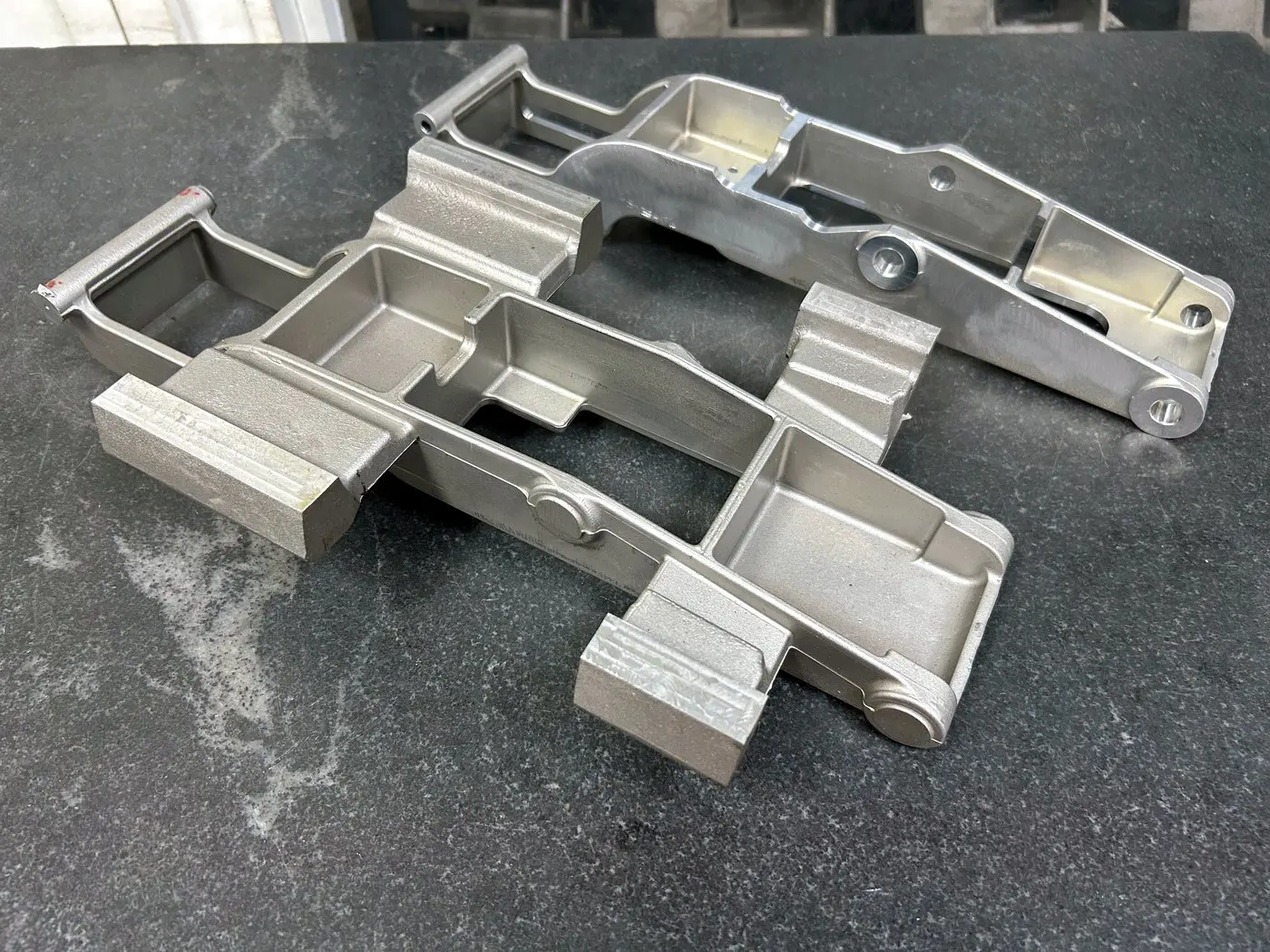
What comes back: the casting as poured with its gating still attached, and the same part machined to print.
What happens after the order
| Step | Precision sand | Printed sand |
|---|---|---|
| Mold | Pattern cut from modeling board on CNC; sand mold made from it | Mold printed directly from the file |
| Time to first mold | Days to a few weeks depending on pattern complexity | As little as 5 days |
| Pour, cool, clean | Same foundry, same alloys | |
| Heat treat | T6 in house, typically 2 to 3 days from casting | |
| Machining | In-house machine shop; add 1 to 2 weeks when required | |
| Inspection | CMM dimensional report; other testing as specified | |
| Typical samples | 4 to 6 weeks for raw castings | Faster, depending on the print queue |
Typical figures. Geometry and current workload move them.
Designing the prototype for production
The single most useful thing you can share is where the part is going. A prototype that will become a permanent mold part should be cast in sand with permanent mold rules in mind: a little more draft, radii on every inside corner, uniform walls. Then the move to a die is a tooling order, not a redesign. The sand versus permanent mold guide covers where that line sits.
Choosing the prototype process
| Situation | Best first step |
|---|---|
| One to a few pieces, complex geometry | Printed sand; no tooling, molds in days |
| Dozens of pieces, design mostly settled | Precision sand; a pattern good for about 500 pieces |
| Design still changing | Printed sand; every iteration is a new print, not a new tool |
| Large or thick-walled part | Precision sand; very few size limits |
| Headed for production at a few hundred a year or more | Sand prototype designed to permanent mold rules, a low-production sand tool to bridge, then the die |
| Headed for production with thin walls | Sand prototype, then a low pressure die |
| Only a machined part will do | Machining from stock in the same shop |
Prototype versus production intent
Say what the prototype is for. A form-and-fit prototype can carry sand tolerances and skip heat treatment. A functional prototype for testing should be the production alloy at the production temper, machined where the production part will be machined, so the test means something. A pre-production prototype should also follow the production process’s design rules. The quote is built differently for each, and the cheapest prototype is the one that answers the question you are asking.
What slows a quote down
- A model with no quantity, or a quantity with no sense of future volume.
- A drawing that tolerances every feature tightly, so nothing can be left as cast.
- No alloy and no application, so the foundry has to guess.
- Testing requirements that arrive after the quote.
- A 2D drawing only; a 3D model is needed to simulate and to cut a pattern or print a mold.
How Protocast fits in
Protocast was founded in 1995 as Prototype Castings and has built its process around getting a first casting into a customer’s hands quickly and then carrying it to production without changing suppliers. Nearly half the staff hold engineering degrees, and reverse engineering, 3D CAD modeling, and drafting are available when a part exists only as a sample or a sketch.
Frequently asked questions about prototype castings
Do you sign NDAs?
Ask when you send the request. Protocast is ITAR registered and ISO 9001:2015 certified.
Can you work from a physical part instead of a model?
Yes. Protocast reverse engineers parts using 3D scanning and modeling and can generate a drawing from the result.
What is the minimum order?
One. Printed sand casting makes single pieces practical.
Can I get the prototype machined?
Yes. Protocast machines its own castings in house; add 1 to 2 weeks to the casting lead time.
What file format do you prefer?
STEP is universal and works well. Native SolidWorks or similar files are also fine. A 3D model is needed; a 2D drawing alone is not enough to quote or produce a casting.
Can I get a quote without a drawing?
Yes, from the model, with your notes on critical dimensions and surfaces. If you need a drawing, Protocast offers drafting and print generation.
How fast can I get a first casting?
Printed sand molds in as little as 5 days, rapid precision sand in as little as three days for the right part, and typical sand samples in 4 to 6 weeks. Machining adds 1 to 2 weeks.
Will the prototype look like the production part?
If you tell us the production process, the prototype will be designed to its rules and cast in the production alloy and temper, so fit, function, and machining are representative.
Send the model. Get a quote with engineering feedback.
Have a model ready? Send it with the quantity and the target date, and the quote will come back with a process recommendation and DFM feedback.
- Engineering review with every quote
- Flow simulation before tooling is cut
- Cast, heat treated, machined, and inspected in one building
- Permanent mold tooling cut in house whenever possible
