
Precision Sand vs. Green Sand: Why We Use No-Bake
“Sand casting” covers several different molding methods, and the one a foundry uses says a lot about the castings it makes. Green sand is the high-volume commodity process most people picture. Precision sand, also called no-bake or air-set, is what Protocast runs, and the reasons come down to finish, tolerance, and the ability to make larger, thicker parts with a better surface.
The three sand systems
- Green sand. Silica sand bonded with clay and water, packed around a pattern while damp (“green” means uncured, not the color). The mold is used once, but the sand is reclaimed and reused continuously. Fast and inexpensive at volume, but the damp, soft mold can shift, the surface is rough, and tolerances are wide.
- Sodium silicate, or water glass. Sand bonded with sodium silicate and hardened with carbon dioxide gas. Sets quickly and holds detail, but the sand is hard to break down after pouring and difficult to reclaim.
- Resin bonded, or no-bake. Sand mixed with a two-part chemical binder that hardens at room temperature in 20 to 30 minutes. The mold is rigid and dimensionally stable, gives the best surface of the three, and the sand is reclaimed. This is precision sand.
How Protocast makes a precision sand mold
A pattern is machined from urethane modeling board on a CNC mill, with metal shrinkage and gating engineered into the mold design. The pattern is framed, fine grain sand mixed with the urethane binder is run through a continuous mixer and packed against it, and the binder sets in about 20 to 30 minutes. The mold halves are stripped from the pattern, assembled with any cores, and poured. After cooling the sand is broken away, gates and risers are removed, and the casting goes to the machine shop. Solidification is simulated in software before the pattern is cut.
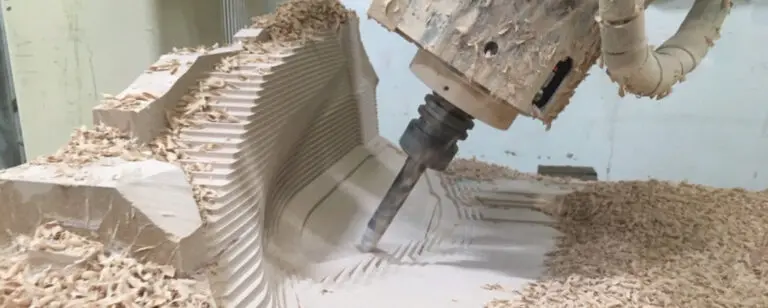
Patterns are cut from modeling board on CNC equipment, a practice Protocast adopted in 2005.
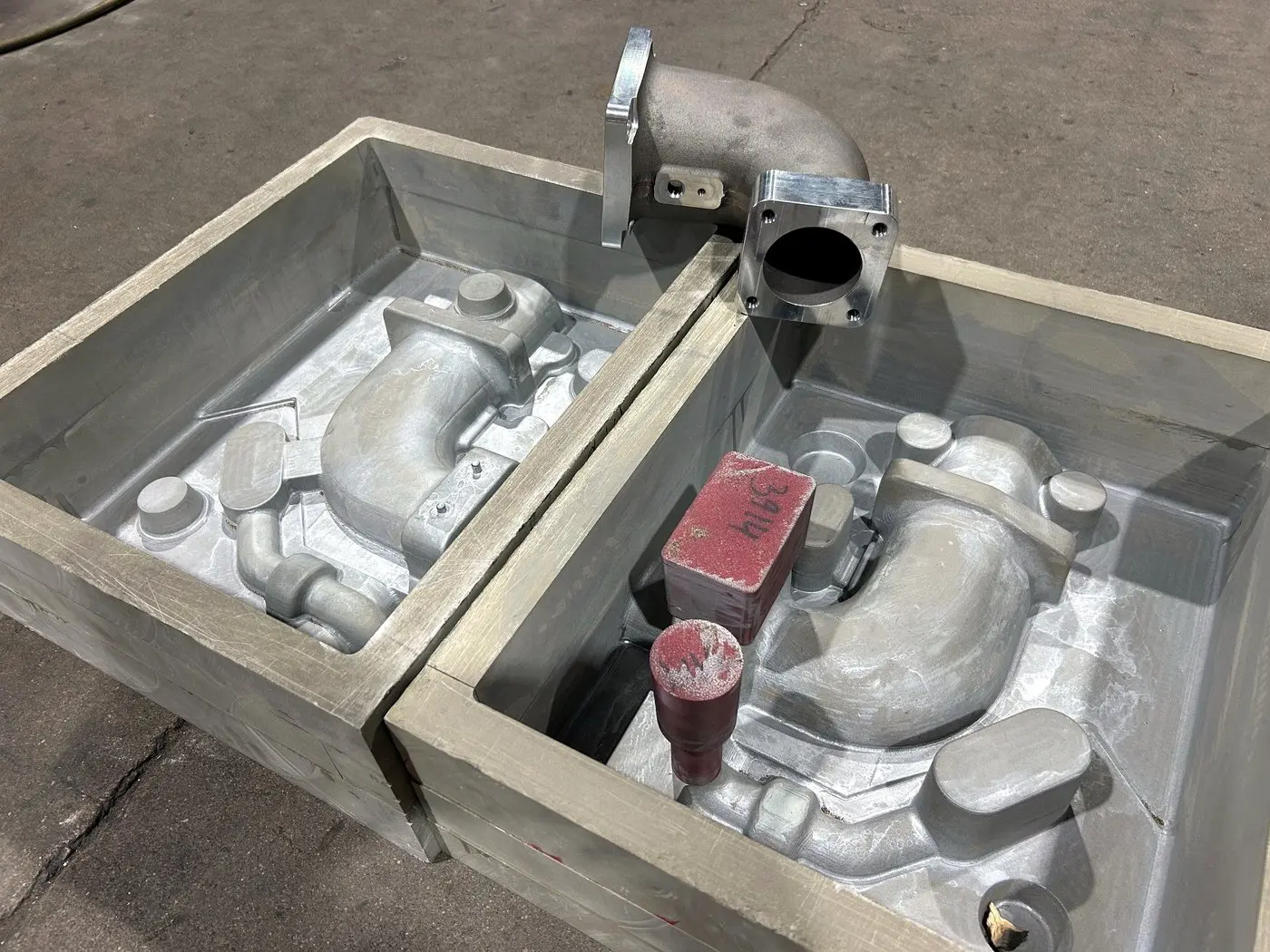
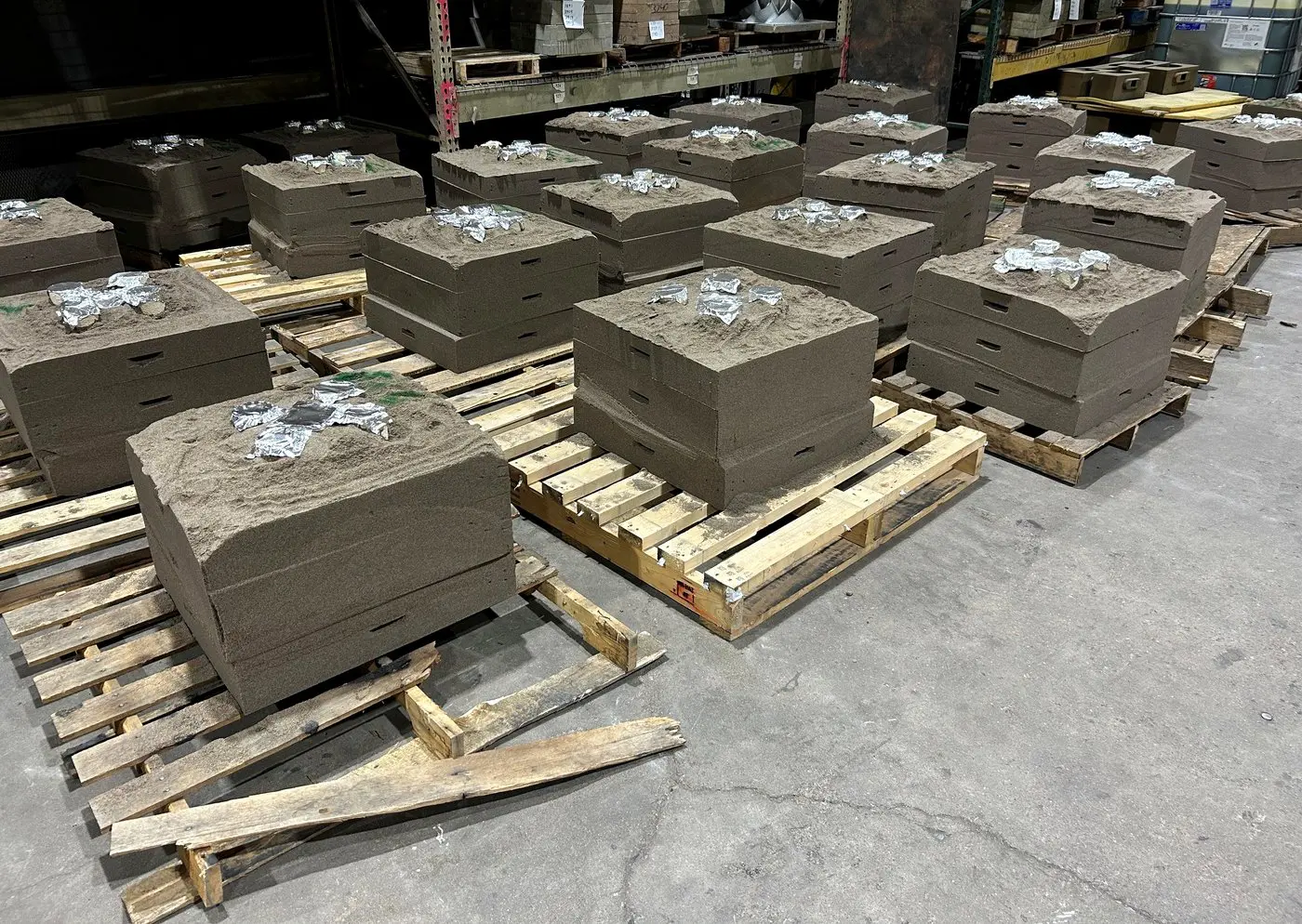
Left: an air set pattern with the machined casting it produced. Right: assembled no-bake molds ready to pour.
Green sand and precision sand, side by side
| Green sand | Precision sand (no-bake) | |
|---|---|---|
| Binder | Clay and water | Two-part urethane resin |
| Mold strength | Soft and damp; can shift or wash | Rigid and stable once set |
| Surface finish | Rougher | Typically 350 to 450 rms; noticeably better |
| Tolerance | Wider | Closer; less mold movement |
| Wall thickness | Limited by mold softness | Supports thicker walls and larger castings; minimum about 0.160 inch |
| Casting size | Limited by flask equipment | Very few size limitations |
| Best for | High-volume commodity parts | Prototypes, short runs, large parts, and production where finish and tolerance matter |
| Sand reuse | Continuous | Mechanically reclaimed; Protocast reuses about 80 percent |
Why it matters for a prototype
A prototype exists to prove the design and to look like the production part. Precision sand gives a surface and a tolerance close enough to permanent mold that fit, function, and machining stock can be evaluated honestly. A green sand prototype can leave you guessing which problems are the design and which are the mold. Precision sand also handles the thick walls and large sizes that show up in industrial and defense parts, and Protocast’s tool life of roughly 500 pieces per pattern carries a program well into short-run production.
What “precision” means in practice
Three things separate a precision sand casting from a green sand casting a buyer might have received elsewhere. The mold does not move: a rigid, cured mold holds its shape under the weight and heat of the metal, so dimensions are closer and repeat better from part to part. The surface is finer: fine grain sand and a stable mold face give a surface that needs less cleaning and less machining stock. And the mold can be big and deep: no-bake molds support large, heavy castings with thick walls that a green sand flask line cannot handle. The trade is cost per mold, which is why green sand persists in high-volume commodity foundries and why precision sand suits prototypes, short runs, and parts where quality matters more than pennies per mold.
Cores in precision sand
Cores are made from the same resin-bonded sand in core boxes, or printed when the geometry is very complex. Because the core and the mold are the same material and set the same way, they behave the same in the pour, which helps dimensional consistency in cored parts.
Sand reclaim and the foundry’s footprint
Precision sand is reclaimed mechanically: after shakeout the sand is crushed, screened, and returned to the mixer, and about 80 percent is reused. Protocast’s 2015 expansion of the sand line added mechanical reclaim specifically to cut silica sand consumption and landfill waste, and secondary markets take the rest. It is a practical point for buyers with supplier sustainability questions.
How Protocast fits in
Protocast added sand casting in 2005 with a Tinker Omega continuous mixer and expanded the line in 2015 with a larger dual-hopper mixer, automated controls, and mechanical reclaim, which took the process from low-quantity prototype work to production quantities. Rapid precision sand castings can be produced in as little as three days for the right part, and typical samples run 4 to 6 weeks. For tooling-free work, printed sand covers the same alloys and the same foundry.
Frequently asked questions about precision sand
Is precision sand the same as air-set sand?
Yes. Precision sand, no-bake, and air-set all describe resin-bonded sand that hardens at room temperature.
What is the tool life of a precision sand pattern?
Approximately 500 pieces, dependent on geometry, proper draft, radii, and similar factors.
What surface finish and wall thickness can I expect?
Typically 350 to 450 rms and a minimum wall of about 0.160 inch, with exceptions possible depending on geometry.
Does Protocast pour green sand?
Not currently. Every sand casting at Protocast is precision sand or printed sand.
Is precision sand casting more expensive than green sand?
Per mold, yes. For prototypes and short runs the difference is small next to the value of a better casting, and for large or thick-walled parts green sand is often not an option at all.
Can precision sand run production quantities?
Yes. Protocast expanded its sand line in 2015 to run production quantities, and a pattern’s roughly 500-piece life covers many programs. From about 300 to 500 pieces a year, permanent mold usually costs less per part.
What is the difference between no-bake and shell molding?
Shell molding uses a resin-coated sand cured against a heated metal pattern and is a higher-volume process with its own tooling. No-bake cures at room temperature against a modeling-board pattern and suits prototypes and short runs.
Send the model. Get a quote with engineering feedback.
Need a first casting that looks like the production part? Send the model and we will quote it in precision sand.
- Engineering review with every quote
- Flow simulation before tooling is cut
- Cast, heat treated, machined, and inspected in one building
- Permanent mold tooling cut in house whenever possible
