

Aluminum Pump and Valve Castings
Pump housings, valve bodies, manifolds, and fluid-handling equipment share one requirement: the casting has to hold pressure. Protocast casts aluminum parts for industrial pump, valve, and fluid equipment makers, from small valve bodies at tens of thousands a year to heavy equipment castings at a thousand. Buyers include wastewater and sewer equipment makers and automotive suppliers. This page covers the processes, the requirements that matter, and what to send for a quote.
What Protocast makes for pump and valve equipment
- Valve bodies, including pressure relief valves.
- Pump housings and covers.
- Manifolds and hydraulic housings with internal passages.
- Fluid equipment castings such as PVC pipe fusion machine components.
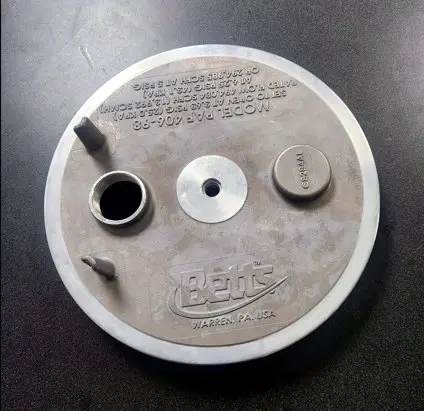
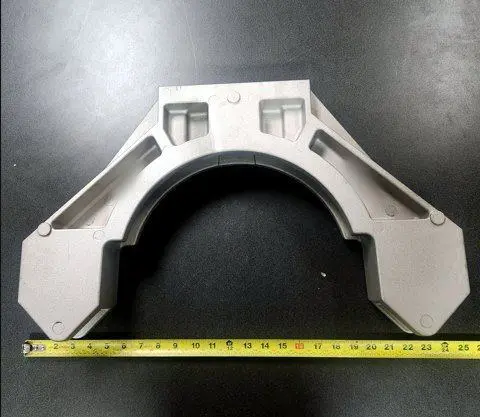
Left: Pressure relief valve. Low pressure permanent mold, about 4 lb, about 30,000 a year. Right: PVC pipe fusion equipment casting. Low pressure permanent mold, about 50 lb, about 1,000 a year.
Why low pressure permanent mold suits fluid parts
A part that holds fluid or gas has to be sound all the way through the wall. In low pressure permanent mold, metal rises into the steel die from a sealed furnace below at a controlled rate, and pressure is held while the casting freezes. The fill pushes air ahead of the metal instead of folding it in, and the held pressure feeds shrinkage as the walls solidify. That addresses both kinds of porosity that cause leaks. The pressure-tight castings guide explains the mechanics in detail.
The two parts above show the range. The pressure relief valve is small and runs at about 30,000 a year, and it has to hold pressure every time. The pipe fusion casting is about 50 lb and runs at about 1,000 a year. Both are low pressure permanent mold.
Choosing a process
| Process | Best for |
|---|---|
| Low pressure permanent mold | Valve bodies, pump housings, and manifolds that must be pressure tight; thin or long walls |
| Tilt pour permanent mold | Heavier, simpler housings and covers; good gating gets close to low pressure soundness |
| Semi-permanent mold | Permanent mold parts with internal passages formed by sand cores |
| Sand and printed sand | Prototypes, short runs, large parts, and complex passages that no steel die can form |
Not sure between the two permanent mold methods? Tilt Pour vs. Low Pressure compares them side by side.
Moving fluid parts from sand to permanent mold
Many pump and valve parts start in sand. Moving them to permanent mold removes two common sources of leaks. A steel die does not erode, so there are no sand inclusions from the mold wall. The steel die also chills the metal faster, so there is less shrinkage. Automotive covers are one example of parts that moved from sand to permanent mold.
What matters on pump and valve parts
A clear requirement. If the part must hold pressure, state the pressure, the medium, and the acceptance criteria on the drawing. Protocast designs the casting and process around that requirement and reviews with you how it will be verified.
Design for soundness. Uniform walls, radiused internal junctions, and extra wall behind any face or bore machined through a pressure boundary. Porosity is the main cause of leaks. EKK flow simulation at tool design shows the problem areas before the die is cut. Gating and air or water cooling are then added in the die to keep those areas sound.
Melt quality. Clean melt practice keeps hydrogen down, and chemistry is checked on the in-house spectrometer.
Heat treatment. Pump and valve parts in 356 or 357 are commonly heat treated to T6, in house. A sound casting stays sound through heat treat; a porous one can blister.
Machined sealing faces. Cast surfaces do not seal reliably against gaskets, so seal faces and ports are machined. Protocast machines in house on CNC equipment and plans the machining with the pressure walls in mind.
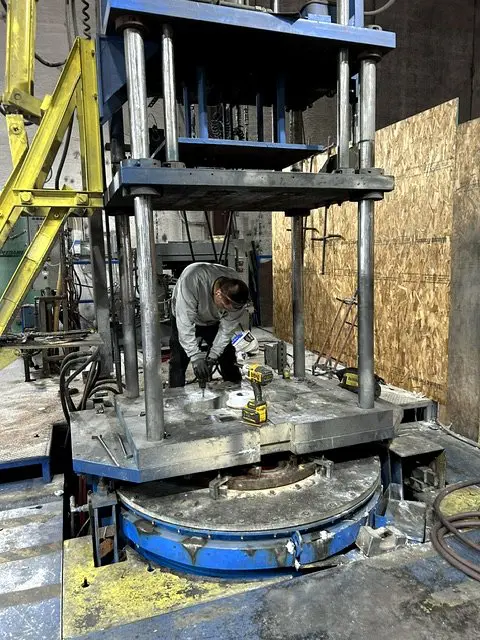
The low pressure machine that makes most of Protocast’s pressure-tight parts runs in house in Commerce City.
Testing and inspection
If your part carries a pressure or leak-test requirement, put it on the drawing and send it with the quote request. Protocast will review the specification with you and confirm how it can be met for your program. Chemistry is verified on the in-house spectrometer and dimensions on the in-house CMM; other inspection requirements are reviewed case by case with your representative.
Impregnation. Impregnation is offered. After machining, a resin drawn in under vacuum seals any micro-porosity in the casting. Automotive buyers often require it as a preventive step.
What to send for a quote
- A 3D model and a drawing, with pressure boundaries and sealing faces marked.
- Any pressure or leak-test requirement, so it can be reviewed with you.
- Annual volume and expected program life.
- Alloy and temper, if specified, and any inspection or documentation requirements.
Frequently asked questions
Can aluminum castings be pressure tight?
Yes, when the fill, the design, and the melt are right. Low pressure permanent mold is the most reliable way to get there for most pump and valve parts.
Does Protocast pressure test castings?
Pressure and leak-test requirements are reviewed at the quote stage. Send the specification with your drawing and your representative will confirm how it can be handled for your program.
What volumes does Protocast run for valve and pump parts?
From a few hundred to tens of thousands a year. The pressure relief valve on this page runs at about 30,000 a year; the pipe fusion casting at about 1,000.
Is impregnation available?
Yes, impregnation is offered. After machining, a vacuum-drawn resin seals micro-porosity in the casting. Automotive buyers often require it as a preventive step.
Can castings with internal passages be made in permanent mold?
Often, yes, using sand cores in a steel die (semi-permanent mold). Passages too complex for cores can be cast in printed sand.
Do you machine the castings?
Yes. Ports, bores, and sealing faces are machined in house, so the casting and the finished part come from one supplier.
Send the model. Get a quote with engineering feedback.
Have a valve body, pump housing, or manifold that has to hold pressure? Send the model with the pressure requirement and the annual quantity, and the quote will recommend a fill method and a test plan.
- Engineering review with every quote
- Flow simulation before tooling is cut
- Cast, heat treated, and machined in one building
- Permanent mold tooling cut in house whenever possible
