
Reshoring Aluminum Castings from Overseas: A Buyer’s Guide
More buyers are looking at moving aluminum castings back from overseas suppliers. Tariffs are part of it, but so are long ocean lead times, inventory tied up in transit, quality problems that take weeks to resolve, and tooling that sits in another country. This guide covers how to move a casting program to a domestic foundry, what the transition looks like, and how to keep parts flowing while it happens.
Why buyers reshore castings
- Landed cost. The overseas part price is only part of the cost. Freight, duties and tariffs, brokerage, and the inventory sitting on the water all add to it.
- Lead time. Ocean freight adds weeks to every order, so buyers carry more safety stock and react slowly to demand changes.
- Quality and communication. A problem found at receiving can mean a full container of suspect parts and weeks before a fix arrives. A domestic foundry can be visited, called, and audited.
- Engineering changes. Revising a die overseas is slow. Domestic tooling can be modified and sampled much faster.
- Requirements. Some programs need domestic sourcing or ITAR control that an overseas supplier cannot provide.
Tariff rates change, so this guide does not quote them. Run the landed cost with current rates and include freight, inventory carrying cost, and the cost of quality escapes.
What to gather before you request a quote
- A 3D model (STEP is ideal) and the current drawing with tolerances.
- Alloy, temper, and any heat treat, finish, or machining requirements. Overseas alloy designations sometimes need translating to an Aluminum Association equivalent; the foundry can help.
- Annual volume, release quantities, and expected program life.
- Current tooling details: who owns it, what process it is for, how many shots it has run, and its condition.
- Inspection and documentation requirements, and any known quality issues with the current parts.
- Current landed cost, so the comparison is real.
The existing tooling question
If you own the overseas tool, ask whether it can be shipped and whether it will run on the domestic foundry’s equipment. A die built for high pressure die casting will not run on permanent mold machines, and a permanent mold die built for a different machine may need rework or may not fit. Tools that have run many cycles may also be near the end of their life. The tooling cost and life guide explains what wears and what can be refurbished.
In many cases a new die is the better choice, and it gives you the chance to fix design issues and to own a tool that is close by. At Protocast, permanent mold dies are cut in its own tool room whenever capacity allows, and the tooling is customer owned.
Protocast has taken over dies moved from Taiwan and run them, replacing worn dies over time. In some cases Protocast designs the tool for a customer that keeps a second supplier overseas. That work covers flow simulation and the CAD data for the die, for an engineering fee.
Keeping parts flowing during the transition
The biggest risk in reshoring is a gap in supply. The usual plan is to build a bridge:
- Build buffer stock from the current supplier before you announce the move.
- Cast bridge parts in sand or printed sand from the same model. Printed sand samples can be ready in as little as 3 to 5 days with no hard tooling, and precision sand samples from cast tooling typically take 4 to 6 weeks.
- Cut the permanent mold die in parallel. First samples are typically 12 to 20 weeks from tooling release.
- Approve first articles, then move production to the die.
The sample to production timeline walks through each step.
| Option | Time to parts | Use it for |
|---|---|---|
| Printed sand | Samples in as little as 3 to 5 days | Urgent bridge parts and complex geometry |
| Precision sand | Typically 4 to 6 weeks for samples from cast tooling | Bridge production at modest volume |
| New permanent mold die | Typically 12 to 20 weeks to first samples | Long-term production |
Typical figures for Protocast. Part size and complexity move them.
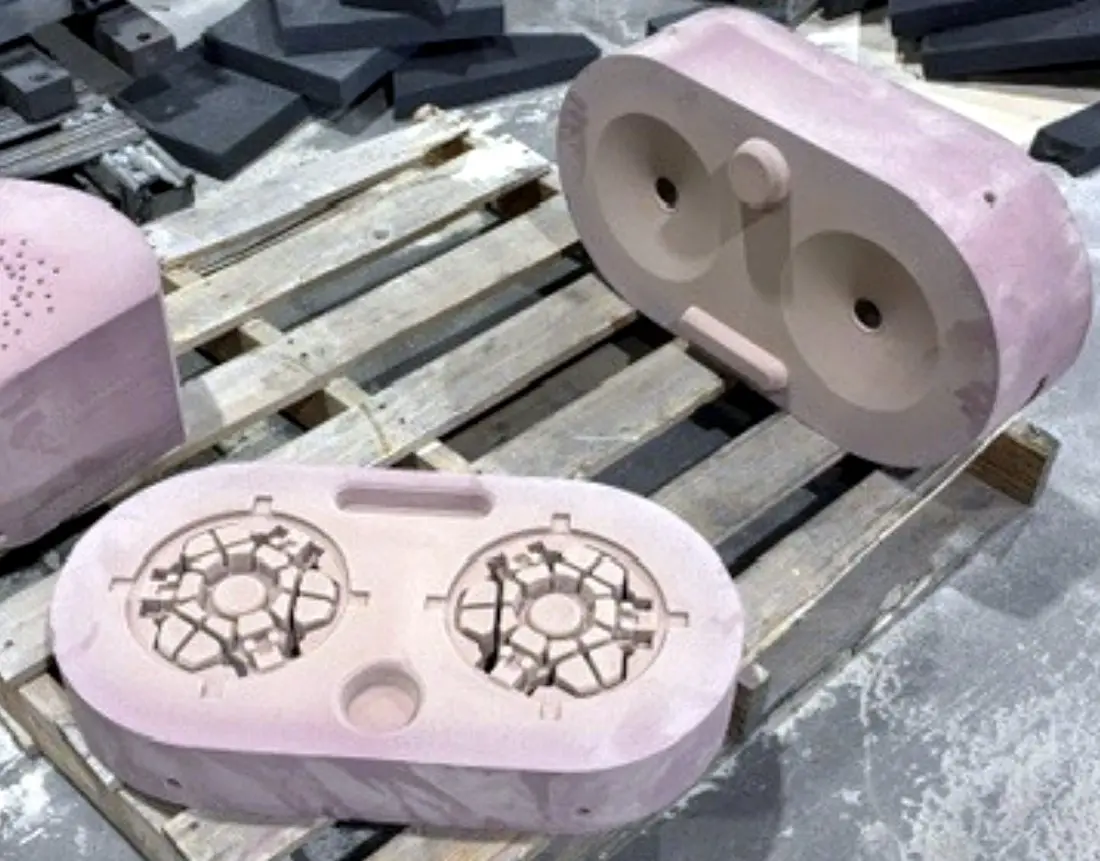
A printed sand mold. Printed sand needs no hard tooling, which makes it a fast bridge while a permanent mold die is cut.
Cost: compare landed cost, not part price
A domestic casting price can be higher than an overseas quote and still cost less once freight, tariffs, inventory, and quality costs are counted. Converting the process can change the math too: a part bought as a sand casting overseas may be cheaper in permanent mold at your volume, and a part bought as a die casting may be better value in permanent mold at a few hundred to tens of thousands a year. See Die Casting vs. Permanent Mold and Permanent Mold vs. Sand Casting.
How Protocast fits in
Protocast has cast aluminum in Commerce City, Colorado since 1995. It is ISO 9001:2015 certified and ITAR registered. Tilt pour and low pressure permanent mold and precision sand run in house, permanent mold dies are cut in its own tool room whenever capacity allows, and T6 heat treat and CNC machining are done on site, so a reshored part can be cast and finished in one building. Most of Protocast’s work ships outside Colorado, to the Pacific Northwest, California, Massachusetts, Florida, Oklahoma, and Canada. Buyers come from out of state because permanent mold foundries are scarce. Printed sand is offered for bridge parts and complex geometry. Send the model and your current volumes, and the quote will recommend a process and a transition plan.
Frequently asked questions
Can I ship my overseas die to Protocast?
Sometimes. It depends on what process the die was built for, whether it fits Protocast’s equipment, and its condition. Send the tooling details with the quote request and they will be reviewed.
How long does it take to move a casting program?
With a new permanent mold die, first samples are typically 12 to 20 weeks from tooling release. Sand or printed sand parts can cover supply in the meantime.
Who owns the new tooling?
The customer. Tooling built for your part is yours.
Will a domestic casting cost more?
The part price may be higher, but the landed cost often is not once freight, tariffs, inventory, and quality costs are included. Run the comparison on landed cost.
Is Protocast ITAR registered?
Yes. Protocast is ITAR registered and ISO 9001:2015 certified.
Send the model. Get a quote with engineering feedback.
Thinking about bringing a casting back from overseas? Send the model, current volumes, and tooling details, and the quote will lay out a process recommendation and a transition plan that keeps parts flowing.
- Engineering review with every quote
- Flow simulation before tooling is cut
- Cast, heat treated, and machined in one building
- Permanent mold tooling cut in house whenever possible
